Geometric Sequences (College Board AP® Precalculus): Study Guide

Geometric sequences
What is a geometric sequence?
A geometric sequence is a sequence in which successive terms have a common ratio
This means each term is obtained by multiplying the previous term by the same constant
This common ratio represents a constant proportional change
The common ratio is usually denoted by
E.g. the sequence is geometric with a common ratio of
Each term is 2 times the previous term
etc.
The common ratio can be any nonzero value:
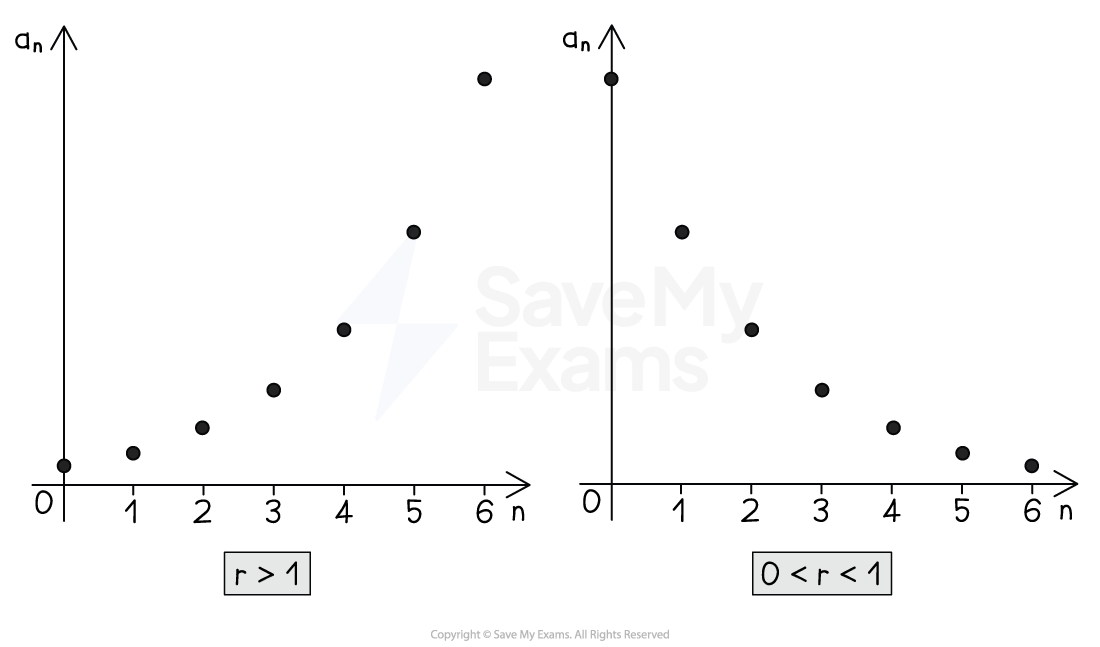
: the terms grow away from zero (for positive-valued sequences)
: the terms shrink toward zero (for positive-valued sequences)
: the terms alternate in sign
How can I find the common ratio of a geometric sequence?
To find the common ratio of a geometric sequence
Divide any term by the term before it
If the ratios between consecutive terms are not all equal, then the sequence is not geometric
What is the general term of a geometric sequence?
The general term (also called the nth term) of a geometric sequence can be written in two forms
Using the initial value
where is the initial value (the term when )
and is the common ratio
Using any known term
where is the value of the th term
and is the common ratio
This form is useful when you don't know but you do know a different term
Both forms express the same idea
Start from a known term and multiply by the common ratio the appropriate number of times
How do these formulas work in practice?
E.g. a geometric sequence has initial value and a common ratio of
The general term is
So , , , ,
Or e.g. you are told that and
Using the second form:
You can verify that to check the answer
✓
And also find other terms
E.g. the initial term is
How does a geometric sequence grow compared to an arithmetic sequence?
An increasing arithmetic sequence increases equally with each step
the same amount is added each time
An increasing geometric sequence (with positive values) increases by a larger amount with each successive step
because the same ratio is applied to an ever-larger value
E.g. consider the geometric sequence (ratio )
The increases between terms are
getting larger each time
Compare this to the arithmetic sequence (difference )
The increases between terms are always
This distinction between additive change (arithmetic) versus multiplicative change (geometric) is a key idea that carries over into the study of linear and exponential functions
What does the graph of a geometric sequence look like?
Like all sequences, the graph of a geometric sequence consists of discrete points at whole number values of
For a geometric sequence with (and positive initial value), the points curve upward with increasing steepness
For a geometric sequence with (and positive initial value), the points curve downward, getting closer and closer to zero
Worked Example
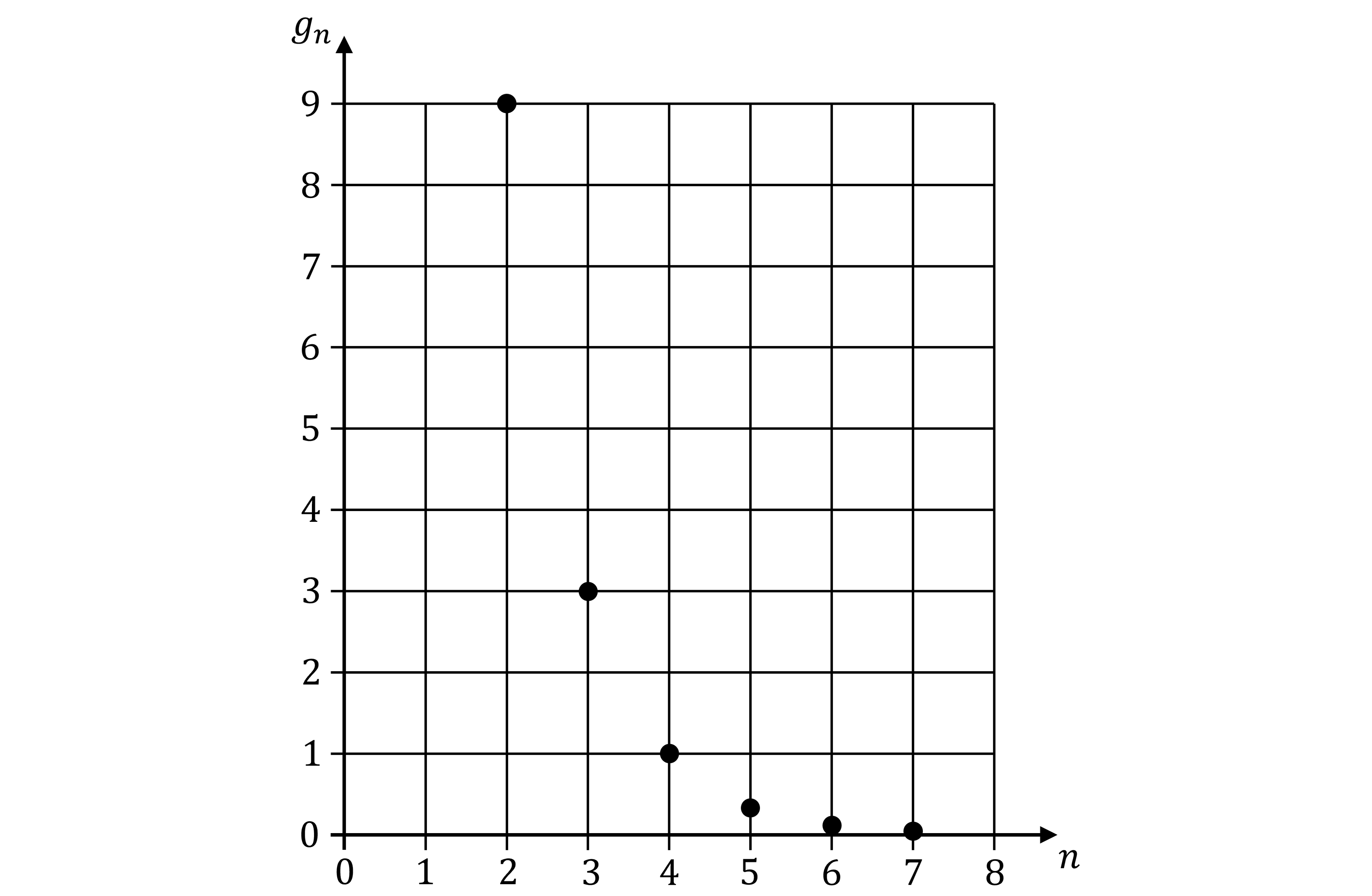
Values of the terms of a geometric sequence are graphed in the figure. Which of the following is an expression for the th term of the geometric sequence?
(A)
(B)
(C)
(D)
Answer:
Consider the values of for the first three points on the graph
I.e. for and
They are going down by a factor of each time
I.e., and
That means that the common ratio is
That rules out option (B), which has a common ratio of 3
Don't be fooled by the fact that when ,
That point agrees with the graph
But that formula will not give correct values for
Test out the values of the other three options when
option (A):
option (C):
option (D):
Only option (A) gives the correct value for
(A)
Examiner Tips and Tricks
If you remember the general form for a sequence
then you should be able to spot right away that option (A) in the above Worked Example gives the correct form for the sequence in the graph with , where and .
Worked Example
Values of the terms of a geometric sequence are given in the table below.
0 | 1 | 2 | 3 | 4 | |
|---|---|---|---|---|---|
6 | 18 | 54 | 162 | 486 |
(a) Find the common ratio of the sequence.
(b) Write an expression for the general term .
(c) Find the value of .
Answer:
(a)
The common ratio is found by dividing consecutive terms:
This can be verified by checking with other terms
, , etc.
(b)
Use the formula
with and :
(c)
Substitute into the equation from part (b)

Unlock more, it's free!
Join the 100,000+ Students that ❤️ Save My Exams
the (exam) results speak for themselves:

Was this revision note helpful?
Build on this topic