Radian Measure & Standard Position (College Board AP® Precalculus): Study Guide

Radian measure & standard position
What is an angle in standard position?
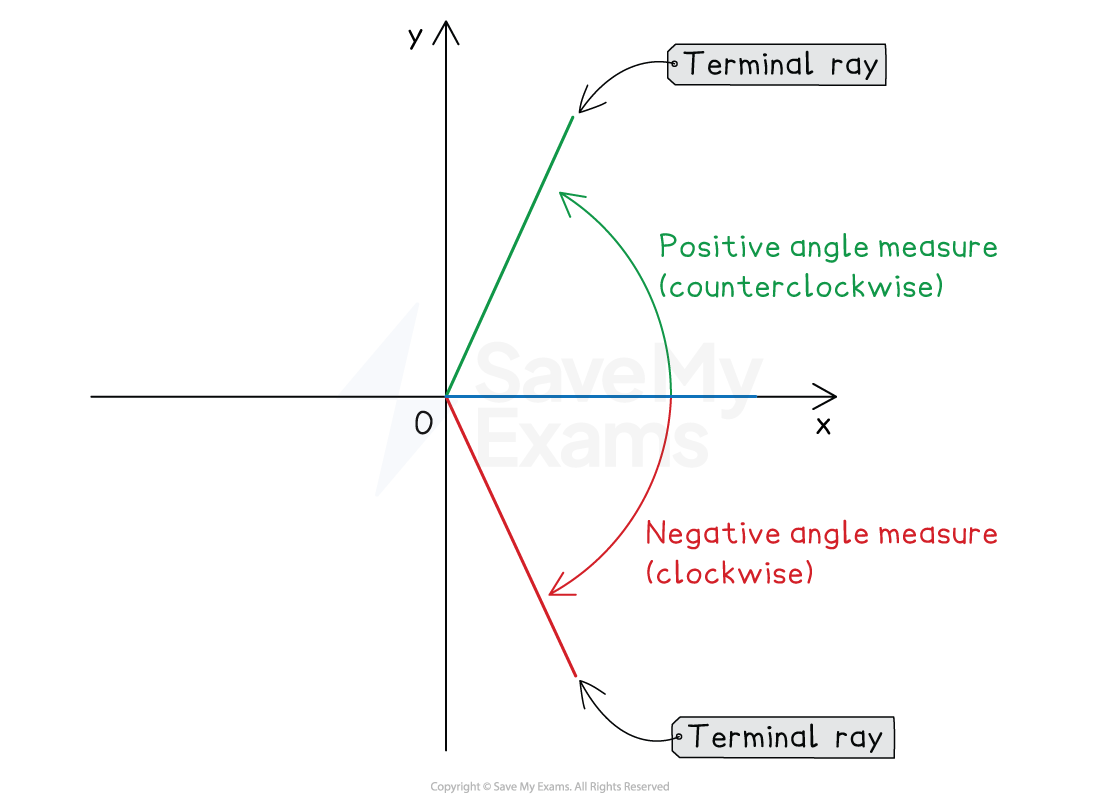
In the coordinate plane, an angle is in standard position when:
The vertex of the angle is at the origin
One ray lies along the positive -axis
this ray is sometimes called the initial ray (or initial side)
The other ray is called the terminal ray (or terminal side)
The measure of the angle describes the amount of rotation from the initial side to the terminal ray
A positive angle measure indicates rotation in the counterclockwise direction
A negative angle measure indicates rotation in the clockwise direction
What are coterminal angles?
Two angles in standard position are coterminal if they share the same terminal ray
Coterminal angles differ by an integer number of full revolutions
In degrees: coterminal angles differ by a multiple of
In radians: coterminal angles differ by a multiple of
E.g. angles of and are coterminal
because
E.g. angles of and are coterminal
because
Every angle has infinitely many coterminal angles
What is radian measure?
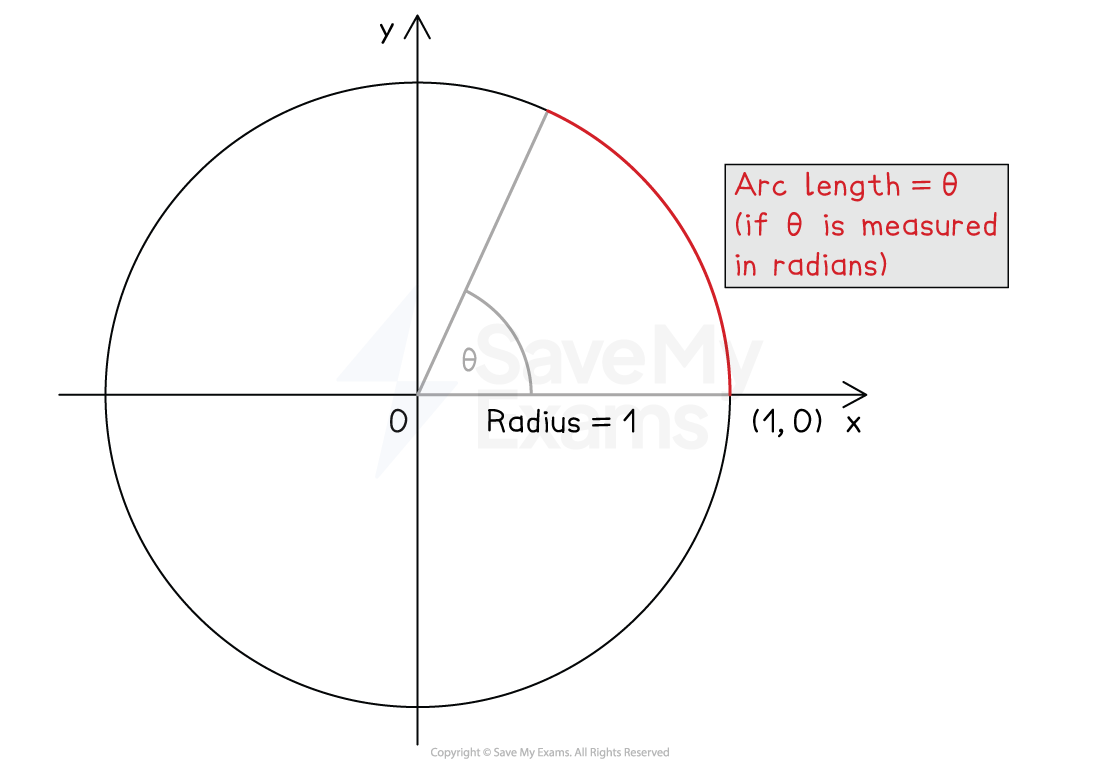
The radian measure of an angle in standard position is defined as
the ratio of the arc length subtended by the angle
to the radius of the circle:
For a unit circle (a circle with radius centered at the origin)
the radian measure of the angle is simply equal to the length of the arc subtended by the angle
because in that case
One full revolution corresponds to the full circumference of the unit circle, which has length
Therefore one full revolution = radians
How are degrees and radians related?
Because one full revolution is in degrees and radians
This gives the conversion factor
To convert from degrees to radians, multiply by
E.g. radians
To convert from radians to degrees, multiply by
E.g.
What are the radian equivalents of important angles?
Certain angles appear frequently throughout trigonometry and their radian equivalents should be memorized
The key angles are the multiples of or of (including and )
Degrees | Radians |
|---|---|
A useful pattern
the multiples of have denominators of (, etc.)
and the multiples of have denominators of (, etc.)
Although in many cases the fraction simplifies (e.g. , , etc.)
Examiner Tips and Tricks
You should be as comfortable working with angles measured in radians as you are with angles measured in degrees.
Throughout this course (and also in calculus), radians are the standard unit for angle measurement.
Practicing converting between the two systems now will save time later, and memorizing the key angle equivalents will help you work more efficiently on the exam.
Worked Example
An angle of radians is in standard position.
(a) Convert radians to degrees.
(b) Find the measure, in radians, of a negative angle that is coterminal with .
(c) A circle centered at the origin has a radius of . Find the length of the arc on this circle that is subtended by the angle .
Answer:
(a)
To convert from radians to degrees, multiply by
(b)
Coterminal angles differ by a multiple of
So find a negative coterminal angle, subtract
A negative coterminal angle is radians
(or radians, or radians, etc.)
(c)
Rearrange the relationship to find the arc length:
The arc length is ()

Unlock more, it's free!
Join the 100,000+ Students that ❤️ Save My Exams
the (exam) results speak for themselves:

Was this revision note helpful?
Build on this topic