Inverse Trigonometric Functions (College Board AP® Precalculus): Study Guide

Arcsin, arccos & arctan
What are inverse trigonometric functions?
An inverse trigonometric function reverses the role of inputs and outputs compared to the corresponding trigonometric function
For a trigonometric function
the input is an angle
and the output is a numerical value
For an inverse trigonometric function
the input is a numerical value
and the output is an angle
For example, if
then the inverse of sine will take an input of
and return and output of
What are the three inverse trigonometric functions called?
The three inverse trigonometric functions are:
Arcsine, the inverse of the sine function
The notation for this is or
Arccosine, the inverse of the cosine function
The notation for this is or
Arctangent, the inverse of the tangent function
The notation for this is or
Examiner Tips and Tricks
Be careful with the notation here!
The notation means "the angle whose sine is "
It does not mean
Why do trigonometric functions need restricted domains to have inverses?
Because trigonometric functions are periodic, they are not one-to-one over their full domains
More than one input value produces the same output value
For example, and
A function must be one-to-one (each output comes from exactly one input) in order to have an inverse
To define inverse trigonometric functions
the domains of sine, cosine, and tangent are restricted to intervals where
each function is one-to-one
and takes on all of its possible output values exactly once
What are the standard domain restrictions?
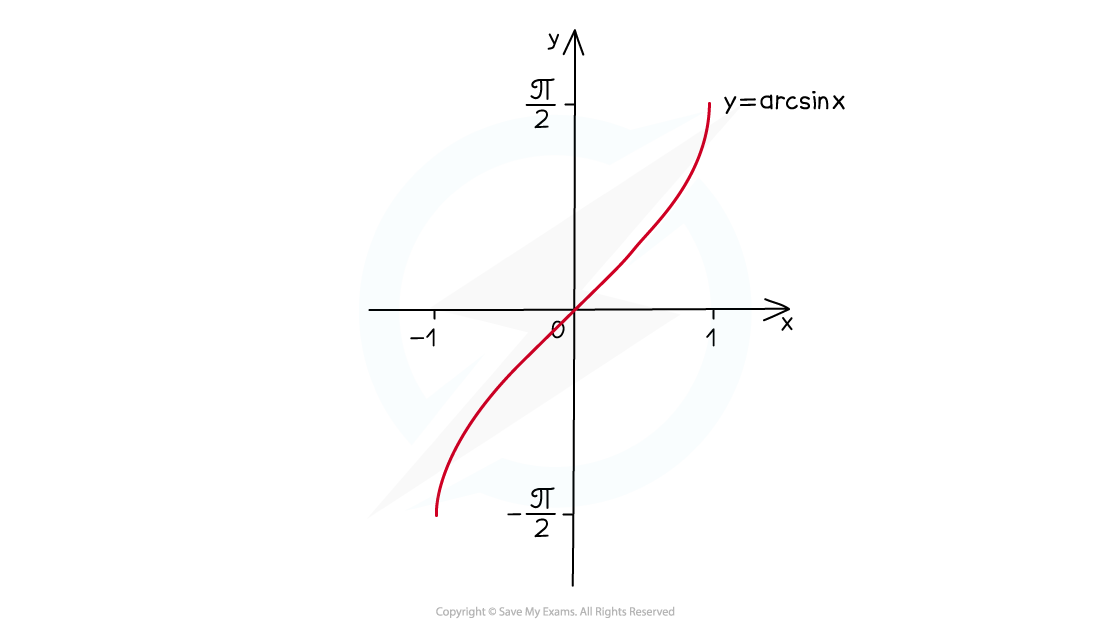
Sine is restricted to the domain
On this interval, sine is increasing
and takes every value from to exactly once
Therefore returns an angle in as an output
The domain of is

Cosine is restricted to the domain
On this interval, cosine is decreasing
and takes every value from to exactly once
Therefore returns an angle in as an output
The domain of is


Tangent is restricted to the domain
On this interval, tangent is increasing
and takes every real number value exactly once
Therefore returns an angle in
The domain of is all real numbers

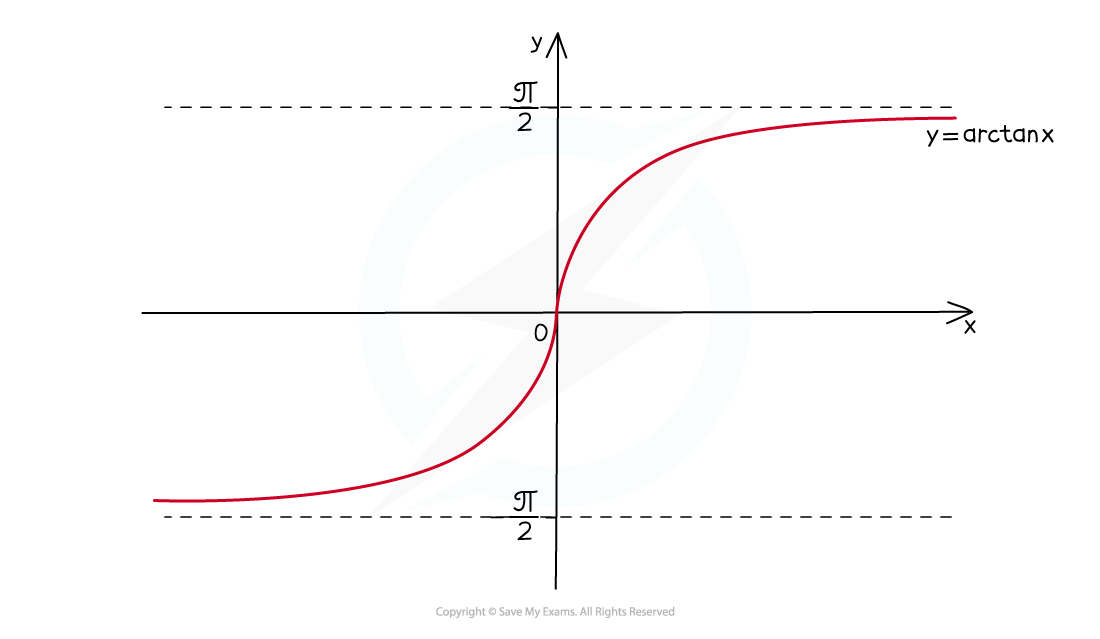
These domain restrictions, along with the domain and range of the inverse functions, are summarised in the table below
Function | Restricted domain | Range of inverse | Domain of inverse |
|---|---|---|---|
All real numbers |
Examiner Tips and Tricks
Both forms of notation for the inverse functions appear on the exam
and
as well as and
Make sure you are comfortable with both forms of notation.
How can inverse trigonometric functions be evaluated?
To evaluate an expression like , ask: "What angle in has sine equal to ?"
From the unit circle,
and is in
So
To evaluate , ask: "What angle in has cosine equal to ?"
and is in
So
To evaluate , ask: "What angle in has tangent equal to ?"
and is in
So
Be careful with negative inputs
the restricted domain determines which angle is returned
E.g.
not , which is outside the restricted domain
Examiner Tips and Tricks
The most common mistake with inverse trigonometric functions is returning an angle outside the restricted domain of the original trig function.
For example, , not or
because must return an angle in
Always check that your answer falls within the correct interval for the inverse function you are using.
Note that using the and buttons on your calculator will automatically return a value in the correct interval.
Worked Example
Find the exact value of each of the following expressions.
(a)
(b)
(c)
(d)
Answer:
(a)
answers the question: what angle in has sine equal to ?
From the unit circle,
The negative value means the angle is in the lower half of the restricted domain
And , so
(b)
answers the question: what angle in has cosine equal to ?
From the unit circle,
The negative value means the angle is in the second quadrant (since cosine is negative in that quadrant)
By symmetry of the cosine function the value you want is
.
(c)
answers the question: what angle in has tangent equal to ?
From the unit circle,
The negative value means the angle is in the lower half of the restricted domain
And , so
(d)
Work from the inside out
First evaluate :
I.e., what angle in has cosine equal to ?
Then substitute into
Worked Example
The function is given by and has a period of . In order to define the inverse function of , which of the following specifies a restricted domain for and provides a rationale for why is invertible on that domain?
(A) , because all possible values of occur without repeating on this interval.
(B) , because all possible values of occur without repeating on this interval.
(C) , because the length of this interval is equal to the period.
(D) , because the length of this interval is half the period.
Answer
A question like this will appear on the calculator section of the exam
Use your graphing calculator to graph the function
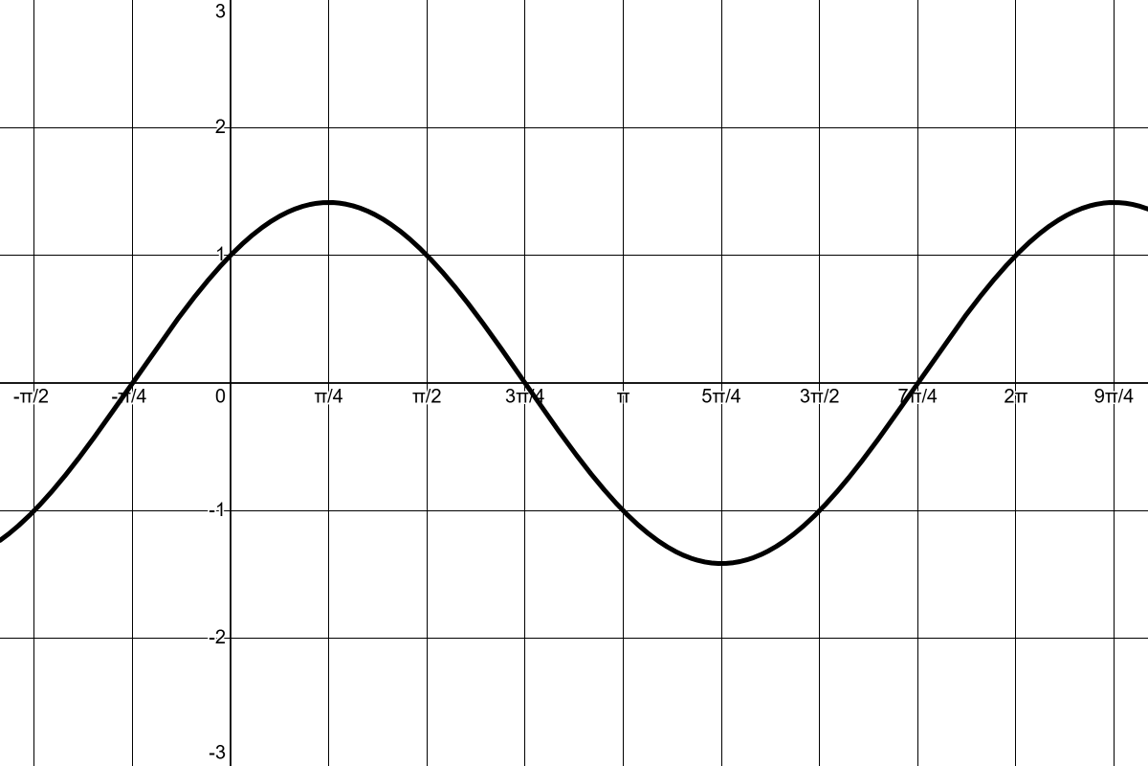
You are looking for an interval on which the function takes on all of its possible output values exactly once
Consider the options:
(A)
Between 0 and the function returns the same output for more than one input (i.e., it fails the 'horizontal line test')
And it doesn't include all possible output values of the function
So this can't provide a restricted domain for an inverse
(B)
Over this interval the function goes from a maximum to the subsequent minimum, including all the values in between
And no output values occur more than once
So this must be the correct answer
(C)
This does have the same length as the period of
But it fails the 'horizontal line test' just like option (A)
So this can't provide a restricted domain for an inverse
(D)
This fails the 'horizontal line test' just like option (A)
And it doesn't include all possible output values of the function
So this can't provide a restricted domain for an inverse
So the correct answer is (B)
(B) , because all possible values of
occur without repeating on this interval

Unlock more, it's free!
Join the 100,000+ Students that ❤️ Save My Exams
the (exam) results speak for themselves:

Was this revision note helpful?
Build on this topic