Reciprocal Trigonometric Functions (College Board AP® Precalculus): Study Guide

Secant, cosecant & cotangent
What is the secant function?
The secant function is the reciprocal of the cosine function
The secant function is undefined wherever
i.e. at for integer values of
What is the cosecant function?
The cosecant function is the reciprocal of the sine function
The cosecant function is undefined wherever
i.e. at for integer values of
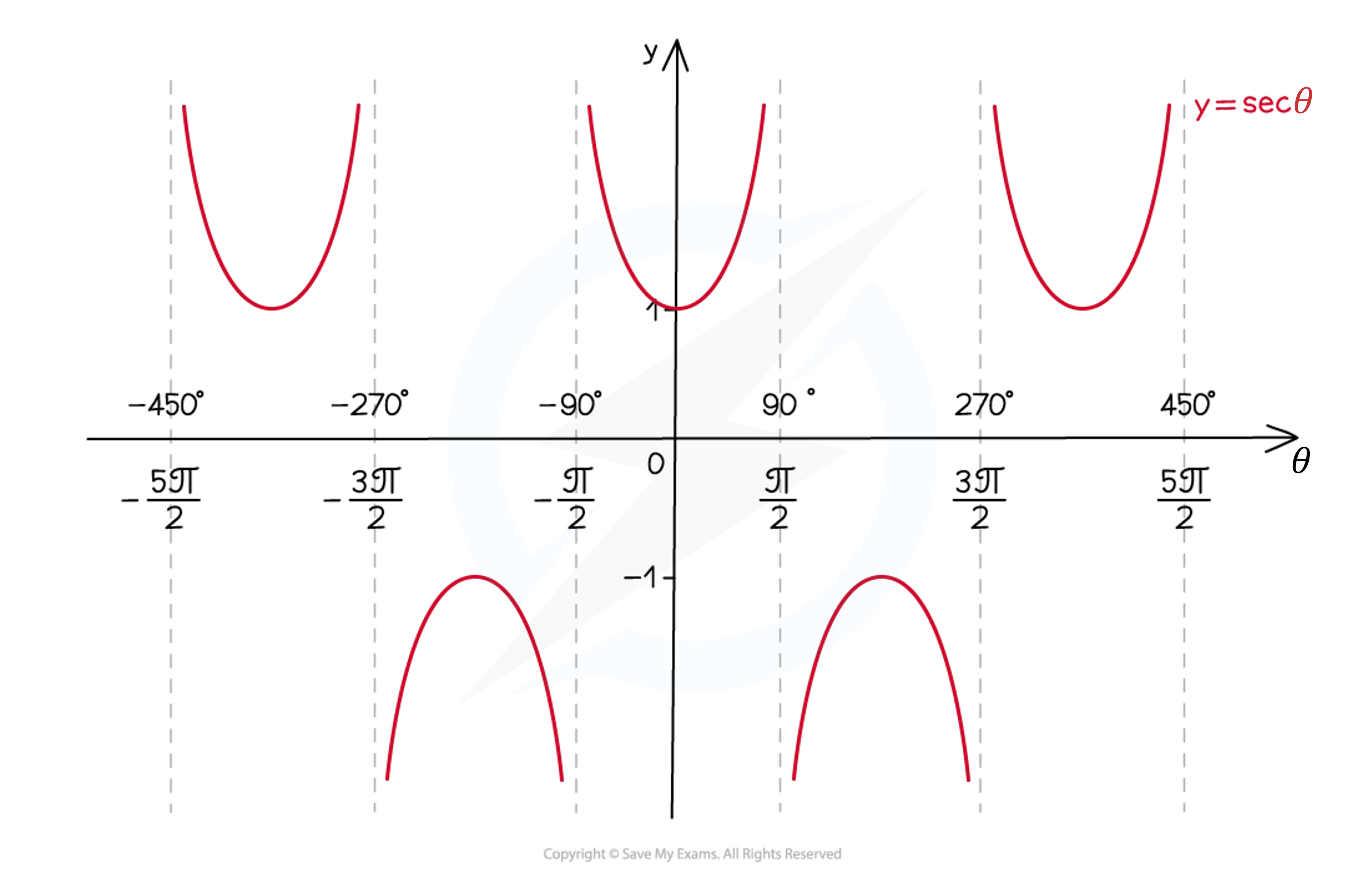
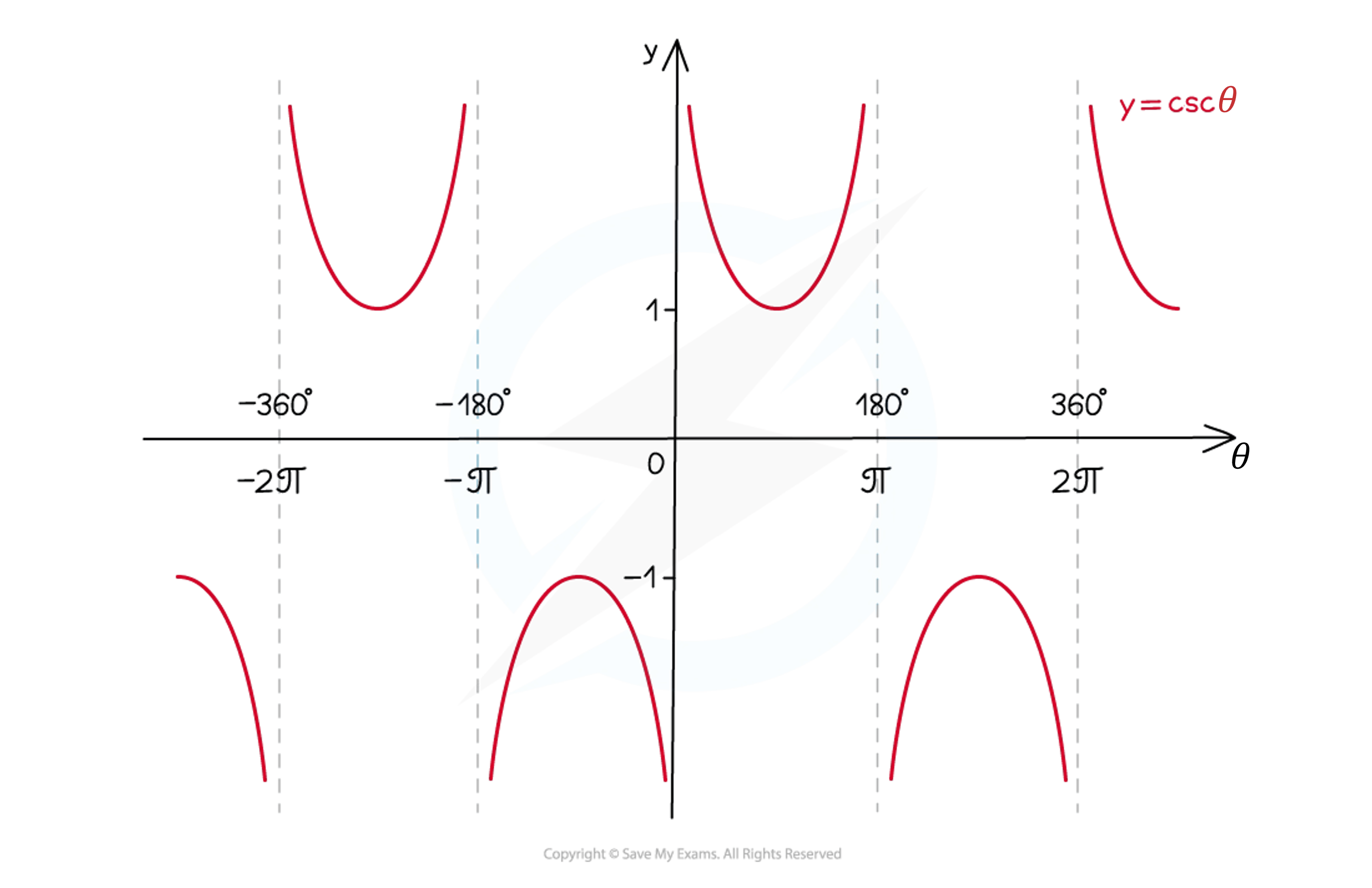
What are the key characteristics of the secant and cosecant graphs?
The graphs of secant and cosecant have vertical asymptotes at the values where cosine and sine are zero, respectively
has vertical asymptotes at
the same values where
has vertical asymptotes at
the same values where
The range of both secant and cosecant is
Output values are always or
the functions will never output values between and
This makes sense because they are reciprocals of functions whose outputs lie between and
Taking the reciprocal of a number with absolute value at most gives a number with absolute value at least
Both functions are periodic
secant has period (same as cosine)
and cosecant has period (same as sine)
What is the cotangent function?
The cotangent function is the reciprocal of the tangent function
Equivalently, cotangent can be written as the ratio of cosine to sine
The cotangent function is undefined wherever
i.e. at for integer values of
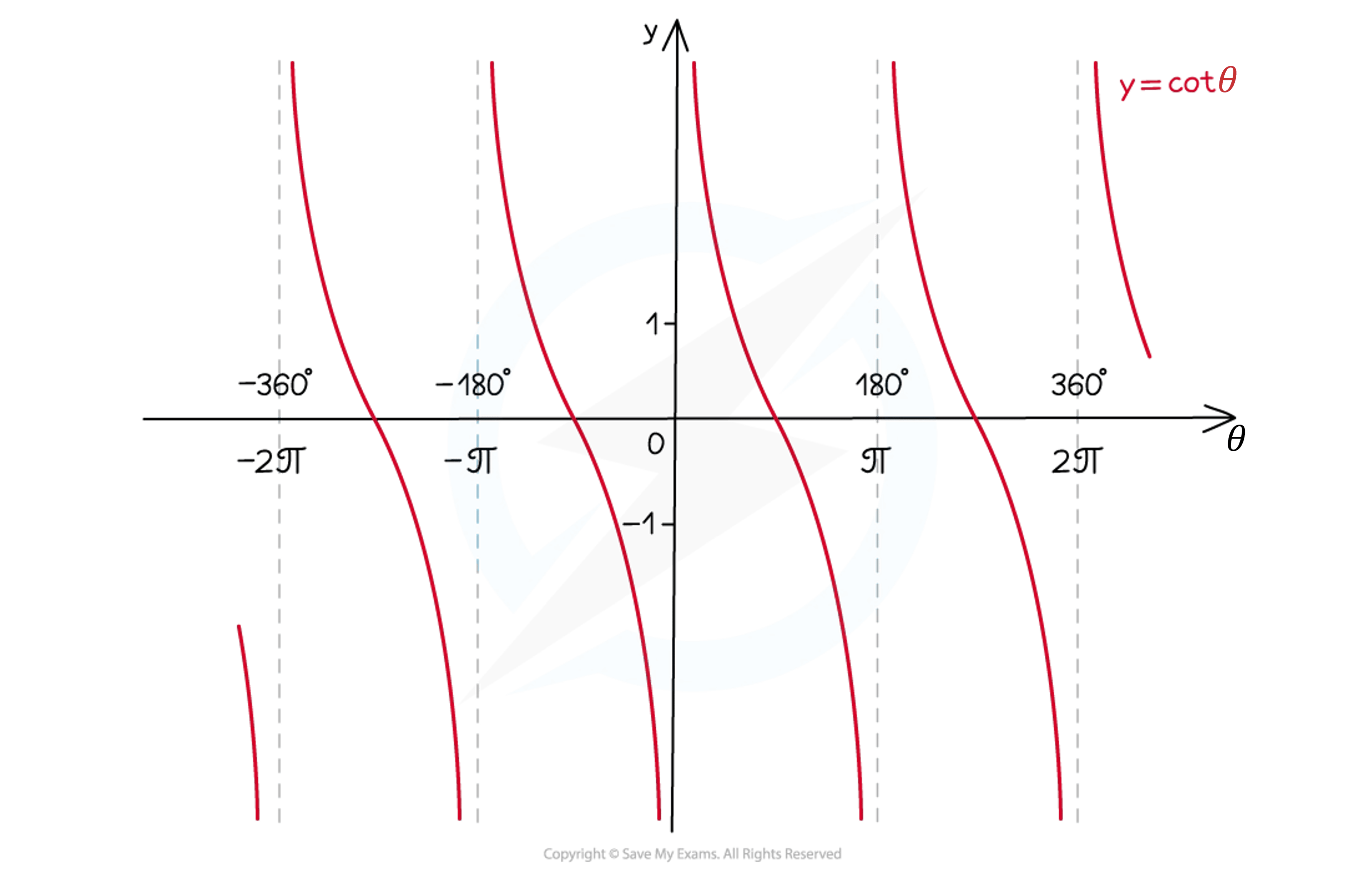
What are the key characteristics of the cotangent graph?
The graph of cotangent has vertical asymptotes at values where
i.e. at for integer values of
Note that these are the same values where
which is consistent with the formula
Between consecutive asymptotes, the cotangent function is always decreasing
This is the opposite of tangent, which is always increasing between its consecutive asymptotes
The cotangent function has a period of (the same as tangent)
The range of cotangent is all real numbers (the same as tangent)
How can the reciprocal functions be evaluated at key angles?
To evaluate secant, cosecant, or cotangent at a specific angle
first find the value of the corresponding base function (cosine, sine, or tangent)
then take the reciprocal
For example:
If the base function equals zero at that angle, the reciprocal function is undefined
E.g. is undefined because
Examiner Tips and Tricks
A quick way to remember where each reciprocal function has asymptotes is to think about where its "partner" base function equals zero.
Secant's asymptotes are where cosine is zero
cosecant's asymptotes are where sine is zero
and cotangent's asymptotes are also where sine is zero (because )
Knowing the zeros of sine and cosine from the unit circle makes it straightforward to identify these asymptote locations.
Worked Example
Find the exact value of each of the following expressions, or state that it is undefined.
(a)
(b)
(c)
(d)
Answer:
(a)
The secant is the reciprocal of cosine
(b)
The cosecant is the reciprocal of sine:
(c)
The cotangent can be found as the reciprocal of tangent, or as
(d)
The cosecant is the reciprocal of sine
Since , the expression is undefined
The graph of cosecant has a vertical asymptote at

Unlock more, it's free!
Join the 100,000+ Students that ❤️ Save My Exams
the (exam) results speak for themselves:

Was this revision note helpful?
Build on this topic