Sine & Cosine Functions (College Board AP® Precalculus): Study Guide

Sine & cosine function values
What are the sine and cosine functions?
The sine function is defined as
The domain of the sine function is all real numbers
I.e. any real number can be used as an input angle measure
The range of the sine function is
I.e., the function's output value oscillates between -1 and 1 as the input values vary
The cosine function is defined as
The domain of the cosine function is all real numbers
I.e. any real number can be used as an input angle measure
The range of the cosine function is
I.e., the function's output value oscillates between -1 and 1 as the input values vary
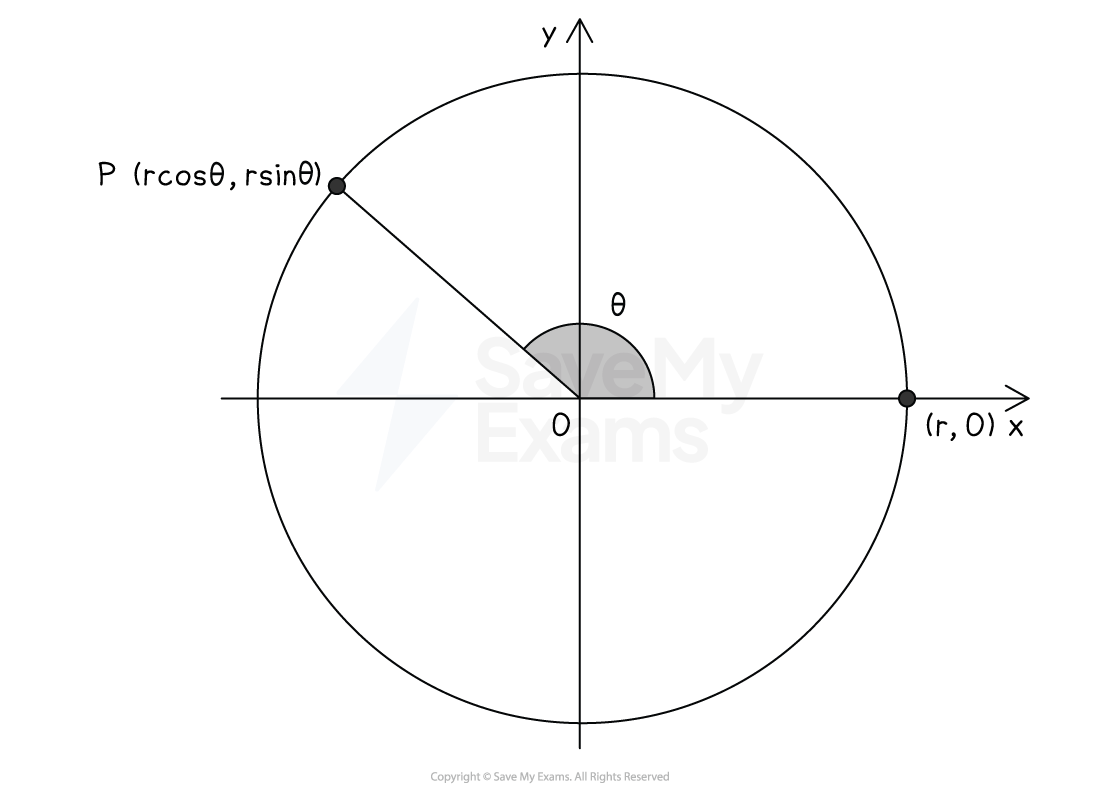
What is the connection between sine and cosine function values and a circle centered at the origin?
Given an angle in standard position and a circle with radius centered at the origin
the terminal ray for the angle will intersect the circle at a point
The coordinates of are
The -coordinate is
The -coordinate is
For the unit circle (), these coordinates simplify to
How can I use triangles to find values of sine and cosine for special angles?
The two special right-angled triangles below can help you to find the exact values of sine and cosine for 30º , 45º and 60º
Pythagoras' theorem and SOHCAHTOA are used to work out the values
Remember that you can rationalize the denominator in a fraction like
I.e.
Triangle for 45°
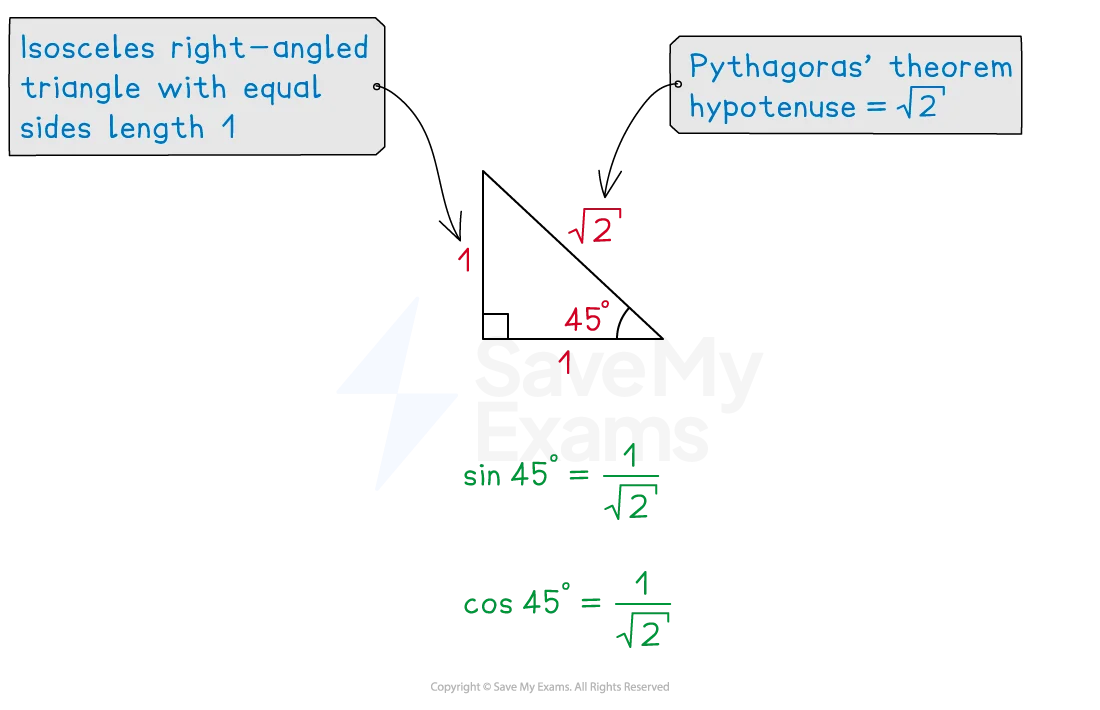
So
Triangle for 30° and 60°
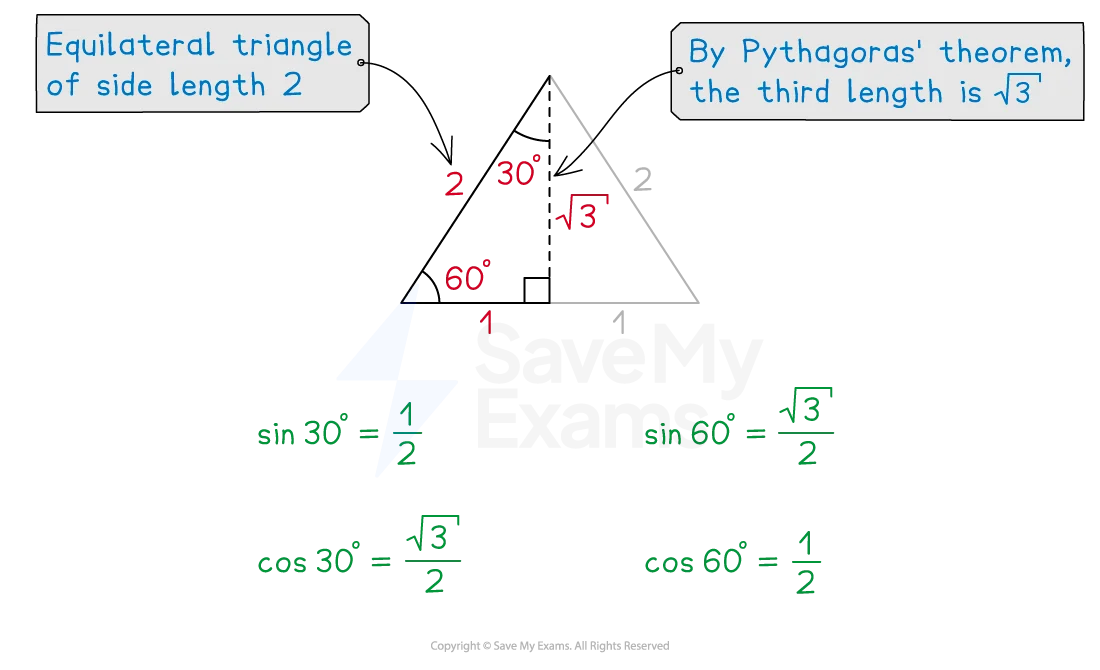
So , , ,
Using the unit circle
How can I use the unit circle to find additional values for sine and cosine?
Given an angle in standard position and a unit circle with radius centered at the origin
we saw above that the terminal ray for the angle will intersect the circle at a point with coordinates
The -coordinate is
The -coordinate is
Using the unit circle allows you to find additional values for sine and cosine
For example
When (0°), the point is on the positive -axis with coordinates
so
When (90°), the point is on the positive -axis with coordinates
so
When (180°), the point is on the negative -axis with coordinates
so
When (270°), the point is on the negative -axis with coordinates
so
Other values can be found using the symmetries of the unit circle
and known values of sine and cosine for angles between 0 and
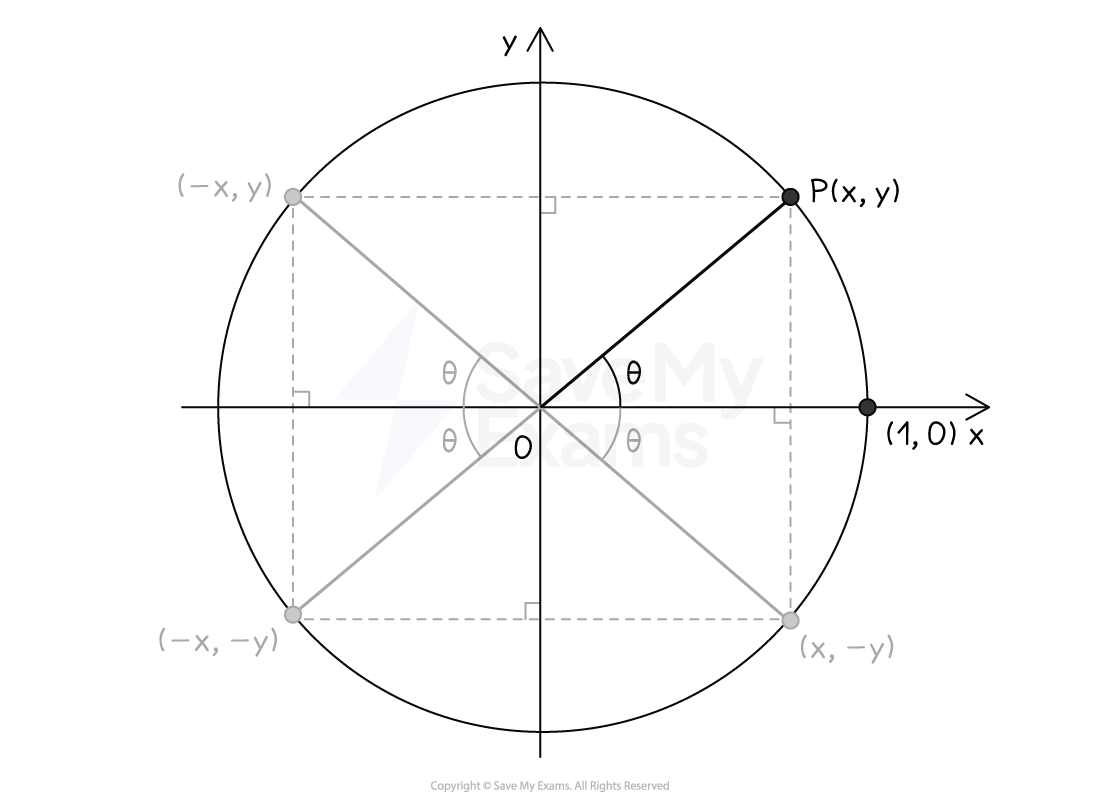
For example, we saw above that and
So the coordinates of point in the diagram would be
Using the other places in the diagram where an angle of size appears, this allows you to determine that
,
,
,
Remember that
A terminal ray along the negative -axis has an angle in standard position of radians
A terminal ray along the positive -axis has an angle in standard position of 0 or radians
What are the exact values of sine and cosine for all key angles?
The process above can also be applied to the results for sine and cosine of and
The results for all the key angles between 0 and 2π are shown in the following table
These values can also all be seen on the following diagram of the unit circle

Examiner Tips and Tricks
Make sure you know the exact values of sine and cosine for the key angles (i.e. multiples of and ).
These come up frequently, and the non-calculator section of the exam expects you to be able to work with them quickly
Understanding how these values come from the special triangles and the unit circle (rather than just memorizing the table) will help you reconstruct any value you forget under exam pressure.
Sine & cosine function graphs
What do the graphs of the sine and cosine functions look like?
As the input values (angle measures) increase
the output values of both the sine and cosine functions oscillate between and
taking every value in between
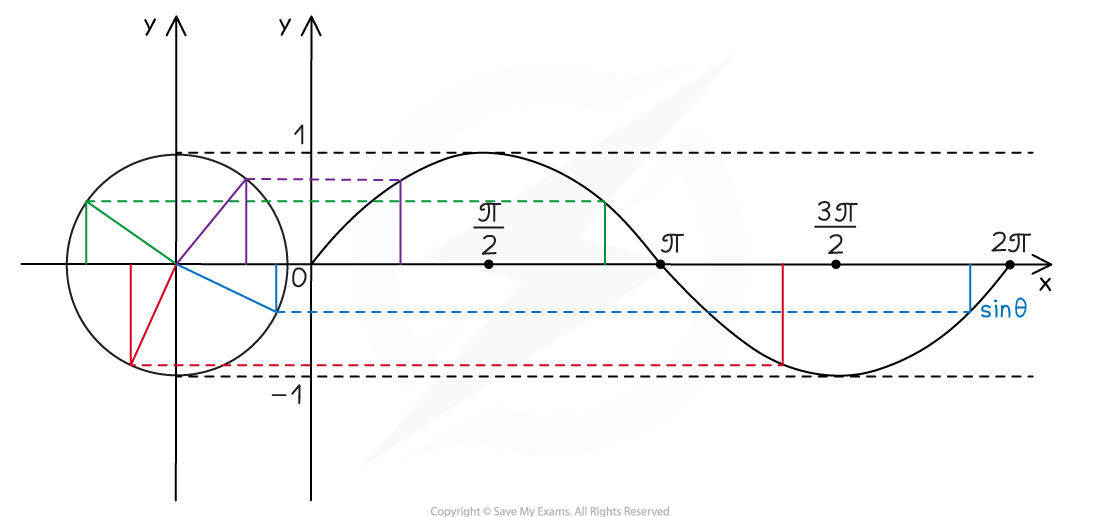
This oscillating behavior comes directly from the unit circle
For sine, the output tracks the vertical displacement of points on the unit circle from the -axis as the angle increases
For cosine, the output tracks the horizontal displacement of points on the unit circle from the -axis as the angle increases
Key features of both graphs
The output values are always in the range
Both functions are periodic with a period of
The graphs are smooth, continuous wave shapes
The domain of both functions is all real numbers
so the graphs can be extended to negative values of the angle
this corresponds to an angle measured clockwise from the positive -axis on the unit circle
or values of the angle greater than
this corresponds to what happens if you 'keep going' counter-clockwise after making one complete revolution
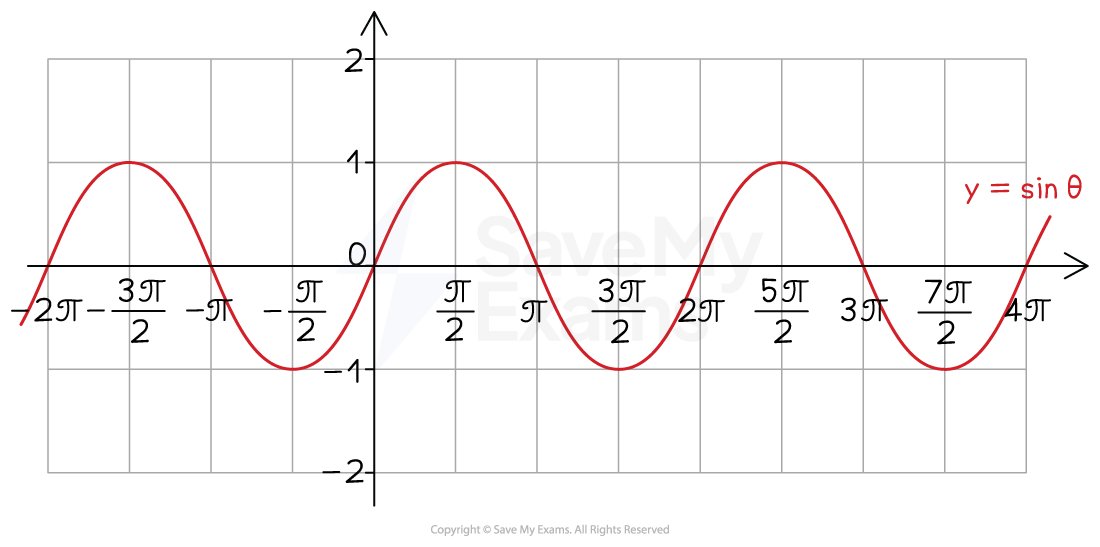
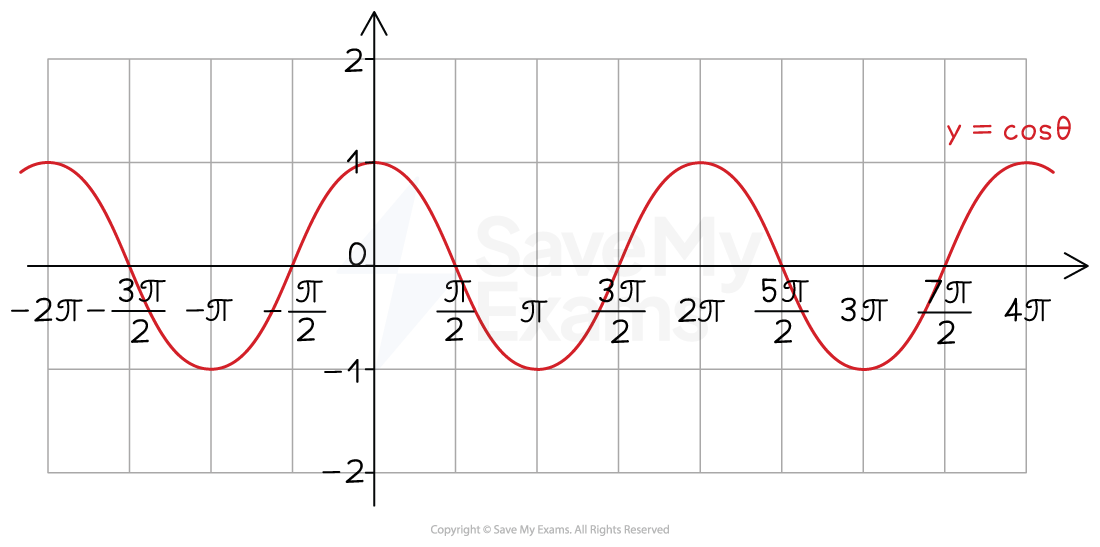
Note that the two graphs are horizontal translations of each other
For example, shifting the graph of sine to the left by units gives the graph of cosine
Or shifting the graph of cosine to the right by units gives the graph of sine
How can the graph of the sine function be understood from the unit circle?
The behavior of the sine graph can be understood by considering the unit circle
Starting at
the point on the unit circle is , so
As increases from to
the -coordinate increases from to
so sine increases to its maximum value of
From to
the -coordinate decreases from back to
so sine decreases back to
From to
the -coordinate decreases from to
so sine reaches its minimum value of
From to
the -coordinate increases from back to
completing one full cycle
How can the graph of the cosine function be understood from the unit circle?
The behavior of the cosine graph can also be understood by considering the unit circle
Starting at
the point on the unit circle is , so
the cosine function starts at its maximum
As increases from to
the -coordinate decreases from to
so cosine decreases back to 0
From to
the -coordinate decreases from to
so cosine reaches its minimum value of
From to
the -coordinate increases from back to
so cosine increases back to 0
From to
the -coordinate increases from back to
completing one full cycle

Worked Example
A circle centered at the origin has a radius of . An angle of measure radians is in standard position, and its terminal ray intersects the circle at point .
(a) Find the exact coordinates of point .
(b) Is the sine function increasing or decreasing at ? Justify your answer by considering the unit circle.
Answer:
(a)
The coordinates of are
where and
If you don't remember the values of sine and cosine for , you can work them out using the values for and the symmetries of the unit circle
So the coordinates are
(b)
At , the point on the unit circle is in the third quadrant III
As increases from to , the point on the unit circle moves from toward
so the -coordinate is decreasing (becoming more negative).
Since the sine function tracks the -coordinate of the point on the unit circle as the angle increases in the counter-clockwise direction, and the point is in the third quadrant, the sine function is decreasing at

Unlock more, it's free!
Join the 100,000+ Students that ❤️ Save My Exams
the (exam) results speak for themselves:

Was this revision note helpful?
Build on this topic