Inverse Functions (College Board AP® Precalculus): Study Guide

Inverse functions
What is an inverse function?
An inverse function is a function that reverses the mapping of an original function
For the function , the inverse function is notated by
Examiner Tips and Tricks
Be careful with the notation here!
The notation means the inverse of
It does not mean
If the original function takes input and produces output
then the inverse function takes as input and returns output
I.e. if
then
You can think of this in terms of input-output pairs
If contains the pair
then contains the pair
This means you can find values of an inverse function
by reading the original function backwards
From a table
If you know that , then
Look for 7 in the output row, then read the corresponding input
From a graph
If the point is on the graph of , then
Find 7 on the -axis, read across to the curve, and then down to the -axis
When does a function have an inverse?
A function has an inverse function (i.e. it is invertible) on a given domain
if every output value comes from exactly one input value
In other words, if no two different inputs produce the same output
Such a function, where no two different inputs produce the same output, is often referred to as a one-to-one function
A function must be one-to-one to be invertible
This invertibility requirement comes because an inverse function must be a function
And a function can only give one output for each input
If a function is not invertible on its full domain, the domain can sometimes be restricted to a smaller interval where it is invertible
There is often more than one way to restrict the domain to achieve this
E.g. the function is not invertible on all real numbers
because both and
Two different inputs give the same output
But if the domain is restricted to
then each output comes from a unique input, and the inverse exists
In that case
How do you determine if a function is invertible from a table or graph?
From a table
Check whether any output value appears more than once
If it does, the function is not invertible (on the given domain)
because multiple inputs map to the same output
From a graph
You can use the 'horizontal line test'
Check whether any horizontal line crosses the graph more than once
If it does, there are multiple inputs producing the same output,
so the function is not invertible
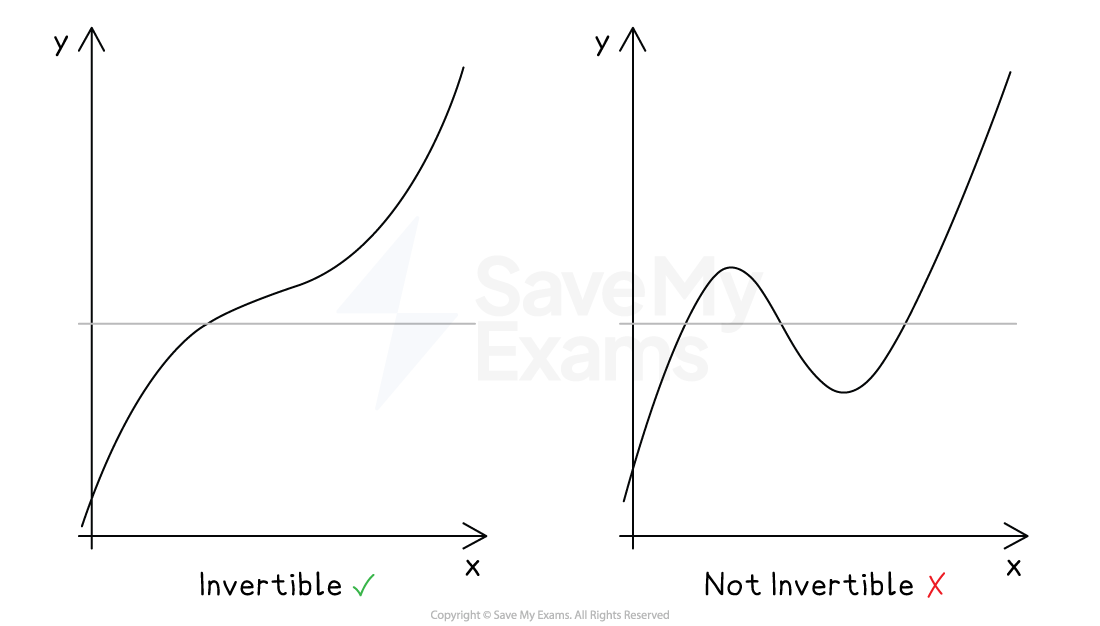
If the function is always increasing or always decreasing on its domain
then it is automatically invertible
because outputs always changing in only one direction
means no two inputs can share the same output
Examiner Tips and Tricks
An exam question may ask you to determine whether a function has an inverse and to justify your answer. Simply stating "the function is not one-to-one" or "it fails the horizontal line test" is not enough to earn the reasoning point. You must refer to specific values from the table or graph.
E.g. " does not have an inverse function because , so the output 1 comes from more than one input"
Worked Example
The function is defined for all real numbers. The table gives values of at selected values of .
0 | 2 | 4 | 6 | |||
10 | 5 | 3 | 5 | 10 | 18 |
The function is an increasing function defined for all real numbers. The table gives values of at selected values of .
0 | 1 | 2 | 3 | 4 | ||
0 | 3 | 8 | 15 |
(a) Find the value of , or indicate that it is not defined.
(b) (i) Determine whether has an inverse function on its given domain.
(ii) Give a reason for your answer based on the definition of a function and the table of values for .
Answer:
(a)
Because is increasing, it is invertible
therefore exists
From the table, , so
(b)
The output values 5 and 10 each appear more than once in the table for
This means that the function has more than one input producing the same output
therefore it is not invertible
(i)
does not have an inverse function on its given domain
(ii)
There are output values of that correspond to more than one input value. For example, and , so the output value 10 is not mapped from a unique input. Similarly, and . Because multiple inputs produce the same output, the reverse mapping would not be a function, so is not invertible.

Unlock more, it's free!
Join the 100,000+ Students that ❤️ Save My Exams
the (exam) results speak for themselves:

Was this revision note helpful?
Build on this topic