Radian Measure & Standard Position (College Board AP® Precalculus): Revision Note

Roger B

Written by: Roger B

Reviewed by: Mark Curtis

Updated on

Radian measure & standard position

What is an angle in standard position?

  • In the coordinate plane, an angle is in standard position when:

    • The vertex of the angle is at the origin

    • One ray lies along the positive x-axis

      • this ray is sometimes called the initial ray (or initial side)

    • The other ray is called the terminal ray (or terminal side)

  • The measure of the angle describes the amount of rotation from the initial side to the terminal ray

    • A positive angle measure indicates rotation in the counterclockwise direction

    • A negative angle measure indicates rotation in the clockwise direction
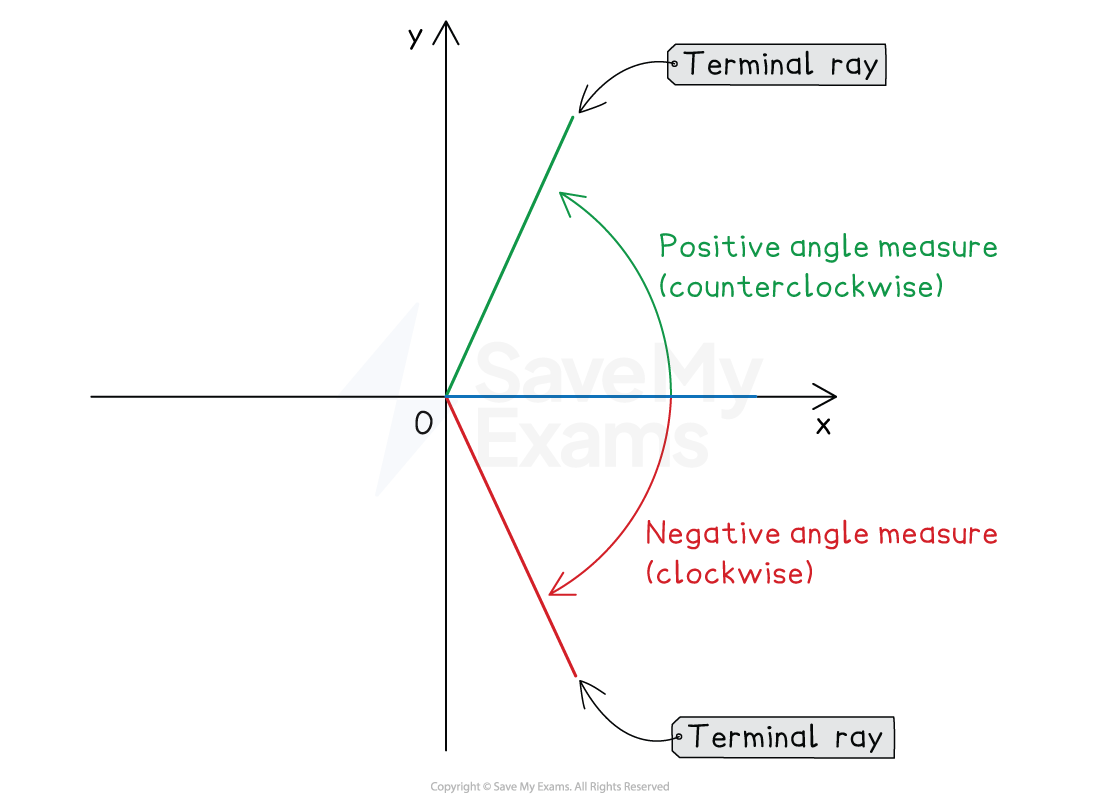
Graph with x and y axes. Positive angle in green is counterclockwise, negative angle in red is clockwise, both from the positive x-axis.
Positive and negative angle measures in standard position

What are coterminal angles?

  • Two angles in standard position are coterminal if they share the same terminal ray

    • Coterminal angles differ by an integer number of full revolutions

      • In degrees: coterminal angles differ by a multiple of 360°

      • In radians: coterminal angles differ by a multiple of 2\pi

    • E.g. angles of 45° and 405° are coterminal

      • because 405° = 45° + 360°

    • E.g. angles of 60° and -300° are coterminal

      • because -300° = 60° - 360°

  • Every angle has infinitely many coterminal angles

What is radian measure?

  • The radian measure of an angle in standard position is defined as

    • the ratio of the arc length subtended by the angle

      • to the radius of the circle:

\theta = \frac{\text{arc length}}{\text{radius}} = \frac{s}{r}

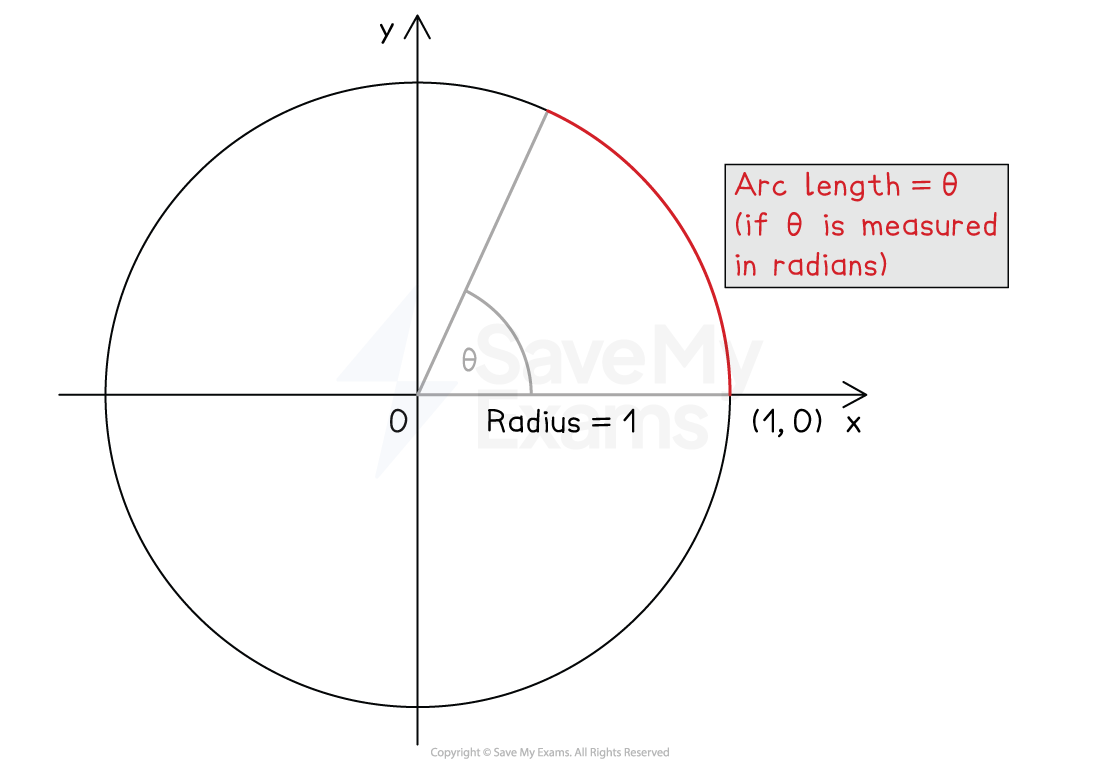
  • For a unit circle (a circle with radius 1 centered at the origin)

    • the radian measure of the angle is simply equal to the length of the arc subtended by the angle

      • because in that case space theta equals fraction numerator text arc length end text over denominator 1 end fraction equals text arc length end text

    • One full revolution corresponds to the full circumference of the unit circle, which has length 2\pi

      • Therefore one full revolution = bold 2 bold italic pi radians

A unit circle with radius 1 on a coordinate plane, angle θ in radians, showing arc length θ in red. Centre at origin, labelled points and axes.
Arc length is equal to angle measure in radians on a unit circle
  • Because one full revolution is 360° in degrees and 2\pi radians

    • 360 degree equals 2 pi text  radians end text

  • This gives the conversion factor

bold 180 bold degree bold equals bold italic pi text bold  radians end text

  • To convert from degrees to radians, multiply by pi over 180

    • E.g. space 90 degree cross times pi over 180 equals pi over 2 radians

  • To convert from radians to degrees, multiply by \frac{180}{\pi}

    • E.g. space fraction numerator 3 pi over denominator 4 end fraction cross times 180 over pi equals 135 degree

What are the radian equivalents of important angles?

  • Certain angles appear frequently throughout trigonometry and their radian equivalents should be memorized

    • The key angles are the multiples of 30° or of 45° (including 0° and 360°)

Degrees

Radians

0°

0

30°

\frac{\pi}{6}

45°

\frac{\pi}{4}

60°

\frac{\pi}{3}

90°

\frac{\pi}{2}

120°

\frac{2\pi}{3}

135°

\frac{3\pi}{4}

150°

\frac{5\pi}{6}

180°

\pi

210°

\frac{7\pi}{6}

225°

\frac{5\pi}{4}

240°

\frac{4\pi}{3}

270°

\frac{3\pi}{2}

300°

\frac{5\pi}{3}

315°

\frac{7\pi}{4}

330°

\frac{11\pi}{6}

360°

2\pi

  • A useful pattern

    • the multiples of 30° have denominators of 6 (pi over 6 comma space fraction numerator 2 pi over denominator 6 end fraction comma space fraction numerator 3 pi over denominator 6 end fraction, etc.)

      • and the multiples of 45° have denominators of 4 (pi over 4 comma space fraction numerator 2 pi over denominator 4 end fraction comma space fraction numerator 3 pi over denominator 4 end fraction, etc.)

    • Although in many cases the fraction simplifies (e.g. fraction numerator 2 pi over denominator 6 end fraction equals pi over 3, fraction numerator 3 pi over denominator 6 end fraction equals fraction numerator 2 pi over denominator 4 end fraction equals pi over 2, etc.)

Examiner Tips and Tricks

You should be as comfortable working with angles measured in radians as you are with angles measured in degrees.

Throughout this course (and also in calculus), radians are the standard unit for angle measurement.

Practicing converting between the two systems now will save time later, and memorizing the key angle equivalents will help you work more efficiently on the exam.

Worked Example

An angle of fraction numerator 5 pi over denominator 3 end fraction radians is in standard position.

(a) Convert fraction numerator 5 pi over denominator 3 end fraction radians to degrees.

Answer:

To convert from radians to degrees, multiply by \frac{180}{\pi}

fraction numerator 5 pi over denominator 3 end fraction cross times 180 over pi equals fraction numerator 5 cross times 180 over denominator 3 end fraction equals 900 over 3

300 degree

(b) Find the measure, in radians, of a negative angle that is coterminal with \frac{5\pi}{3}.

Answer:

Coterminal angles differ by a multiple of 2\pi

  • So find a negative coterminal angle, subtract 2\pi

\frac{5\pi}{3} - 2\pi = \frac{5\pi}{3} - \frac{6\pi}{3} = -\frac{\pi}{3}

A negative coterminal angle is -\frac{\pi}{3} radians
(or negative fraction numerator 7 pi over denominator 3 end fraction radians, or negative fraction numerator 13 pi over denominator 3 end fraction radians, etc.)

(c) A circle centered at the origin has a radius of 4. Find the length of the arc on this circle that is subtended by the angle \frac{5\pi}{3}.

Answer:

Rearrange the relationship theta equals s over r to find the arc length:

s equals r theta equals 4 cross times fraction numerator 5 pi over denominator 3 end fraction equals fraction numerator 20 pi over denominator 3 end fraction

The arc length is \frac{20\pi}{3} (almost equal to 20.944)

Unlock more, it's free!

Join the 100,000+ Students that ❤️ Save My Exams

the (exam) results speak for themselves:

Roger B

Author: Roger B

Expertise: Maths Content Creator

Roger's teaching experience stretches all the way back to 1992, and in that time he has taught students at all levels between Year 7 and university undergraduate. Having conducted and published postgraduate research into the mathematical theory behind quantum computing, he is more than confident in dealing with mathematics at any level the exam boards might throw at you.

Mark Curtis

Reviewer: Mark Curtis

Expertise: Maths Content Creator

Mark graduated twice from the University of Oxford: once in 2009 with a First in Mathematics, then again in 2013 with a PhD (DPhil) in Mathematics. He has had nine successful years as a secondary school teacher, specialising in A-Level Further Maths and running extension classes for Oxbridge Maths applicants. Alongside his teaching, he has written five internal textbooks, introduced new spiralling school curriculums and trained other Maths teachers through outreach programmes.