Inverse Trigonometric Functions (College Board AP® Precalculus): Revision Note

Roger B

Written by: Roger B

Reviewed by: Mark Curtis

Updated on

Arcsin, arccos & arctan

What are inverse trigonometric functions?

  • An inverse trigonometric function reverses the role of inputs and outputs compared to the corresponding trigonometric function

  • For a trigonometric function

    • the input is an angle

    • and the output is a numerical value

  • For an inverse trigonometric function

    • the input is a numerical value

    • and the output is an angle

  • For example, if sin pi over 6 equals 1 half

    • then the inverse of sine will take an input of 1 half

    • and return and output of pi over 6

What are the three inverse trigonometric functions called?

  • The three inverse trigonometric functions are:

    • Arcsine, the inverse of the sine function

      • The notation for this is sin to the power of negative 1 end exponent x or arcsin x

    • Arccosine, the inverse of the cosine function

      • The notation for this is cos to the power of negative 1 end exponent x or arc cos x

    • Arctangent, the inverse of the tangent function

      • The notation for this is tan to the power of negative 1 end exponent x or arctan x

Examiner Tips and Tricks

Be careful with the notation here!

  • The notation sin to the power of negative 1 end exponent x means "the angle whose sine is x"

  • It does not mean \frac{1}{\sin x}

Why do trigonometric functions need restricted domains to have inverses?

  • Because trigonometric functions are periodic, they are not one-to-one over their full domains

    • More than one input value produces the same output value

    • For example, sin pi over 6 equals 1 half and sin fraction numerator 5 pi over denominator 6 end fraction equals 1 half

  • A function must be one-to-one (each output comes from exactly one input) in order to have an inverse

  • To define inverse trigonometric functions

    • the domains of sine, cosine, and tangent are restricted to intervals where

      • each function is one-to-one

      • and takes on all of its possible output values exactly once

What are the standard domain restrictions?

  • Sine is restricted to the domain open square brackets negative pi over 2 comma   pi over 2 close square brackets

    • On this interval, sine is increasing

      • and takes every value from -1 to 1 exactly once

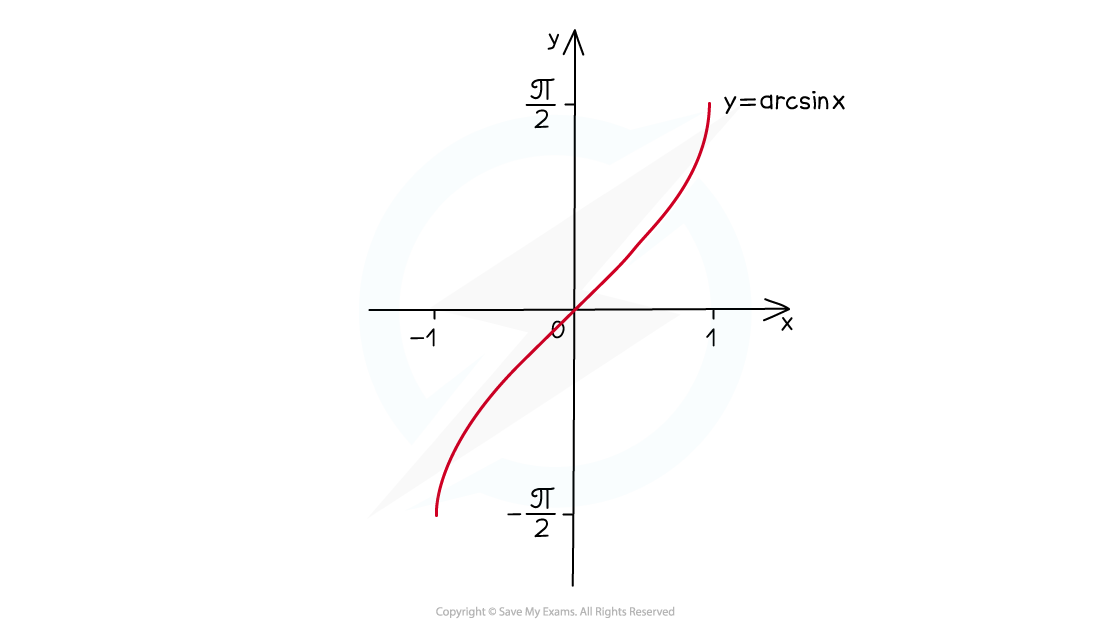
    • Therefore sin to the power of negative 1 end exponent x returns an angle in open square brackets negative pi over 2 comma   pi over 2 close square brackets as an output

    • The domain of \sin^{-1} is [-1, 1]

Graph of y equals sin x from -π/2 to π/2, showing a curve from -1 to 1 through the origin, with x and y axes labelled.
Graph of y=sinx with restricted domain
Graph of y equals arcsin x, showing a red curve from (-1, -π/2) to (1, π/2) on the Cartesian plane, with x and y axes labelled.
Graph of y=arcsinx
  • Cosine is restricted to the domain left square bracket 0 comma   pi right square bracket

    • On this interval, cosine is decreasing

      • and takes every value from -1 to 1 exactly once

    • Therefore cos to the power of negative 1 end exponent x returns an angle in left square bracket 0 comma   pi right square bracket as an output

    • The domain of \cos^{-1} is left square bracket negative 1 comma 1 right square bracket

Graph of y = cos(x) with the x-axis ranging from 0 to π and the y-axis from -1 to 1, highlighting the curve's wave-like shape.
Graph of y=cosx with restricted domain
Graph of y=arccos(x) showing a curve from (1,0) through (0,π/2) to (-1,π), with x and y axes labelled.
Graph of y=arccosx
  • Tangent is restricted to the domain \left(-\frac{\pi}{2},\, \frac{\pi}{2}\right)

    • On this interval, tangent is increasing

      • and takes every real number value exactly once

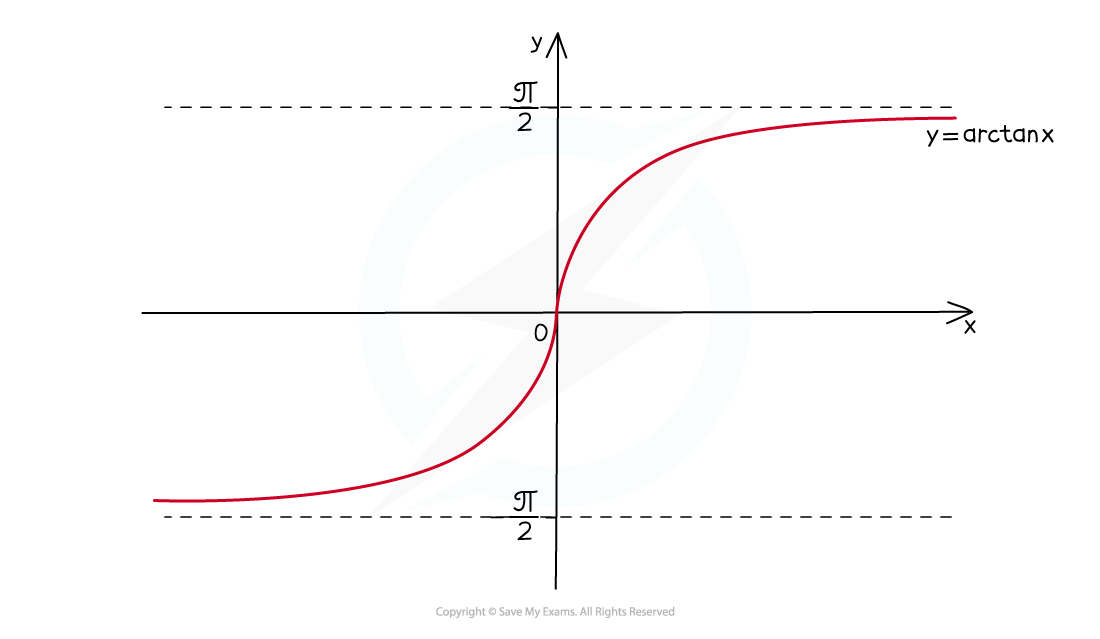
    • Therefore tan to the power of negative 1 end exponent x returns an angle in open parentheses negative pi over 2 comma   pi over 2 close parentheses

    • The domain of \tan^{-1} is all real numbers

Graph of y = tan(x) with vertical asymptotes at -π/2 and π/2, passing through the origin, with x and y axes labeled.
Graph of y=tan x with domain restriction
Graph of y = arctan(x), showing an S-shaped curve centred at the origin. Asymptotes at y = π/2 and y = -π/2 are indicated by dashed lines.
Graph of y=arctanx
  • These domain restrictions, along with the domain and range of the inverse functions, are summarised in the table below

Function

Restricted domain

Range of inverse

Domain of inverse

sin

open square brackets negative pi over 2 comma   pi over 2 close square brackets

open square brackets negative pi over 2 comma   pi over 2 close square brackets

left square bracket negative 1 comma 1 right square bracket

cos

left square bracket 0 comma   pi right square bracket

left square bracket 0 comma   pi right square bracket

left square bracket negative 1 comma 1 right square bracket

tan

open parentheses negative pi over 2 comma   pi over 2 close parentheses

open parentheses negative pi over 2 comma   pi over 2 close parentheses

All real numbers

Examiner Tips and Tricks

Both forms of notation for the inverse functions appear on the exam

  • sin to the power of negative 1 end exponent x comma space cos to the power of negative 1 end exponent x and tan to the power of negative 1 end exponent x

  • as well as arcsin x italic comma italic space arccos x and arctan x

Make sure you are comfortable with both forms of notation.

How can inverse trigonometric functions be evaluated?

  • To evaluate an expression like sin to the power of negative 1 end exponent blank open parentheses fraction numerator square root of 3 over denominator 2 end fraction close parentheses space, ask: "What angle in open square brackets negative pi over 2 comma   pi over 2 close square brackets has sine equal to fraction numerator square root of 3 over denominator 2 end fraction?"

    • From the unit circle, sin pi over 3 equals fraction numerator square root of 3 over denominator 2 end fraction

      • and pi over 3 is in open square brackets negative pi over 2 comma   pi over 2 close square brackets

    • So sin to the power of negative 1 end exponent blank open parentheses fraction numerator square root of 3 over denominator 2 end fraction close parentheses equals pi over 3 space

  • To evaluate cos to the power of negative 1 end exponent blank open parentheses negative 1 half close parentheses space, ask: "What angle in left square bracket 0 comma   pi right square bracket has cosine equal to negative 1 half?"

    • cos fraction numerator 2 pi over denominator 3 end fraction equals negative 1 half

      • and fraction numerator 2 pi over denominator 3 end fraction is in left square bracket 0 comma   pi right square bracket

    • So cos to the power of negative 1 end exponent blank open parentheses negative 1 half close parentheses equals fraction numerator 2 pi over denominator 3 end fraction space

  • To evaluate tan to the power of negative 1 end exponent left parenthesis 1 right parenthesis, ask: "What angle in open parentheses negative pi over 2 comma   pi over 2 close parentheses has tangent equal to 1?"

    • tan pi over 4 equals 1

      • and pi over 4 is in open parentheses negative pi over 2 comma   pi over 2 close parentheses

    • So \tan^{-1}(1) = \frac{\pi}{4}

  • Be careful with negative inputs

    • the restricted domain determines which angle is returned

    • E.g. sin to the power of negative 1 end exponent blank open parentheses negative fraction numerator square root of 2 over denominator 2 end fraction close parentheses equals negative pi over 4 space

      • not \frac{5\pi}{4}, which is outside the restricted domain

Examiner Tips and Tricks

The most common mistake with inverse trigonometric functions is returning an angle outside the restricted domain of the original trig function.

  • For example, cos to the power of negative 1 end exponent blank open parentheses negative fraction numerator square root of 3 over denominator 2 end fraction close parentheses equals fraction numerator 5 pi over denominator 6 end fraction space, not negative fraction numerator 5 pi over denominator 6 end fraction or fraction numerator 7 pi over denominator 6 end fraction

    • because \cos^{-1} must return an angle in [0, \pi]

Always check that your answer falls within the correct interval for the inverse function you are using.

Note that using the sin to the power of negative 1 end exponent comma space cos to the power of negative 1 end exponent and tan to the power of negative 1 end exponent buttons on your calculator will automatically return a value in the correct interval.

Worked Example

Find the exact value of each of the following expressions.

(a) sin to the power of negative 1 end exponent blank open parentheses negative fraction numerator square root of 3 over denominator 2 end fraction close parentheses space

Answer:

sin to the power of negative 1 end exponent blank open parentheses negative fraction numerator square root of 3 over denominator 2 end fraction close parentheses space answers the question: what angle in open square brackets negative pi over 2 comma   pi over 2 close square brackets has sine equal to negative fraction numerator square root of 3 over denominator 2 end fraction?

  • From the unit circle, sin pi over 3 equals fraction numerator square root of 3 over denominator 2 end fraction

  • The negative value means the angle is in the lower half of the restricted domain

    • And sin open parentheses negative x close parentheses equals negative sin x, so

sin to the power of negative 1 end exponent blank open parentheses negative fraction numerator square root of 3 over denominator 2 end fraction close parentheses equals negative pi over 3 space

(b) cos to the power of negative 1 end exponent blank open parentheses negative fraction numerator square root of 2 over denominator 2 end fraction close parentheses space

Answer:

cos to the power of negative 1 end exponent blank open parentheses negative fraction numerator square root of 2 over denominator 2 end fraction close parentheses space answers the question: what angle in left square bracket 0 comma   pi right square bracket has cosine equal to negative fraction numerator square root of 2 over denominator 2 end fraction?

  • From the unit circle, cos pi over 4 equals fraction numerator square root of 2 over denominator 2 end fraction

  • The negative value means the angle is in the second quadrant (since cosine is negative in that quadrant)

  • By symmetry of the cosine function the value you want is

pi minus pi over 4 equals fraction numerator 3 pi over denominator 4 end fraction.

cos to the power of negative 1 end exponent blank open parentheses negative fraction numerator square root of 2 over denominator 2 end fraction close parentheses equals fraction numerator 3 pi over denominator 4 end fraction space

(c) tan to the power of negative 1 end exponent left parenthesis negative 1 right parenthesis

Answer:

tan to the power of negative 1 end exponent left parenthesis negative 1 right parenthesis answers the question: what angle in open parentheses negative pi over 2 comma   pi over 2 close parentheses has tangent equal to negative 1?

  • From the unit circle, \tan\frac{\pi}{4} = 1

  • The negative value means the angle is in the lower half of the restricted domain

    • And tan open parentheses negative x close parentheses equals negative tan x, so

\tan^{-1}(-1) = -\frac{\pi}{4}

(d) sin blank open parentheses cos to the power of negative 1 end exponent 1 half close parentheses space

Answer:

Work from the inside out

  • First evaluate cos to the power of negative 1 end exponent 1 half:

  • I.e., what angle in [0,\, \pi] has cosine equal to \frac{1}{2}?

cos to the power of negative 1 end exponent 1 half equals pi over 3

Then substitute into sin

sin pi over 3 equals fraction numerator square root of 3 over denominator 2 end fraction

sin blank open parentheses cos to the power of negative 1 end exponent 1 half close parentheses equals fraction numerator square root of 3 over denominator 2 end fraction space

Worked Example

The function space f is given by space f left parenthesis x right parenthesis equals cos x plus sin x and has a period of 2\pi. In order to define the inverse function of space f, which of the following specifies a restricted domain for space f and provides a rationale for why space f is invertible on that domain?

(A) 0 less or equal than x less or equal than pi, because all possible values of space f left parenthesis x right parenthesis occur without repeating on this interval.

(B) pi over 4 less or equal than x less or equal than fraction numerator 5 pi over denominator 4 end fraction, because all possible values of space f left parenthesis x right parenthesis occur without repeating on this interval.

(C) 0 less or equal than x less or equal than 2 pi, because the length of this interval is equal to the period.

(D) negative pi over 4 less or equal than x less or equal than fraction numerator 3 pi over denominator 4 end fraction, because the length of this interval is half the period.

Answer

A question like this will appear on the calculator section of the exam

Use your graphing calculator to graph the function space f
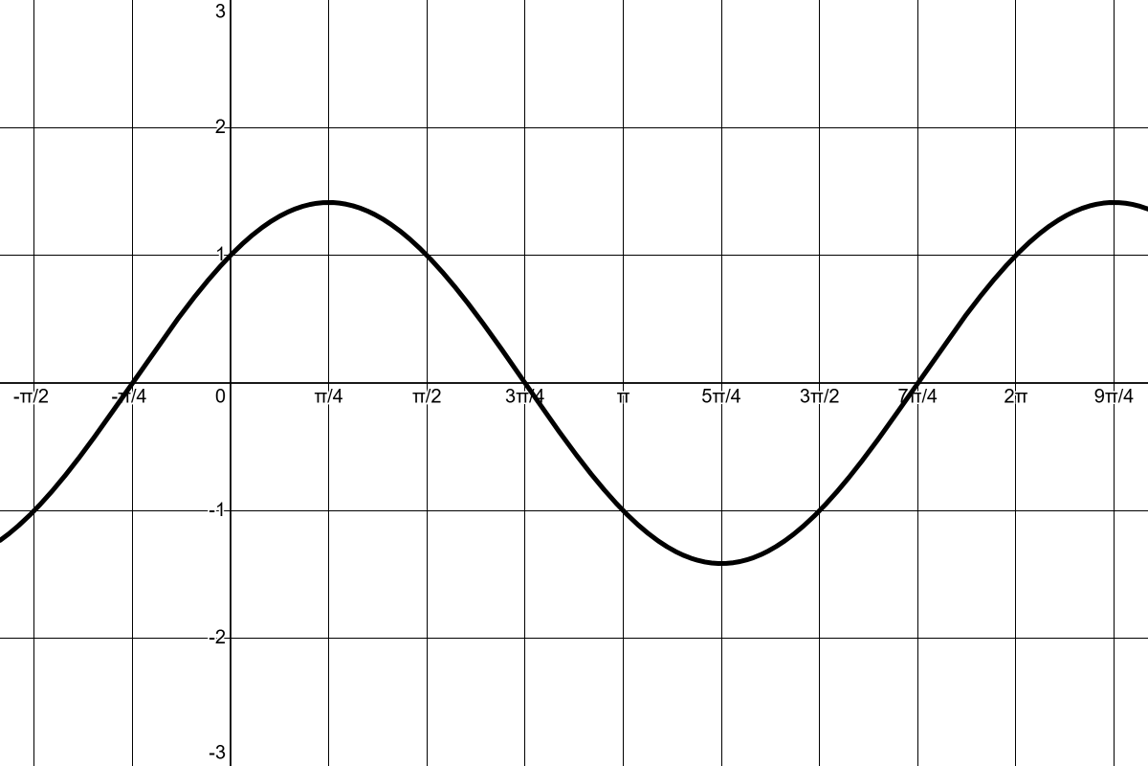
Graph showing a sinusoidal curve, representing function cos x + sin x, with labelled key points along the horizontal axis from -π to 9π/4.

You are looking for an interval on which the function takes on all of its possible output values exactly once

Consider the options:

  • (A) 0 \leq x \leq \pi

    • Between 0 and pi over 2 the function returns the same output for more than one input (i.e., it fails the 'horizontal line test')

    • And it doesn't include all possible output values of the function

      • So this can't provide a restricted domain for an inverse

  • (B) pi over 4 less or equal than x less or equal than fraction numerator 5 pi over denominator 4 end fraction

    • Over this interval the function goes from a maximum to the subsequent minimum, including all the values in between

    • And no output values occur more than once

      • So this must be the correct answer

  • (C) 0 less or equal than x less or equal than 2 pi

    • This does have the same length as the period of space f

    • But it fails the 'horizontal line test' just like option (A)

      • So this can't provide a restricted domain for an inverse

  • (D) negative pi over 4 less or equal than x less or equal than fraction numerator 3 pi over denominator 4 end fraction

    • This fails the 'horizontal line test' just like option (A)

    • And it doesn't include all possible output values of the function

      • So this can't provide a restricted domain for an inverse

So the correct answer is (B)

(B) pi over 4 less or equal than x less or equal than fraction numerator 5 pi over denominator 4 end fraction, because all possible values of space f left parenthesis x right parenthesis
occur without repeating on this interval

Unlock more, it's free!

Join the 100,000+ Students that ❤️ Save My Exams

the (exam) results speak for themselves:

Roger B

Author: Roger B

Expertise: Maths Content Creator

Roger's teaching experience stretches all the way back to 1992, and in that time he has taught students at all levels between Year 7 and university undergraduate. Having conducted and published postgraduate research into the mathematical theory behind quantum computing, he is more than confident in dealing with mathematics at any level the exam boards might throw at you.

Mark Curtis

Reviewer: Mark Curtis

Expertise: Maths Content Creator

Mark graduated twice from the University of Oxford: once in 2009 with a First in Mathematics, then again in 2013 with a PhD (DPhil) in Mathematics. He has had nine successful years as a secondary school teacher, specialising in A-Level Further Maths and running extension classes for Oxbridge Maths applicants. Alongside his teaching, he has written five internal textbooks, introduced new spiralling school curriculums and trained other Maths teachers through outreach programmes.