Key Characteristics of Logarithmic Functions (College Board AP® Precalculus): Revision Note

Key characteristics of logarithmic functions
What are the domain and range of a logarithmic function?
For a logarithmic function in general form
The domain is all positive real numbers,
The range is all real numbers
The domain restriction exists because you can only take the logarithm of a positive number
is not defined when
Compare this to the general exponential function , which has the opposite features
its domain is all real numbers
its range is only positive values (when )
This swap of domain and range reflects the inverse relationship between the two function types
Is a logarithmic function always increasing or always decreasing?
Because logarithmic functions are inverses of exponential functions
they share a similar "one-direction" behavior
A logarithmic function is always increasing or always decreasing
It never changes direction
When and
the function is always increasing
When and
the function is always decreasing
When , these are reversed
i.e. decreasing when
and increasing when
The graph is also always concave up or always concave down
The concavity never changes
As a consequence:
Logarithmic functions have no extrema (no maximum or minimum values)
unless the domain is restricted to a closed interval
Their graphs have no points of inflection
These are the same properties that exponential functions have
Both function types exhibit this consistent, one-directional behavior because of their proportional structure
What are the end behavior and asymptotic behavior of a logarithmic function?
Logarithmic functions in general form have a vertical asymptote at
As approaches 0 from the right
the function values decrease or increase without bound (depending on the signs of and )
As increases without bound, the function values also increase or decrease without bound
but they do so very slowly
In limit notation (for the most common case with , )
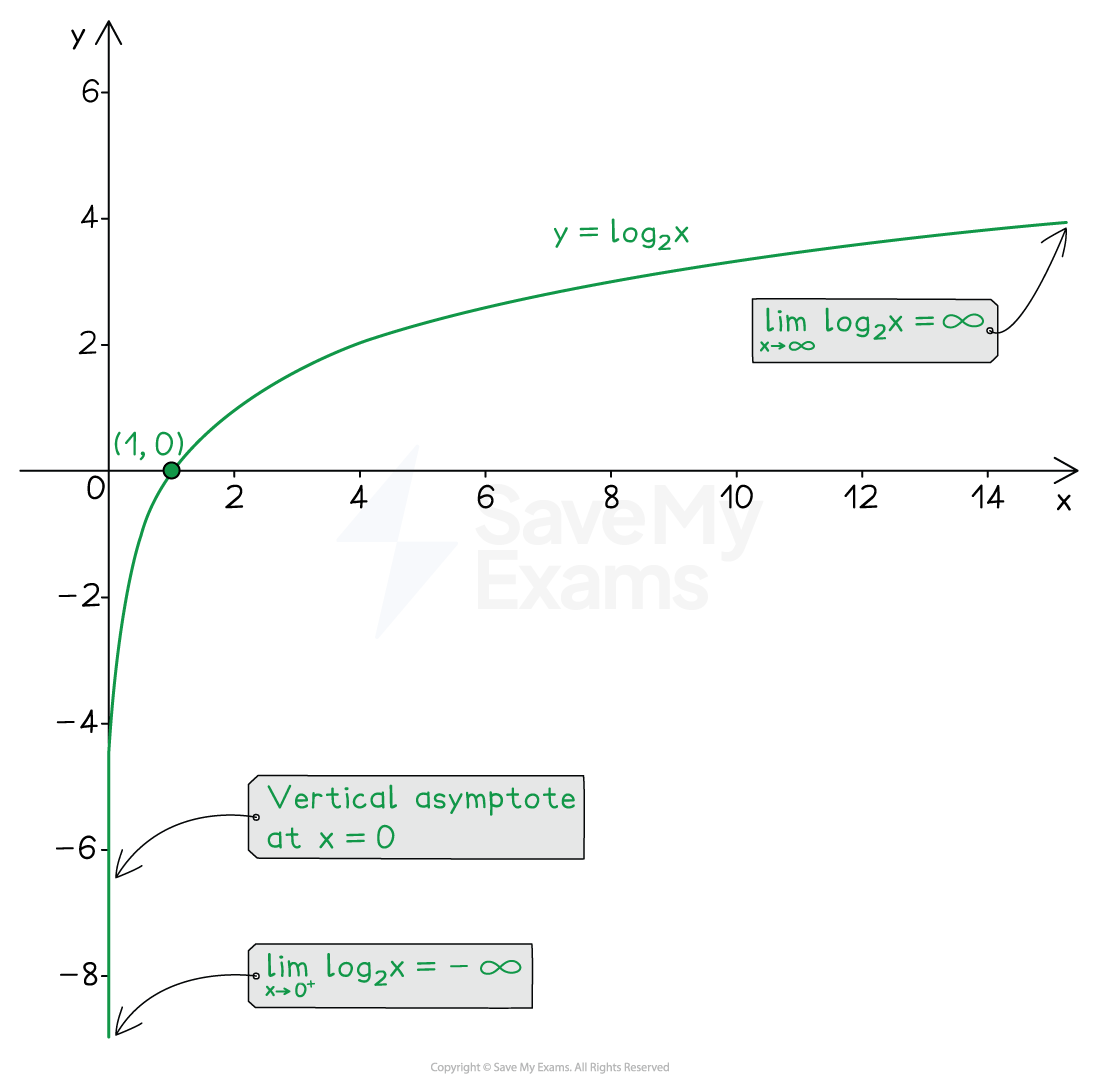
Compare this to exponential functions, which have a horizontal asymptote
The swap from horizontal to vertical asymptote is another consequence of the inverse relationship
Reflecting over the line turns horizontal asymptotes into vertical ones
Examiner Tips and Tricks
Limit notation for logarithmic end behavior is assessed on the exam.
Make sure you are comfortable writing expressions like and .
Note the "" notation in the first limit, indicating approach from the right (positive side) only
This is necessary since the function is not defined for
How can you identify a 'hidden' logarithmic function?
Just as with exponential functions, data may not immediately appear to be logarithmic because of a shift
For a logarithmic function in general form
the input values change proportionally
over equal-length output-value intervals
This is the "reversed" version of the exponential property, where output values change proportionally over equal-length input intervals
If an additive transformation (where ) is applied to a logarithmic function in general form
the transformed function no longer has this proportional-input property
However, if you encounter any function where an additive transformation does produce proportional input values over equal-length output intervals
that's a signal that the function can be modeled as a translation of a logarithmic function
E.g. consider the following table of input-output values
5 | 8 | 14 | 26 | 50 | |
3 | 4 | 5 | 6 | 7 |
The outputs increase by 1 each time
and the corresponding inputs are
The inputs are not proportional
But subtracting 2 from each input gives
and , which is a constant ratio
So the data in the table can be modeled by a horizontal translation of a logarithmic function
I.e.
where is a logarithmic function
possibly with a vertical translation as well to produce those precise output values
Examiner Tips and Tricks
The characteristics of logarithmic functions mirror those of exponential functions in many ways.
If you understand one, you can often deduce the other by thinking about the inverse relationship.
swapping inputs and outputs
swapping domain and range
swapping horizontal and vertical asymptotes
Worked Example
The function is given by .
(a) State the domain of .
(b) Determine whether is increasing or decreasing. Justify your answer.
(c) Describe the end behavior of as increases without bound. Express your answer using the mathematical notation of a limit.
(d) Describe the behavior of near its vertical asymptote. Express your answer using the mathematical notation of a limit.
Answer:
(a)
The domain of is (all positive real numbers), since the input to a logarithm must be positive
(b)
The base is , so is an increasing function
However, the coefficient is negative, which reflects the graph over the -axis and reverses the direction
Therefore is decreasing
(c)
As increases without bound, increases without bound
so decreases without bound.
(d)
The function has a vertical asymptote at
As approaches 0 from the right, decreases without bound (becomes very negative)
so increases without bound (becomes very positive)

Unlock more, it's free!
Join the 100,000+ Students that ❤️ Save My Exams
the (exam) results speak for themselves:

Was this revision note helpful?
Build on this topic