The Tangent Function (College Board AP® Precalculus): Revision Note

Roger B

Written by: Roger B

Reviewed by: Mark Curtis

Updated on

The tangent function & the unit circle

How is the tangent function defined using the unit circle?

  • Given an angle theta in standard position and a unit circle centered at the origin

    • the terminal ray intersects the circle at a point P

  • The value of the tangent function, space f left parenthesis theta right parenthesis equals tan theta

    • is given by the slope of the terminal ray

  • This connects directly to the unit circle coordinates of point P

    • P has coordinates left parenthesis cos theta comma sin theta right parenthesis

    • So the slope of a line through the origin open parentheses 0 comma space 0 close parentheses and the point P is

      • text slope end text equals fraction numerator sin theta minus 0 over denominator cos theta minus 0 end fraction equals fraction numerator sin theta over denominator cos theta end fraction

  • Therefore

    • tan theta equals fraction numerator sin theta over denominator cos theta end fraction comma    text where  end text cos theta not equal to 0

  • This slope interpretation means

    • When the terminal ray is steep and rising

      • \tan\theta is a large positive number

    • When the terminal ray is horizontal (along the x-axis)

      • \tan\theta = 0

    • When the terminal ray is steep and falling

      • \tan\theta is a large negative number

    • When the terminal ray is vertical

      • the slope is undefined

      • so \tan\theta is undefined

What are the exact values of tangent for key angles?

  • Since tan theta equals fraction numerator sin theta over denominator cos theta end fraction, the exact values can be calculated from the sine and cosine values

\theta

\sin\theta

\cos\theta

\tan\theta

negative pi over 2

negative 1

0

undefined

negative pi over 3

negative fraction numerator square root of 3 over denominator 2 end fraction

\frac{1}{2}

negative square root of 3

negative pi over 4

negative fraction numerator square root of 2 over denominator 2 end fraction

\frac{\sqrt{2}}{2}

negative 1

negative pi over 6

negative 1 half

\frac{\sqrt{3}}{2}

negative fraction numerator 1 over denominator square root of 3 end fraction equals negative fraction numerator square root of 3 over denominator 3 end fraction

0

0

1

0

\frac{\pi}{6}

\frac{1}{2}

\frac{\sqrt{3}}{2}

\frac{1}{\sqrt{3}} = \frac{\sqrt{3}}{3}

\frac{\pi}{4}

\frac{\sqrt{2}}{2}

\frac{\sqrt{2}}{2}

1

\frac{\pi}{3}

\frac{\sqrt{3}}{2}

\frac{1}{2}

\sqrt{3}

\frac{\pi}{2}

1

0

undefined

  • Because tangent has a period of pi , the values repeat every pi radians

    • E.g. tan fraction numerator 7 pi over denominator 6 end fraction equals tan pi over 6 equals fraction numerator square root of 3 over denominator 3 end fraction

Key characteristics of the tangent function

What is the period of the tangent function?

  • The slope values of the terminal ray repeat every half revolution of the unit circle

    • For example, the terminal rays at \theta and \theta + \pi point in opposite directions

      • but they lie on the same line

      • and therefore have the same slope

  • Therefore the tangent function has a period of \pi:

\tan(\theta + \pi) = \tan\theta

  • This is different from sine and cosine

    • which both have a period of 2\pi

Where does the tangent function have asymptotes?

  • The tangent function is undefined when bold cos bold italic theta bold equals bold 0, which occurs at

Error converting from MathML to accessible text.

  • At these input values, the terminal ray is vertical (pointing straight up or straight down)

    • so its slope does not exist

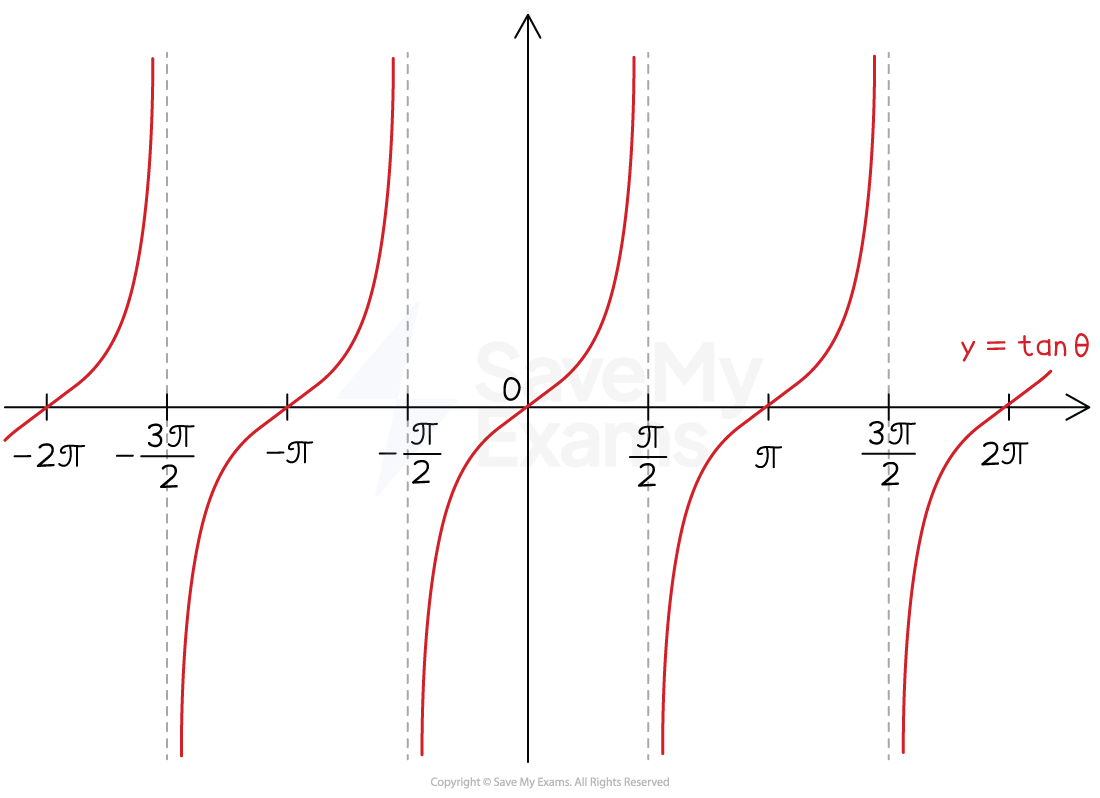
  • The graph of the tangent function has vertical asymptotes at each of these values

    • E.g. as theta approaches pi over 2 from the left, tan theta increases without bound

    • and as theta approaches pi over 2 from the right, tan theta decreases without bound

  • The tangent function therefore demonstrates periodic asymptotic behavior

    • the pattern of asymptotes repeats with the same period as the function

What is the behavior of the tangent function between consecutive asymptotes?

  • Between any two consecutive asymptotes

    • the tangent function is always increasing

  • The graph changes from concave down to concave up between consecutive asymptotes

    • Specifically, the graph is

      • concave down on the first half of the interval

      • and concave up on the second half

    • The changeover occurs at the point of inflection

      • which is where \tan\theta = 0

      • i.e. at integer multiples of \pi

  • Between consecutive asymptotes, the tangent function takes all real number output values, from -\infty to +\infty

Graph showing the tangent function y = tan θ with vertical asymptotes at odd multiples of π/2, between -2π and 2π, with curves rising and falling.
Graph of y=tanθ

Transformations of the tangent function

How do additive transformations affect the tangent function?

  • A vertical translation of the tangent function is given by g left parenthesis theta right parenthesis equals tan theta plus d

    • This shifts the graph vertically by d units

    • The line containing the points of inflection is also shifted up by d units

      • from space y equals 0 to space y equals d

    • The asymptotes are not affected by a vertical translation

  • A horizontal translation (phase shift) is given by g left parenthesis theta right parenthesis equals tan left parenthesis theta plus c right parenthesis

    • This shifts the graph horizontally by negative c units

      • to the left if c greater than 0, to the right if c less than 0

    • The asymptotes shift by negative c units as well

How do multiplicative transformations affect the tangent function?

  • A vertical dilation is given by g left parenthesis theta right parenthesis equals a tan theta

    • This stretches the graph vertically by a factor of |a|

    • If bold italic a bold less than bold 0, the graph is also reflected over the x-axis

      • this causes the function to be decreasing (instead of increasing) between consecutive asymptotes

      • and reverses the concavity pattern

    • The asymptotes and period are not affected

  • A horizontal dilation is given by g left parenthesis theta right parenthesis equals tan left parenthesis b theta right parenthesis

    • This changes the period of the function by a factor of \frac{1}{|b|}

      • The new period is \frac{\pi}{|b|}

    • If bold italic b bold less than bold 0, the graph is also reflected over the space y-axis

      • this causes the function to be decreasing (instead of increasing) between consecutive asymptotes

      • and reverses the concavity pattern

    • The asymptotes are compressed or stretched accordingly

How are all transformations combined?

  • The general form combining all transformations is space f left parenthesis theta right parenthesis equals a tan left parenthesis b left parenthesis theta plus c right parenthesis right parenthesis plus d

  • The parameters have the following effects

    • |a|: vertical dilation factor (with reflection over the x-axis if a < 0)

    • \frac{\pi}{|b|}: the period of the function

    • -c: the phase shift (horizontal translation)

    • d: the vertical shift (the new midline of the points of inflection is y = d)

  • For example, g left parenthesis theta right parenthesis equals 3 tan left parenthesis 2 left parenthesis theta minus pi over 4 right parenthesis right parenthesis plus 1 has:

    • Vertical dilation factor 3

    • Period equals pi over 2

    • Phase shift of pi over 4 to the right (since c equals negative pi over 4)

    • Vertical shift of 1 unit up

Examiner Tips and Tricks

When identifying the period of a transformed tangent function, remember that the base period is pi, not 2 pi. A common mistake is to use the sine/cosine period formula fraction numerator 2 pi over denominator vertical line b vertical line end fraction instead of the correct tangent period formula fraction numerator pi over denominator vertical line b vertical line end fraction.

Worked Example

The function g is defined by g left parenthesis theta right parenthesis equals negative 2 tan blank open parentheses theta over 3 close parentheses plus 4 space.

(a) Find the period of g.

Answer:

The function has the form a tan left parenthesis b theta right parenthesis plus d where b equals 1 third

  • So the period of the tangent function is

fraction numerator pi over denominator vertical line b vertical line end fraction equals fraction numerator pi over denominator 1 third end fraction equals 3 pi

period equals 3 pi

(b) Find the equations of two consecutive vertical asymptotes of the graph of g.

Answer:

The asymptotes of space y equals tan theta occur at theta equals pi over 2 plus k pi

For g left parenthesis theta right parenthesis equals negative 2 tan blank open parentheses theta over 3 close parentheses plus 4 space, asymptotes occur when

theta over 3 equals pi over 2 plus k pi

  • i.e. when

\theta = \frac{3\pi}{2} + 3k\pi

So a possible set of two consecutive asymptotes (using k = 0 and k = 1) is

theta equals fraction numerator 3 pi over denominator 2 end fraction plus 3 open parentheses 0 close parentheses pi equals fraction numerator 3 pi over denominator 2 end fraction

text and end text    theta equals fraction numerator 3 pi over denominator 2 end fraction plus 3 open parentheses 1 close parentheses pi equals fraction numerator 9 pi over denominator 2 end fraction

theta equals fraction numerator 3 pi over denominator 2 end fraction space space space and space space space theta equals fraction numerator 9 pi over denominator 2 end fraction

(c) Find the coordinates of the point of inflection of the graph of g that lies between the two asymptotes found in part (b).

Answer:

The point of inflection lies midway between the two consecutive asymptotes

theta equals 1 half open parentheses fraction numerator 3 pi over denominator 2 end fraction plus fraction numerator 9 pi over denominator 2 end fraction close parentheses equals 1 half cross times fraction numerator 12 pi over denominator 2 end fraction equals 3 pi

At a point of inflection of a transformed tangent function, the tangent part equals zero, so

g left parenthesis 3 pi right parenthesis equals negative 2 tan blank open parentheses fraction numerator 3 pi over denominator 3 end fraction close parentheses plus 4 equals negative 2 tan left parenthesis pi right parenthesis plus 4 equals negative 2 left parenthesis 0 right parenthesis plus 4 equals 4 space

Therefore

The point of inflection is left parenthesis 3 pi comma   space 4 right parenthesis

Unlock more, it's free!

Join the 100,000+ Students that ❤️ Save My Exams

the (exam) results speak for themselves:

Roger B

Author: Roger B

Expertise: Maths Content Creator

Roger's teaching experience stretches all the way back to 1992, and in that time he has taught students at all levels between Year 7 and university undergraduate. Having conducted and published postgraduate research into the mathematical theory behind quantum computing, he is more than confident in dealing with mathematics at any level the exam boards might throw at you.

Mark Curtis

Reviewer: Mark Curtis

Expertise: Maths Content Creator

Mark graduated twice from the University of Oxford: once in 2009 with a First in Mathematics, then again in 2013 with a PhD (DPhil) in Mathematics. He has had nine successful years as a secondary school teacher, specialising in A-Level Further Maths and running extension classes for Oxbridge Maths applicants. Alongside his teaching, he has written five internal textbooks, introduced new spiralling school curriculums and trained other Maths teachers through outreach programmes.