Function Basics (College Board AP® Precalculus): Study Guide

Function basics
What is a function?
A function is a mathematical relation that maps a set of input values to a set of output values
Each input value is mapped to exactly one output value
E.g. in the relation , is a function
because for any value of you put in, you get exactly one output value out
If a single input value can produce more than one output value, then the relation is not a function
E.g. the relation is not a function of
because for the input
there are two output values: and
What are the domain and range of a function?
The domain of a function is the set of all input values
The variable representing input values is called the independent variable
The range of a function is the set of all output values
The variable representing output values is called the dependent variable
It is called the dependent variable because its value depends on the value chosen for the independent variable
E.g. consider the function given by , defined for
The domain is
The range is
The square of any real number is positive, so cannot take on values less than zero
is the independent variable
and (or , where ) is the dependent variable
The function takes any value in its domain
and maps it to the value in its range

When are two functions equal?
Two functions and are equal when both of the following are true
they have the same domain
for every input value in that domain, they produce the same output value
that is, for every in the domain
Both conditions are required
Two functions with the same rule but different domains are not equal
E.g. with domain all real numbers, and with domain , are not equal functions, because their domains are different
Two functions that are written differently can still be equal, provided they share the same domain and give the same output for every input in it
E.g. and , both with domain all real numbers, are equal functions
What are the image and preimage?
These two terms describe precisely how a function pairs inputs with outputs
The image of an input value is the single output value that the function rule produces for that input
E.g. for the function , the image of the input is the output
The preimage of an output value is the set of all input values for which the function rule produces that output
E.g. for the function , the preimage of the output is the set
because and
Note the difference between the two terms
An input value always has exactly one image
because each input maps to exactly one output
An output value may have a preimage containing one, several, or no input values
How can a function be represented?
The input and output values of a function vary in tandem according to the function rule
This rule can be expressed in four ways:
Analytically (i.e. as an equation), e.g.
Graphically, as a curve or line on a set of axes
Numerically, as a table of input-output pairs
Verbally, as a description in words, e.g. "the output is five less than three times the input"
These are all different ways of representing the same function
Being able to move between representations is a key skill in AP® Precalculus
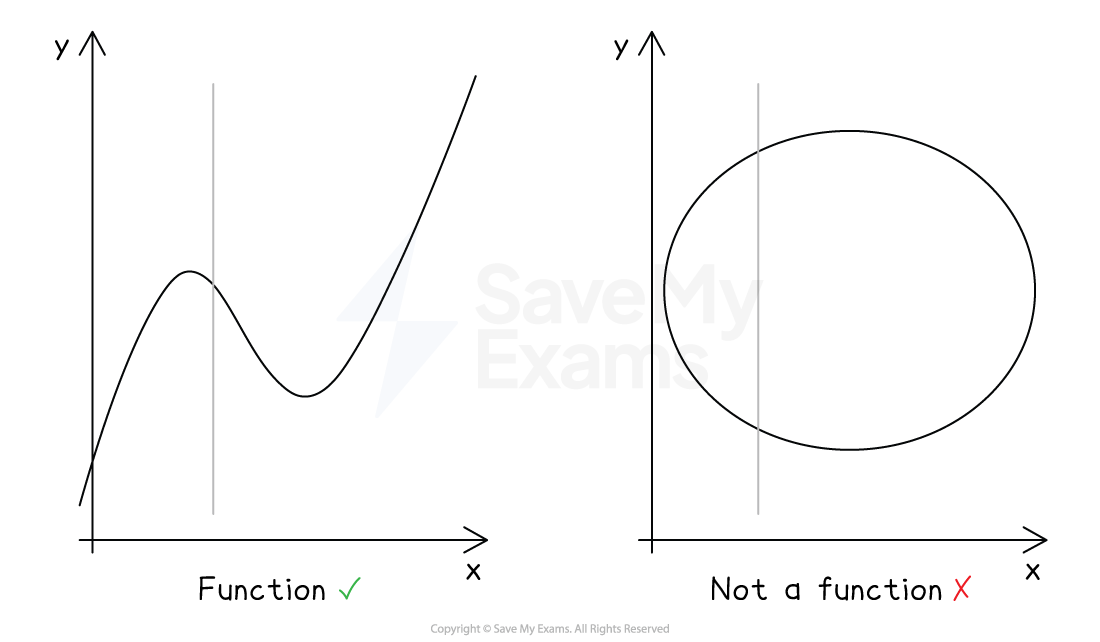
How can you tell if a graph represents a function?
Use the vertical line test
If any vertical line drawn on the graph crosses the curve at more than one point, then the graph does not represent a function
This is because a vertical line represents a single input value, and crossing more than once means that input is mapped to more than one output
Worked Example
A store is monitoring the temperature, in degrees Fahrenheit, inside a refrigerator unit after a power outage. The following table records the temperature , in degrees Fahrenheit, at time , in hours after the outage.
(hours) | 0 | 1 | 2 | 3 | 4 |
(°F) | 35 | 38 | 44 | 53 | 65 |
(a) Find . Describe the meaning of this value in the context of the problem.
(b) Describe how the temperature and time are varying in tandem. Is the temperature increasing or decreasing as time increases?
(c) In the context of the problem, identify the independent variable and the dependent variable.
Answer:
(a)
. This means that 3 hours after the power outage, the temperature inside the refrigerator unit is 53°F.
(b)
As the input values (time) increase, the output values (temperature) also increase. The temperature and time are increasing in tandem, i.e. as more time passes since the outage, the temperature inside the refrigerator gets higher.
(c)
The independent variable is (time in hours), and the dependent variable is (temperature in °F).
Worked Example
The function is defined by , with domain .
Find the range of .
Answer:
The domain of this function is only the five values given.
Find the output value for each input value in the domain:
The range is the set of output values
The range is
Examiner Tips and Tricks
In the second Worked Example, note that although , the value 4 is only listed once in the range.
Two different inputs mapping to the same output is allowed for a function.
It is only one input mapping to two different outputs that is not allowed

Unlock more, it's free!
Join the 100,000+ Students that ❤️ Save My Exams
the (exam) results speak for themselves:

Was this revision note helpful?
Build on this topic