Vertical Asymptotes of Rational Functions (College Board AP® Precalculus): Study Guide

Vertical asymptotes of rational functions
What is a vertical asymptote of a rational function?
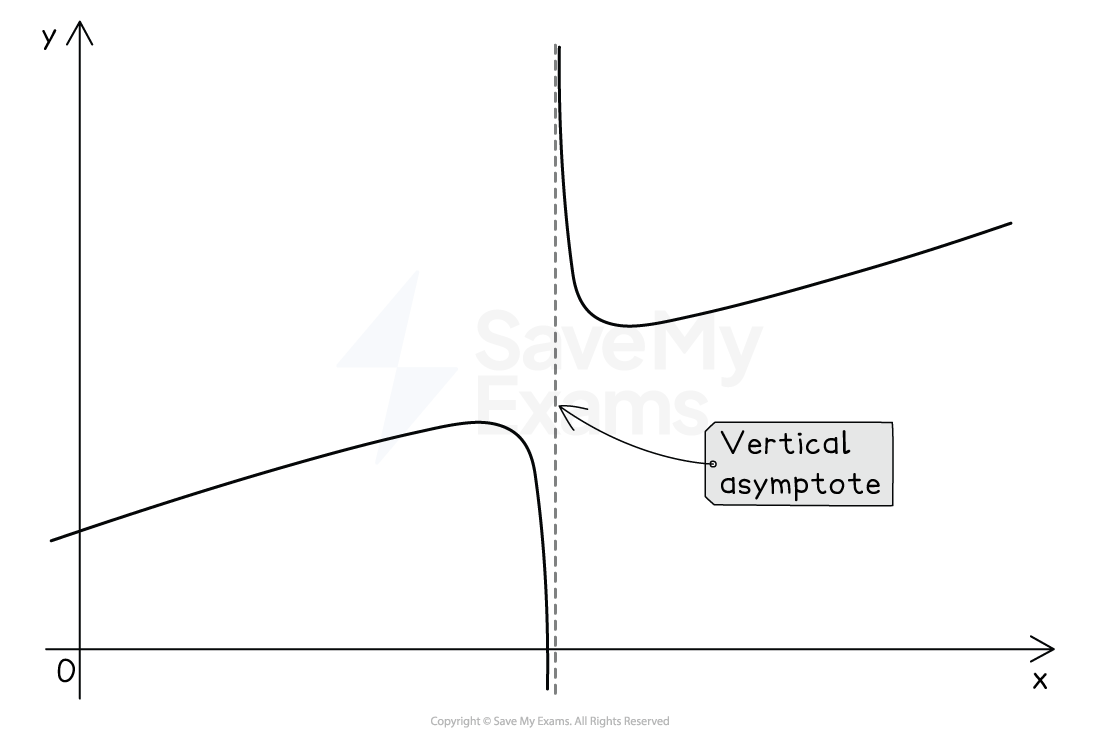
A vertical asymptote is often represented by a dashed vertical line on a graph
For a rational function, it corresponds to an input value for which the function is not defined
However the graph of the function approaches closer and closer to the line from either side
It is a boundary for the graph of the function, rather than a part of the graph itself
Where do vertical asymptotes occur in rational functions?
Let be a rational function
i.e. where and are both polynomial functions
If is a real zero of , i.e. if
and if is not a real zero of , i.e. if
then the graph of has a vertical asymptote at
E.g. has a vertical asymptote at
If is also a real zero of , there can still be a vertical asymptote at
if the multiplicity of as a real zero of is greater than its multiplicity as a real zero of
E.g. has a vertical asymptote at
because the multiplicity of in the denominator (6) is greater than its multiplicity in the numerator (5)
Note that the expression can be simplified to give
If the multiplicity of as a real zero of is less than or equal to its multiplicity as a real zero of , then there is a hole at
Examiner Tips and Tricks
A vertical asymptote can only occur at an input value where the denominator of a rational function becomes zero.
But be careful, not every input value where the denominator becomes zero corresponds with a vertical asymptote.
How do I express the behavior of rational functions near vertical asymptotes using limit notation?
If is a vertical asymptote of a rational function
then near the vertical asymptote the values of the function's denominator become arbitrarily close to zero
This means that near the vertical asymptote the values of increase or decrease without bound
E.g. consider the behavior of close to
2.9 | -69 |
2.99 | -699 |
2.999 | -6999 |
2.9999 | -69999 |
3 | undefined |
3.0001 | 70001 |
3.001 | 7001 |
3.01 | 701 |
3.1 | 71 |
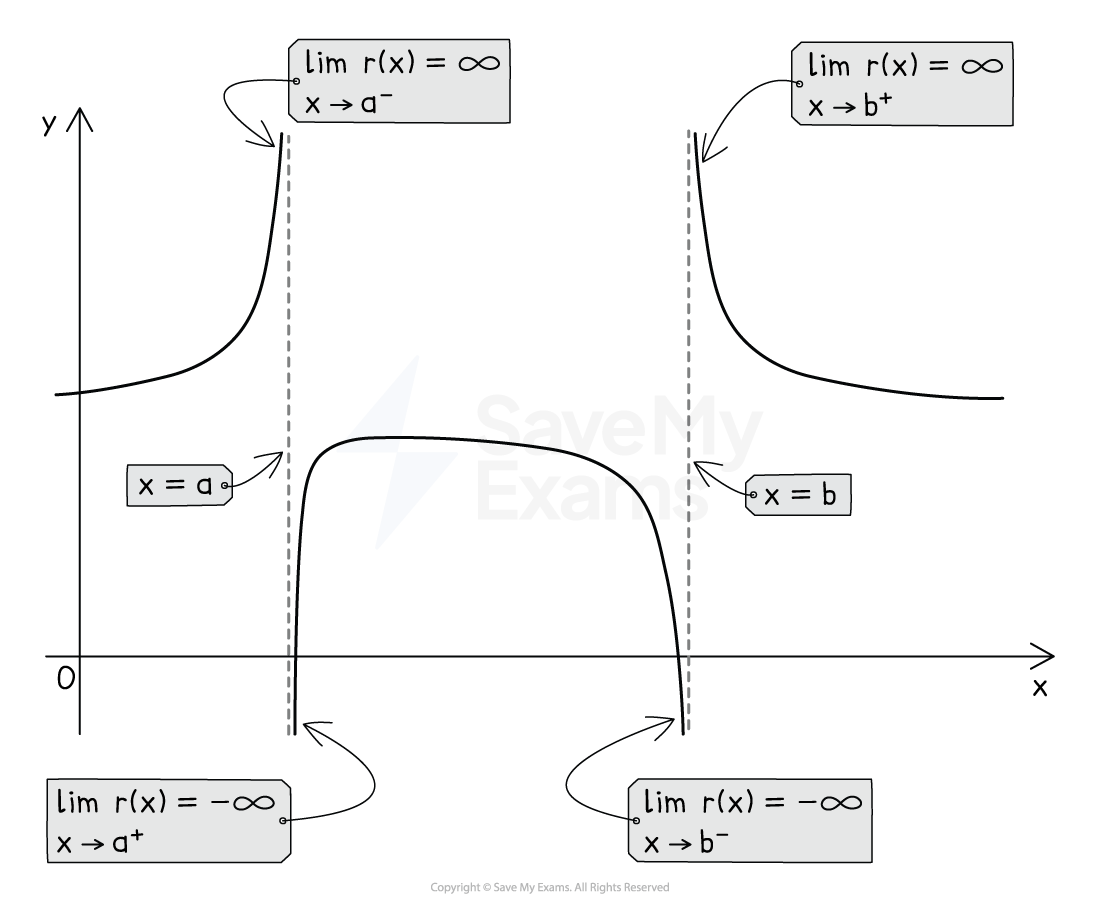
For input values near and greater than , the corresponding limit notation is
or
For input values near and less than , the corresponding limit notation is
or
can be read as "the limit as approaches from above (or from the right)"
and can be read as "the limit as approaches from below (or from the left)"
Whether a particular limit is or will depend on the precise nature of the function
How do I decide whether a limit goes to ∞ or -∞?
To decide whether the limit is or , look at values of the function near to the vertical asymptote
E.g. has a vertical asymptote at
At ,
As increases towards 3, the numerator stays positive
and the denominator stays negative (while getting closer and closer to 0)
so
At ,
As decreases towards 3, the numerator stays positive
and the denominator stays positive (while getting closer and closer to 0)
so
Worked Example
In the -plane, the graph of a rational function has a vertical asymptote at . Which of the following could be an expression for ?
(A)
(B)
(C)
(D)
Answer:
A vertical asymptote can occur where an input value makes the denominator of a rational function zero
When ,
So options (A) and (C) will both have denominators equal to zero when
But a vertical asymptote does not necessarily occur if the same input value also makes the numerator zero
In option (A), becomes when
and the expression can be simplified to
so there is no vertical asymptote at
In option (C), the numerator is not equal to zero when
so (C) has a vertical asymptote at
(C)

Unlock more, it's free!
Join the 100,000+ Students that ❤️ Save My Exams
the (exam) results speak for themselves:

Was this revision note helpful?
Build on this topic