Logarithmic Expressions (College Board AP® Precalculus): Revision Note

Definition of a logarithm
What is a logarithm?
A logarithm answers the question: "What power must I raise a base to, in order to get a particular value?"
In the expression
is the base
and is the 'particular value'
So the value of that expression represents
the exponent (power) that the base must be raised to
in order to produce the value
The base must satisfy and
The value must be positive
you cannot take the logarithm of zero or a negative number
In other words
means exactly the same thing as
These two forms (logarithmic form and exponential form) are just two equivalent ways of writing the same relationship
Here are some examples:
Logarithmic form | Exponential form | In words |
|---|---|---|
"2 raised to the power 3 gives 8" | ||
"5 raised to the power 2 gives 25" | ||
"10 raised to the power 3 gives 1000" | ||
"3 raised to the power gives " |
Examiner Tips and Tricks
Being able to move confidently between logarithmic form () and exponential form () is essential.
Many problems become much easier when you convert to whichever form is more convenient
What is the common logarithm?
When no base is written, the logarithm is understood to have base 10
This is called the common logarithm
E.g. means the same thing as
and it is equal to 2 because
The common logarithm appears frequently on calculators and in applications
How do you evaluate logarithmic expressions?
Some logarithmic values can be worked out using basic arithmetic
i.e. by thinking about what power of the base gives the desired value
E.g.
since , it follows that
E.g.
since , it follows that
E.g.
since , it follows that
Other values cannot be evaluated exactly by hand
but can be estimated using technology (a calculator)
E.g.
There is no integer or simple fraction such that exactly
But a calculator will give you the value
Examiner Tips and Tricks
Don't forget that logarithms can give negative answers (when the value is a reciprocal power of the base) and fractional answers (when the value is a root of the base).
Worked Example
Evaluate each of the following logarithmic expressions, without a calculator where possible.
(a)
(b)
(c)
(d)
Answer:
(a)
You need the power of 3 that gives 81
, , ,
So
(b)
You need the power of 10 that gives 0.01
So
(c)
You need the power of 8 that gives 2
Substitute and use laws of exponents
So
(c):
You need the power of 5 that gives 12
and , so the answer is somewhere between 1 and 2
but there is no exact value you can find by hand
Using your calculator
Round to 3 decimal places
Logarithmic scales
What is a logarithmic scale?
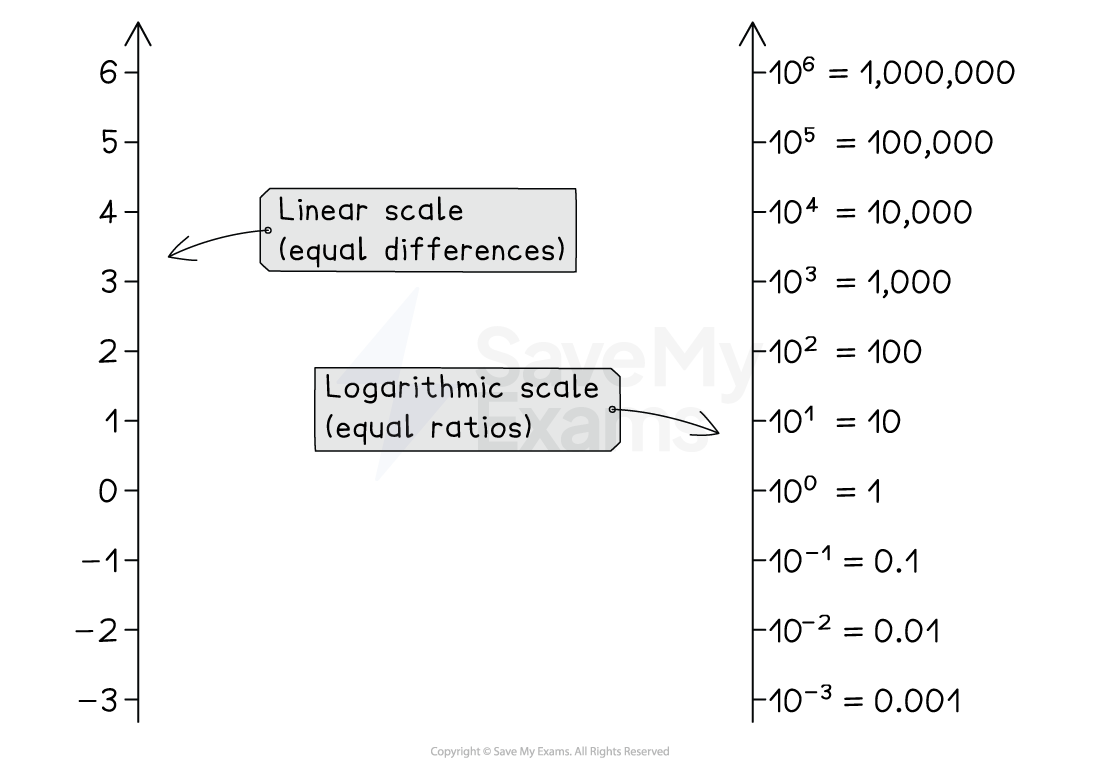
On a standard (linear) scale, each unit represents the same additive change
E.g. the marks might be at
with equal spacing between them
On a logarithmic scale, each unit represents the same multiplicative change
specifically, a multiplication by the base of the logarithm
E.g. on a base-10 logarithmic scale
the marks might be at
, , , ,
Each step along the scale multiplies the value by 10, rather than adding a fixed amount
Logarithmic scales are useful for displaying data that would otherwise span a very wide range of values
Examples of commonly-used logarithmic scales include:
earthquake magnitudes (the Richter scale)
sound intensity (decibels)
and the pH scale in chemistry
How does a logarithmic scale work?
On a logarithmic scale with base
the position of a value on the scale is its logarithm base
E.g. on a base-10 scale
the value 1 sits at position 0 (since )
the value 10 sits at position 1
the value 100 sits at position 2
etc.
Equal spacing on the scale corresponds to equal ratios in the actual values
not equal differences
E.g. the distance from 10 to 100 on a base-10 log scale is the same as the distance from 100 to 1000
both represent a multiplication by 10
Values that are close together on a linear scale (like 0.01 and 0.001) may be far apart on a logarithmic scale
and values that seem vastly different on a linear scale (like 1000 and 10,000) may be close together on a logarithmic scale

Unlock more, it's free!
Join the 100,000+ Students that ❤️ Save My Exams
the (exam) results speak for themselves:

Was this revision note helpful?
Build on this topic