Even & Odd Functions (College Board AP® Precalculus): Study Guide

Even & odd functions
What are even functions?
A function is called even if
for all values of
A polynomial function , , is even if
is even
and
So, e.g., , and are all even functions
Linear combinations of even functions are also even functions
E.g. is an even function
Not all even functions are polynomial functions
E.g.
So and are both even functions
What are odd functions?
A function is called odd if
for all values of
A polynomial function , , is odd if
is odd
and
So, e.g., , and are all odd functions
Linear combinations of odd functions are also odd functions
E.g. is an odd function
Not all odd functions are polynomial functions
E.g.
So and are both odd functions
and are also both odd functions
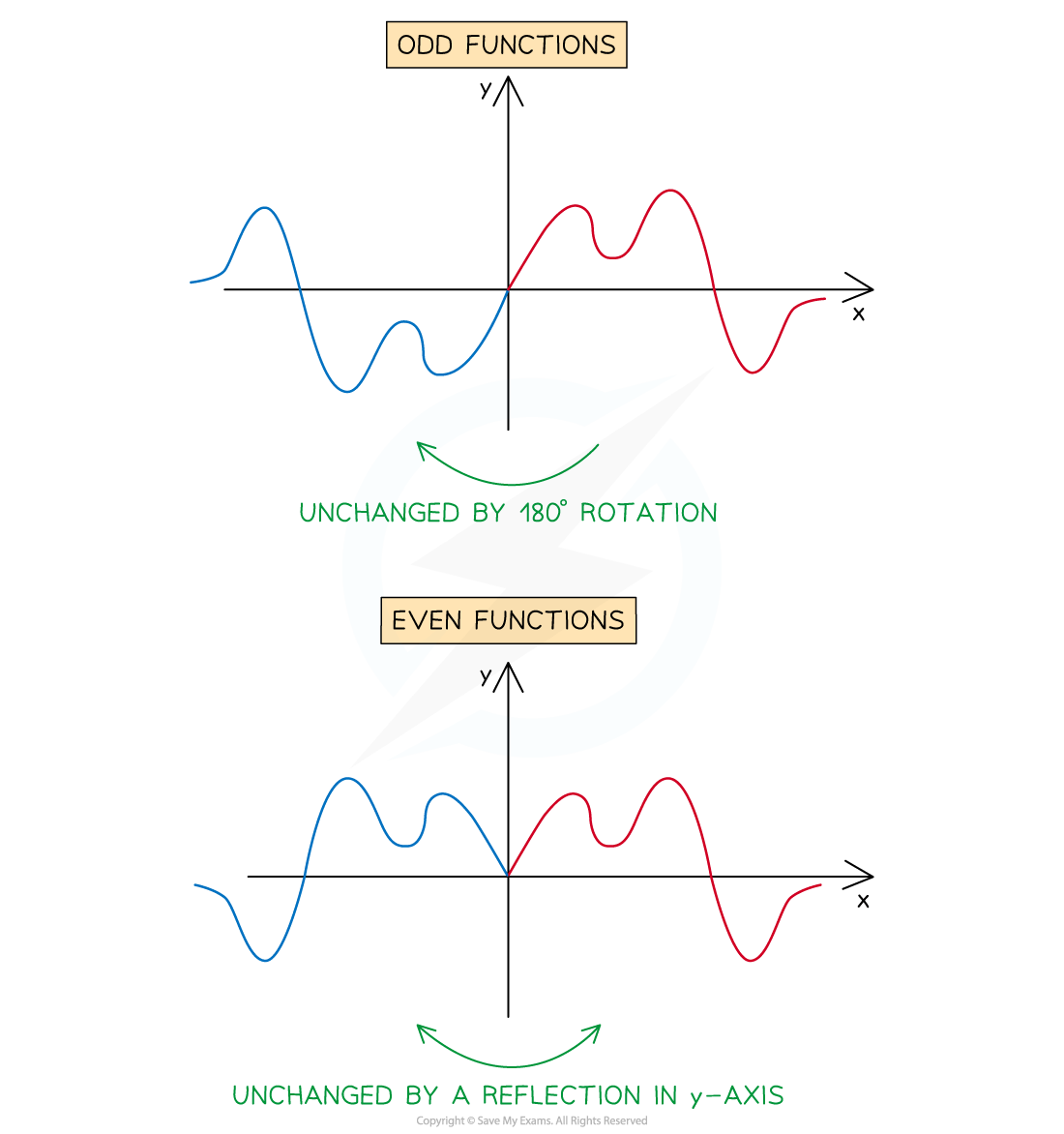
What do the graphs of even or odd functions look like?
An even function is graphically symmetric over the line
This means that its graph is unchanged by a reflection in the y-axis
If a point is on the graph, then the point is also on the graph
An odd function is graphically symmetric about the point
This means that for every point on its graph, there is a corresponding point at an equal distance but in the opposite direction through the origin
The graph is unchanged by a 180° rotation about the origin
If a point is on the graph, then the point is also on the graph
Examiner Tips and Tricks
Rotating your graphing calculator by 180° can help to check if a graph is odd!
How do local maximum and minimum points appear on graphs of even and odd functions?
The symmetry of even and odd functions means there are correspondences between local maximum and minimum points on either side of the -axis
For an even function
If is a local maximum then is also a local maximum
If is a local minimum then is also a local minimum
In both cases,
For an odd function
If is a local maximum then is a local minimum
If is a local minimum then is a local maximum
In both cases,
Worked Example
The polynomial function is an odd function. If is a relative minimum of , which of the following statements about must be true?
(A) is a relative minimum
(B) is a relative minimum
(C) is a relative maximum
(D) is a relative maximum
Answer:
An odd function is graphically symmetric about the point
This means that
i.e.
And also a minimum at corresponds to a maximum at , and vice versa
i.e. is a relative minimum, so is a relative maximum
(D) is a relative maximum
Examiner Tips and Tricks
In the Worked Example, don't be fooled by the fact that . That doesn't stop from being a relative (i.e. local) minimum and from being a relative (i.e. local) maximum.

Unlock more, it's free!
Join the 100,000+ Students that ❤️ Save My Exams
the (exam) results speak for themselves:

Was this revision note helpful?
Build on this topic