Equations & Inequalities with Sinx, Cosx and Tanx (College Board AP® Precalculus): Revision Note

Roger B

Written by: Roger B

Reviewed by: Mark Curtis

Updated on

Solving simple trigonometric equations

What are simple trigonometric equations?

  • A simple trigonometric equation is one of the form

    • sin theta equals k comma    cos theta equals k comma    text or end text    tan theta equals k

      • where k is a constant

  • The goal is to find all values of theta in a specified solution interval that make the equation true

  • Because trigonometric functions are periodic

    • there are usually infinitely many solutions to a trigonometric equation across all real numbers

    • but a question typically restricts the solution interval

      • e.g. 0 less or equal than theta less than 2 pi

How can I find an initial solution?

  • The first step is to find an initial solution

    • i.e. any one specific value of theta that satisfies the equation

  • For values of k corresponding to special angles (multiples of pi over 6 or pi over 4)

    • you can use your knowledge of exact trigonometric values from the unit circle

      • E.g. for sin theta equals fraction numerator square root of 3 over denominator 2 end fraction

      • recognize that sin pi over 3 equals fraction numerator square root of 3 over denominator 2 end fraction

        • so \theta = \frac{\pi}{3} is an initial solution

  • On a calculator part of the exam

    • you can use an inverse trigonometric function on your graphing calculator

      • E.g. for sin theta equals 0.4

        • an initial solution is theta equals sin to the power of negative 1 end exponent left parenthesis 0.4 right parenthesis almost equal to 0.4115

How can I find other solutions from the initial solution?

  • Once one solution is known, additional solutions in the interval can be found using the symmetry and periodicity of the trigonometric functions

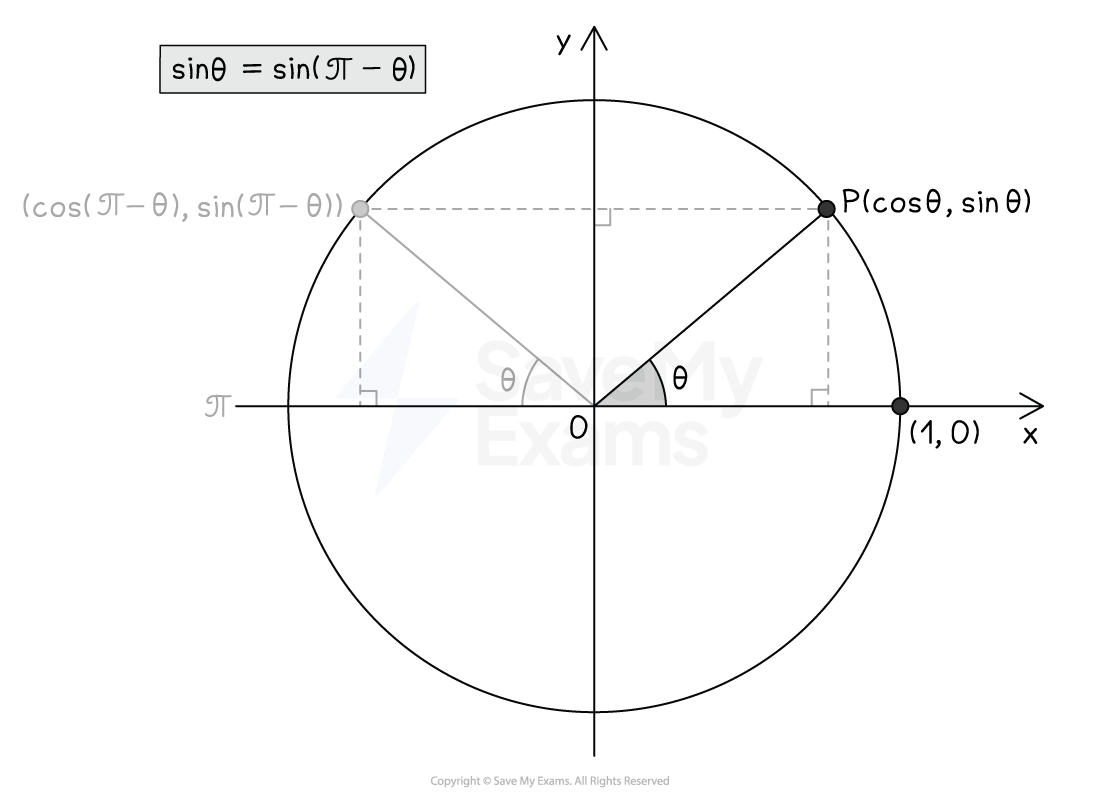
  • For sine equations (sin theta equals k)

    • If theta subscript 0 is one solution, then pi minus theta subscript 0 is another solution

      • by symmetry of the sine graph about theta equals pi over 2 in the unit circle (see diagram below)

    • All other solutions can then be obtained

      • by adding or subtracting integer multiples of 2\pi (the period) to the first two solutions

    • Note that subtracting 2 pi from pi minus theta subscript 0 gives negative pi minus theta subscript 0

      • If theta subscript 0 is in the interval open square brackets negative pi comma 0 close square brackets, this automatically gives another solution inopen square brackets negative pi comma 0 close square brackets

    • Note that adding 2 pi to pi minus theta subscript 0 gives 3 pi minus theta subscript 0

      • If theta subscript 0 is in the interval open square brackets pi comma 2 pi close square brackets, this automatically gives another solution inopen square brackets pi comma 2 pi close square brackets

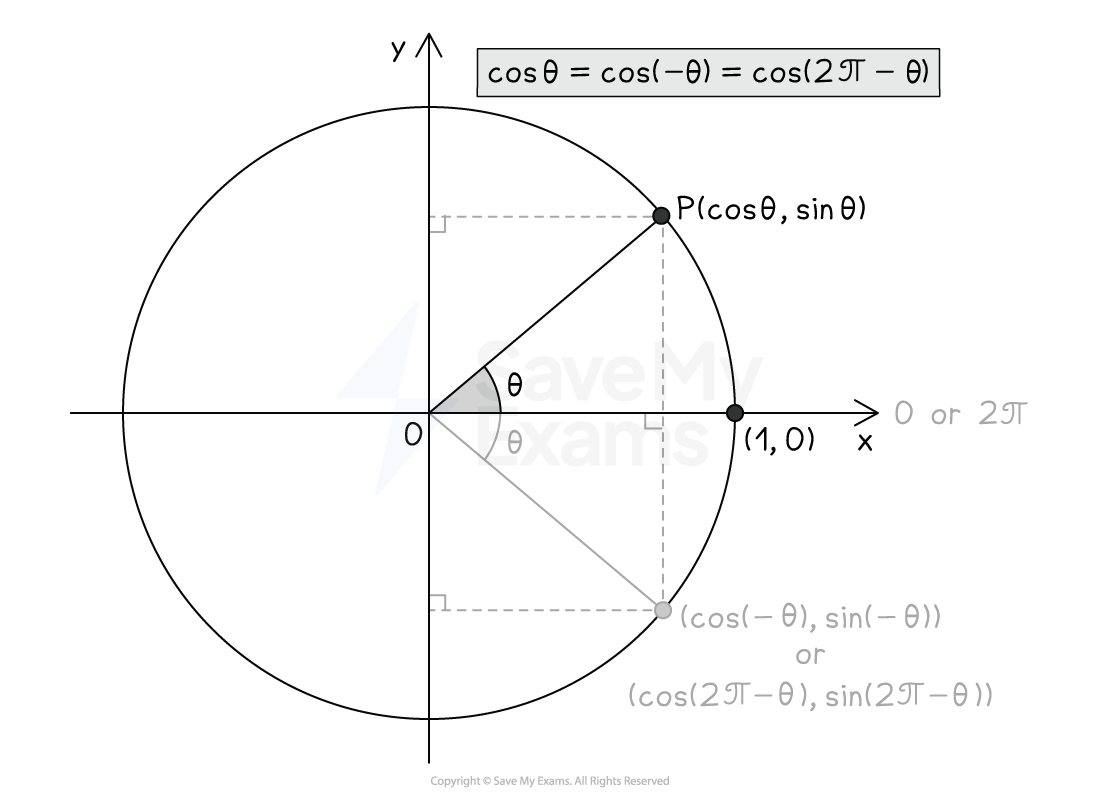
  • For cosine equations (cos theta equals k)

    • If theta subscript 0 is one solution, then negative theta subscript 0 is another solution

      • by symmetry of the cosine graph about theta equals 0 in the unit circle (see diagram below)

      • This also corresponds with cosine being an even function

        • i.e. cos open parentheses negative theta close parentheses equals cos theta in general

    • All other solutions can then be obtained

      • by adding or subtracting integer multiples of 2\pi (the period) to the first two solutions

    • Note that adding 2 pi to negative theta subscript 0 gives 2 pi minus theta subscript 0

      • If theta subscript 0 is in the interval open square brackets 0 comma 2 pi close square brackets, this automatically gives another solution inopen square brackets 0 comma 2 pi close square brackets

  • For tangent equations (tan theta equals k):

    • All other solutions differ from the principal solution by integer multiples of pi

      • since tangent has period pi

What is the general process for solving a trigonometric equation in a given interval?

  • Start by rearranging the equation (if needed) so that it has the form sin theta equals k, cos theta equals k, or tan theta equals k

    • If the equation involves a trigonometric function appearing more than once (e.g. 2 cos squared theta equals cos theta), use algebra (typically factoring) to break it into simpler equations

      • 2 cos squared theta minus cos theta equals 0 space rightwards double arrow space cos theta open parentheses 2 cos theta minus 1 close parentheses equals 0 space rightwards double arrow space cos theta equals 0 space or space cos theta equals 1 half

  • Next find an initial solution

    • using exact values or a calculator

  • Then use symmetry and periodicity

    • to find all other solutions in the specified interval

  • Finally check that all solutions are within the given interval

    • and discard any that are not

Examiner Tips and Tricks

When a question gives a specific solution interval (e.g. 0 \leq \theta < 2\pi or -\pi \leq \theta \leq \pi), be careful to include all solutions within that interval, and only those.

  • A common error is to find the principal solution and stop, missing other solutions that come from symmetry or periodicity

Sketching the unit circle (or the relevant trig graph) and marking the solutions visually is a reliable way to check that you have found all of them.

How can the symmetry properties be visualized?

  • The unit circle is the most reliable tool for visualizing how many solutions exist and where they are

  • For sin theta equals k (with negative 1 less than k less than 1, k not equal to 0)

    • there are two solutions in any interval of length 2 pi

    • located symmetrically across the vertical line theta equals pi over 2

      • If sin theta equals k, then sin open parentheses pi minus theta close parentheses equals k is also true

Unit circle diagram showing angles θ and π-θ. It includes points P(cos θ, sin θ) and (cos(π-θ), sin(π-θ)), with the identity sin θ = sin(π-θ).
Symmetry of the sine function in the unit circle
  • For cos theta equals k (with negative 1 less than k less than 1, k not equal to 0)

    • there are two solutions in any interval of length 2 pi

    • located symmetrically across the horizontal axis (i.e. \theta = 0)

      • If cos theta equals k, then cos open parentheses negative theta close parentheses equals k and cos open parentheses 2 pi minus theta close parentheses equals k are also true

Unit circle with angle θ, showing cosine symmetry. Point P at (cos θ, sin θ). Equation: cos θ = cos(−θ) = cos(2π − θ).
Symmetry of the cosine function in the unit circle
  • For \tan\theta = k

    • there is one solution in any interval of length pi

    • and all other solutions are integer multiple of pi apart

      • If tan theta equals k, then it's also true that tan open parentheses theta minus pi close parentheses equals k, tan open parentheses theta plus pi close parentheses equals k, etc.

How are 'hidden quadratic' trigonometric equations solved?

  • Some trigonometric equations are quadratics in disguise

    • They have the form of a quadratic equation

      • but with a trigonometric function in place of the variable

    • For example space 2 cos squared x plus 7 cos x plus 3 equals 0

      • has the same structure as the algebraic equation 2 y squared plus 7 y plus 3 equals 0

  • These equations can be solved using a substitution

  • E.g. to solve space 2 cos squared x plus 7 cos x plus 3 equals 0 in the interval left square bracket 0 comma 2 pi right parenthesis

    • Let space bold italic y (or another variable) stand for the trigonometric function

      • I.e. space y equals cos x

      • The equation becomes a standard quadratic in space y

        • 2 y squared plus 7 y plus 3 equals 0

    • Solve the quadratic in space y by factoring or using the quadratic formula

      • left parenthesis 2 y plus 1 right parenthesis left parenthesis y plus 3 right parenthesis equals 0, giving space y equals negative 1 half or space y equals negative 3

    • Substitute the trigonometric function back in

      • space cos x equals negative 1 half or space cos x equals negative 3

    • Some solutions may need to be rejected

      • For sine and cosine, only values with negative 1 less or equal than y less or equal than 1 are valid

        • any other value of space y corresponds to no solution and must be discarded

        • So in this case cos x equals negative 3 must be rejected

      • For tangent, all real values of space y are valid

    • cos x equals negative 1 half has initial solution x equals fraction numerator 2 pi over denominator 3 end fraction

      • which means that, by symmetry, x equals 2 pi minus fraction numerator 2 pi over denominator 3 end fraction equals fraction numerator 4 pi over denominator 3 end fraction is also a solution

    • So the only solutions to space 2 cos squared x plus 7 cos x plus 3 equals 0 space in left square bracket 0 comma 2 pi right parenthesis are x equals fraction numerator 2 pi over denominator 3 end fraction comma   fraction numerator 4 pi over denominator 3 end fraction

Worked Example

Find all values of x, for 0 \leq x < 2\pi, that satisfy the equation 2 sin squared x equals sin x.

Answer

Rearrange the equation so one side is zero

2 sin squared x minus sin x equals 0

Factor out the common factor of sin x

sin x left parenthesis 2 sin x minus 1 right parenthesis equals 0

This gives two simpler equations

sin x equals 0    text or end text    2 sin x minus 1 equals 0

Solve sin x equals 0 on left square bracket 0 comma 2 pi right parenthesis:

  • From the unit circle, sine is zero when the terminal ray is horizontal

  • In left square bracket 0 comma 2 pi right parenthesis, this occurs at

x equals 0 comma    x equals pi

Solve 2 sin x minus 1 equals 0 on left square bracket 0 comma 2 pi right parenthesis:

sin x equals 1 half

  • One solution is

x equals sin to the power of negative 1 end exponent space blank open parentheses 1 half close parentheses equals pi over 6

  • By the symmetry of sine, the other solution in [0, 2\pi) is

pi minus pi over 6 equals fraction numerator 5 pi over denominator 6 end fraction

Combining all the solutions gives

x equals 0 comma   pi over 6 comma   fraction numerator 5 pi over denominator 6 end fraction comma   pi

Worked Example

Solve each of the following equations in the interval 0 \leq x < 2\pi.

(a) space sin x equals negative 1 third

Answer:

None of the 'special angles' has a sine equal to negative 1 third

  • so use sin to the power of negative 1 end exponent on your calculator

x equals sin to the power of negative 1 end exponent open parentheses negative 1 third close parentheses equals negative 0.339836...

Use the symmetry of the sine function to find another solution

  • If theta subscript 0 is one solution, then pi minus theta subscript 0 is another solution

x equals pi minus open parentheses negative 0.339836... close parentheses equals 3.481429...

negative 0.339836... is not in the interval 0 less or equal than x less than 2 pi

  • But sine has a period of 2 pi

  • So adding 2 pi gives another valid solution that is in the interval

x equals negative 0.339836... plus 2 pi equals 5.943348...

Round the two valid answers to 3 decimal places

space x equals 3.481 comma space 5.943 space space open parentheses 3 space straight d. straight p. close parentheses

(b) space 2 plus cos x equals 1.2

Answer:

Start by rearranging to isolate cos x

cos x equals negative 0.8

None of the 'special angles' has a cosine equal to negative 0.8

  • so use cos to the power of negative 1 end exponent on your calculator

x equals cos to the power of negative 1 end exponent open parentheses negative 0.8 close parentheses equals 2.498091...

Use the symmetry of the cosine function to find another solution

  • If theta subscript 0 is one solution, then negative theta subscript 0 is another solution

x equals negative 2.498091...

negative 2.498091... is not in the interval 0 less or equal than x less than 2 pi

  • But cosine has a period of 2 pi

  • So adding 2 pi gives another valid solution that is in the interval

x equals negative 2.498091... plus 2 pi equals 3.785093...

Round the two valid answers to 3 decimal places

space x equals 2.498 comma space 3.785 space space open parentheses 3 space straight d. straight p. close parentheses

(c) space tan x equals 19

Answer:

None of the 'special angles' has a tangent equal to 19

  • so use tan to the power of negative 1 end exponent on your calculator

x equals tan to the power of negative 1 end exponent open parentheses 19 close parentheses equals 1.518213...

The tangent function has a period of pi

  • So add pi to that to give another valid solution in the interval

x equals 1.518213... plus pi equals 4.659805...

Round the two valid answers to 3 decimal places

space x equals 1.518 comma space 4.660 space space open parentheses 3 space straight d. straight p. close parentheses

Solving simple trigonometric inequalities

How can I solve a trigonometric inequality?

  • A simple trigonometric inequality has the form sin theta less than k, cos theta greater or equal than k, etc.

    • The solution is an interval (or a union of intervals) within the specified solution interval

  • In general

    • Start by solving the corresponding equation

      • i.e. with = instead of the inequality sign

      • This will give you the boundary values of \theta

    • Use a graph (or the unit circle) to determine

      • which intervals between (or outside) those boundary values satisfy the inequality

    • Finally, check the endpoints

      • Include them if the inequality is non-strict (\leq or \geq)

      • Exclude them if the inequality is strict (< or >)

How can I solve a system of trigonometric inequalities?

  • If a question requires more than one inequality to be satisfied at the same time:

    • Find the solution set for each inequality separately

    • then take the intersection

      • i.e. find the values of \theta that satisfy all of them

  • Sketching the solution intervals on a number line can help identify the intersection clearly

Worked Example

What are all values of \theta, -\pi \leq \theta \leq \pi, for which 2\sin\theta < 1 and 2\cos\theta > -\sqrt{3}?

(A) space minus pi less or equal than theta less than pi over 6

(B) space minus fraction numerator 5 pi over denominator 6 end fraction less than theta less than fraction numerator 5 pi over denominator 6 end fraction

(C) space minus fraction numerator 5 pi over denominator 6 end fraction less than theta less than pi over 6 only

(D) space pi over 6 less than theta less than fraction numerator 5 pi over denominator 6 end fraction only

Answer

Start by solving 2 sin theta less than 1 on left square bracket negative pi comma pi right square bracket

  • Rewrite as sin theta less than 1 half and solve the corresponding equation

  • sin pi over 6 equals 1 half, so

sin theta equals 1 half space space rightwards double arrow space space theta equals pi over 6

  • and by symmetry of the sine function another solution is

theta equals pi minus pi over 6 equals fraction numerator 5 pi over denominator 6 end fraction

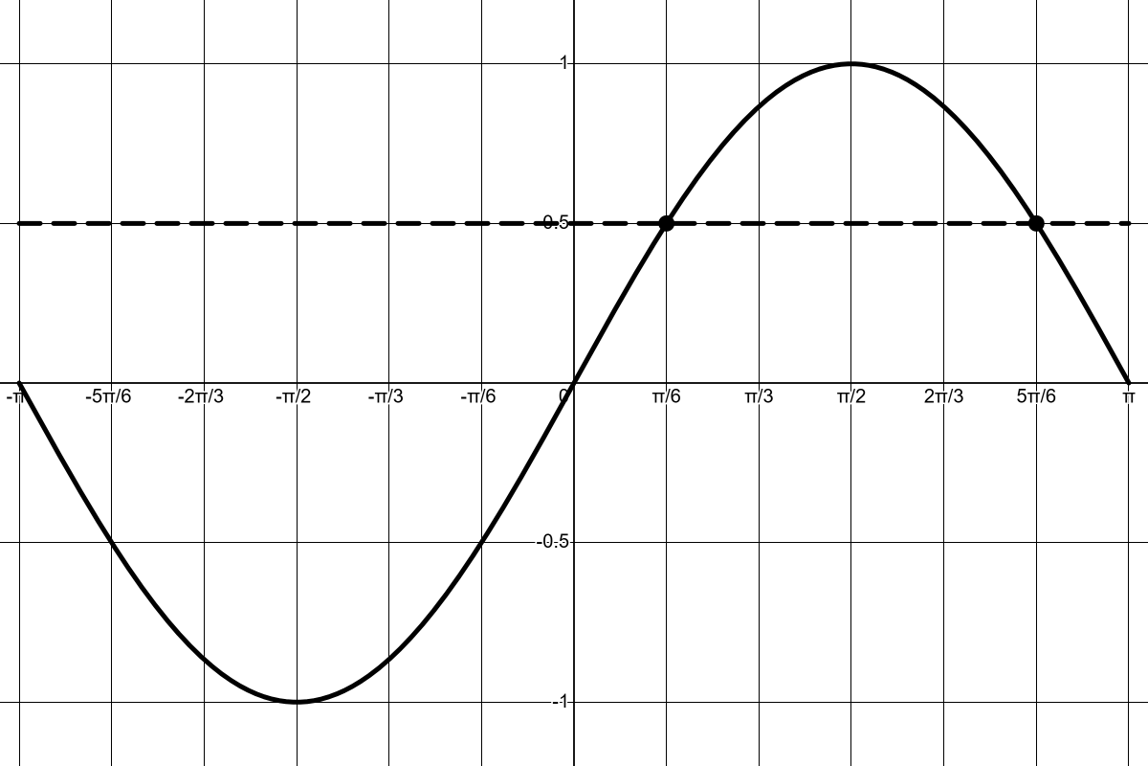
  • Sketch the sine function on [-\pi, \pi]

Graph of a sine wave from -π to π with peaks at 1 and troughs at -1, intersecting the horizontal axis at -π, 0, and π, with grid lines. The dashed horizontal line y = 0.5 is shown which intersects at pi/6 and 5*pi/6.
  • sin theta less than 1 half to the left of pi over 6 and to the right of fraction numerator 5 pi over denominator 6 end fraction

  • So the solution for sin theta less than 1 half is

\theta \in \left[-\pi,\, \frac{\pi}{6}\right) \cup \left(\frac{5\pi}{6},\, \pi\right]

Now solve 2 cos theta greater than negative square root of 3 on left square bracket negative pi comma pi right square bracket

  • Rewrite as cos theta greater than negative fraction numerator square root of 3 over denominator 2 end fraction and solve the corresponding equation

  • cos fraction numerator 5 pi over denominator 6 end fraction equals negative fraction numerator square root of 3 over denominator 2 end fraction, so

cos theta equals negative fraction numerator square root of 3 over denominator 2 end fraction space space rightwards double arrow space space theta equals fraction numerator 5 pi over denominator 6 end fraction

  • and by symmetry of the cosine function another solution is

theta equals negative fraction numerator 5 pi over denominator 6 end fraction

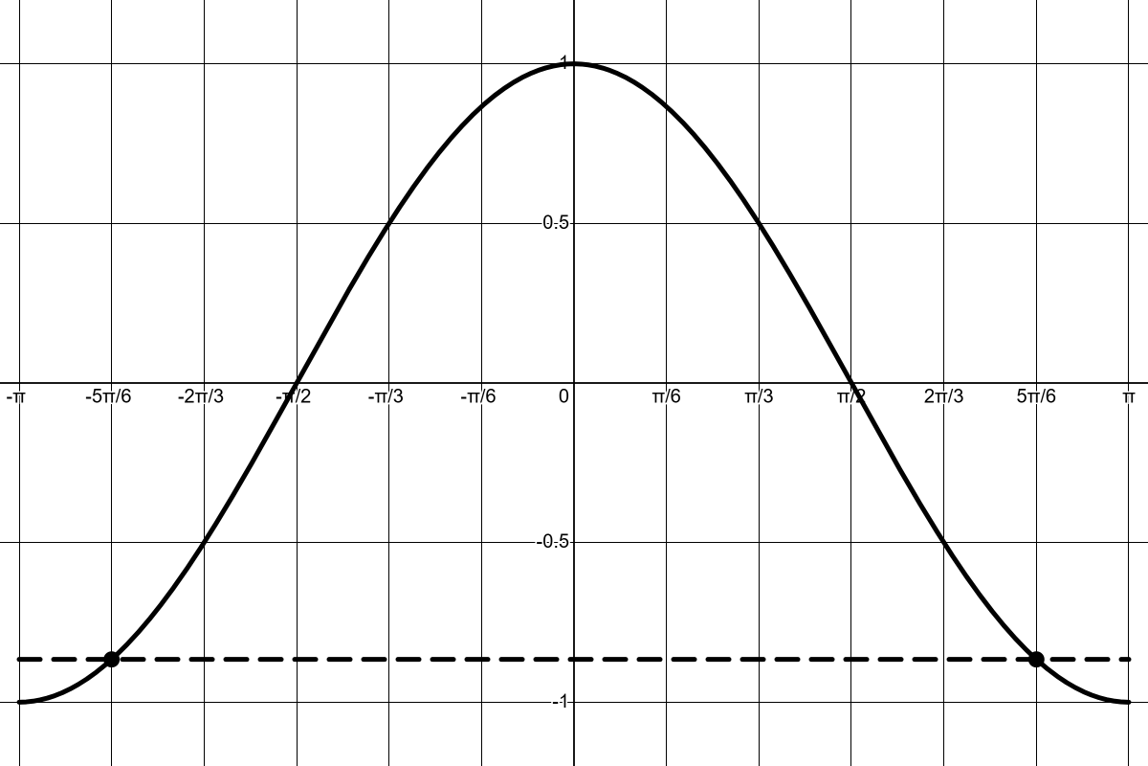
  • Sketch the cosine function on [-\pi, \pi]

Graph of a cosine wave from -π to π, peaking at 1, showing symmetrical rise and fall on a grid background.  The dashed line at y=-sqrt(3)/2 is shown, which intersects at -5*pi/6 and 5*pi/6.
  • cos theta greater than negative fraction numerator square root of 3 over denominator 2 end fraction between these two values

  • So the solution for cos theta greater than negative fraction numerator square root of 3 over denominator 2 end fraction is

\theta \in \left(-\frac{5\pi}{6},\, \frac{5\pi}{6}\right)

Finally, find the intersection of those two solution sets

  • This gives the values of \theta that satisfy both inequalities

\left[\left[-\pi,\, \frac{\pi}{6}\right) \cup \left(\frac{5\pi}{6},\, \pi\right]\right] \cap \left(-\frac{5\pi}{6},\, \frac{5\pi}{6}\right) = \left(-\frac{5\pi}{6},\, \frac{\pi}{6}\right)

  • So the solution is -\frac{5\pi}{6} < \theta < \frac{\pi}{6}

(C) space minus fraction numerator 5 pi over denominator 6 end fraction less than theta less than pi over 6 only

Unlock more, it's free!

Join the 100,000+ Students that ❤️ Save My Exams

the (exam) results speak for themselves:

Roger B

Author: Roger B

Expertise: Maths Content Creator

Roger's teaching experience stretches all the way back to 1992, and in that time he has taught students at all levels between Year 7 and university undergraduate. Having conducted and published postgraduate research into the mathematical theory behind quantum computing, he is more than confident in dealing with mathematics at any level the exam boards might throw at you.

Mark Curtis

Reviewer: Mark Curtis

Expertise: Maths Content Creator

Mark graduated twice from the University of Oxford: once in 2009 with a First in Mathematics, then again in 2013 with a PhD (DPhil) in Mathematics. He has had nine successful years as a secondary school teacher, specialising in A-Level Further Maths and running extension classes for Oxbridge Maths applicants. Alongside his teaching, he has written five internal textbooks, introduced new spiralling school curriculums and trained other Maths teachers through outreach programmes.