Combining Transformations (College Board AP® Precalculus): Revision Note

Combining transformations
What happens when transformations are combined?
The previous two study guides covered individual transformations
translations and dilations (including reflections)
In practice, functions are often transformed by several of these different transformations at once
E.g. the function
This involves
a horizontal translation
a horizontal compression
a reflection over the -axis
and a vertical translation
all applied to
To handle combined transformations correctly, you need to
identify the individual transformations
and apply them in the correct order
What are the preimage and image of a transformation?
Two terms describe the sets of points involved when transformations are applied
The preimage of the transformations is the set of points before the transformations are applied
I.e. the points on the graph of the original function
The image of the transformations is the set of points after the transformations are applied
I.e. the points on the graph of the transformed function
E.g. for the combined transformation
the preimage is the set of points on the graph of
the image is the set of points on the graph of
What is the factored form of a combined transformation?
The factored form of a combined transformation is
When a transformation is written in that form, the constants , , and produce the same effects that you saw in the study guides for the individual transformations
causes a vertical dilation with a scale factor of
If this also causes a reflection over the -axis
causes a horizontal dilation with a scale factor of
If this also causes a reflection over the -axis
causes a horizontal translation by units
If it is a translation to the left
If it is a translation to the right
causes a vertical translation by units
If it is a translation up
If it is a translation down
What order should transformations be applied in?
Make sure your combined transformation is written in factored form
Rewrite the expression if need be
Separate the transformations into two groups
Horizontal transformations
caused by and
these come from changes to the input (inside the function)
Vertical transformations
caused by and
these come from changes to the output (outside the function)
Horizontal and vertical transformations don't affect each other, so you can do either group first
Within each group, however, the order does matter
Dilations and reflections are applied first
followed by translations
So if you start with the horizontal transformations, the effects of proceed as follows
first the horizontal dilation (and possibly reflection)
This takes to
followed by the horizontal translation
This takes to
then the vertical dilation (and possibly reflection)
This takes to
and finally the vertical translation
This takes to
If you start with vertical transformations first, the end result will be the same
as long as you do the dilations and reflections before the translations in each case
How does this work in practice?
Consider the example
Start by rewriting in factored form
That is in factored form with
Starting with the horizontal transformations
First comes the horizontal dilation caused by , with scale factor
next comes the horizontal translation caused by , which translates by units to the left
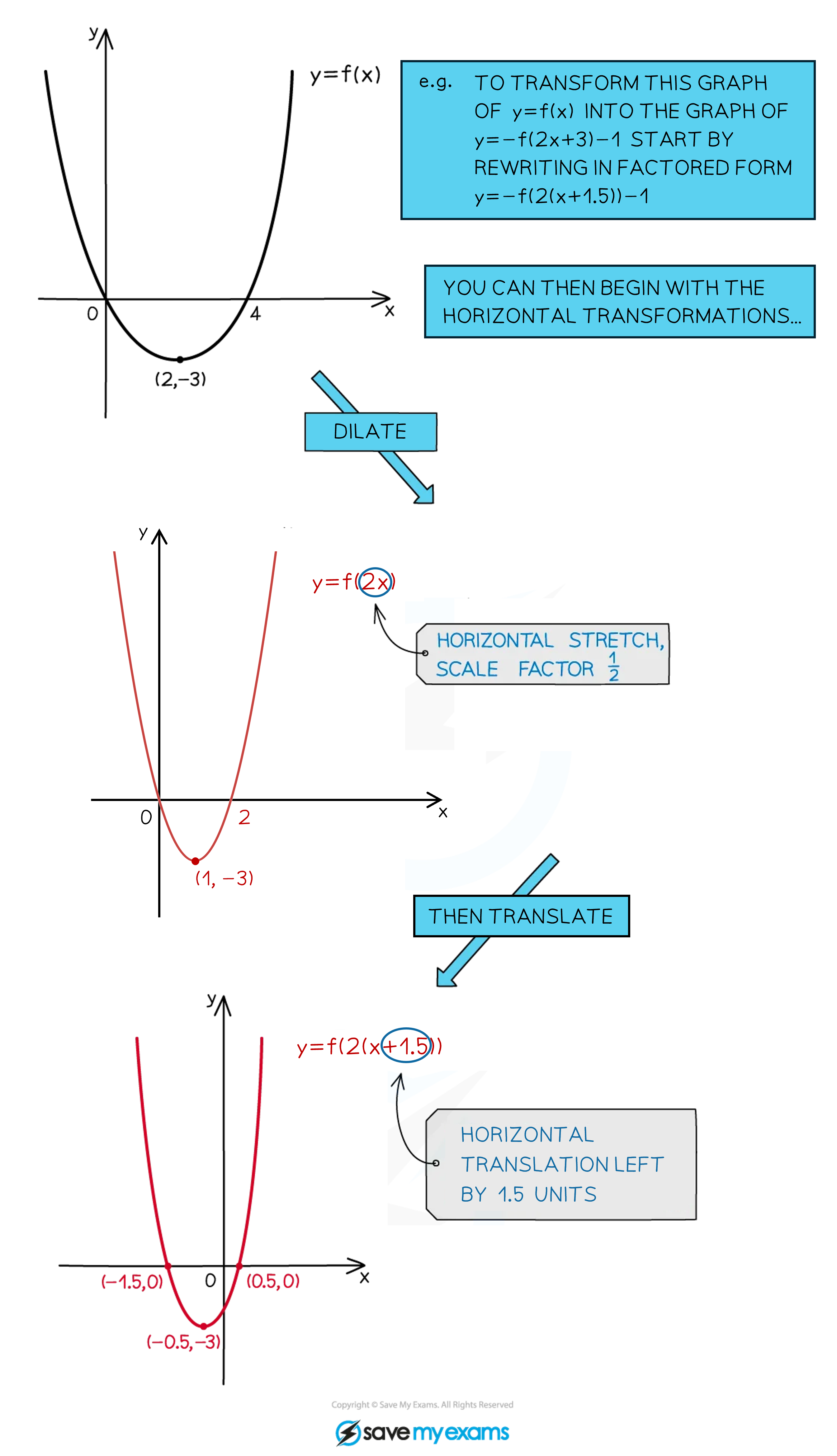
Moving on to the vertical translations
First comes the vertical reflection caused by (the scale factor is , so this doesn't affect the scale of the graph, but the negative sign causes a reflection over the -axis)
and finally the vertical translation caused by
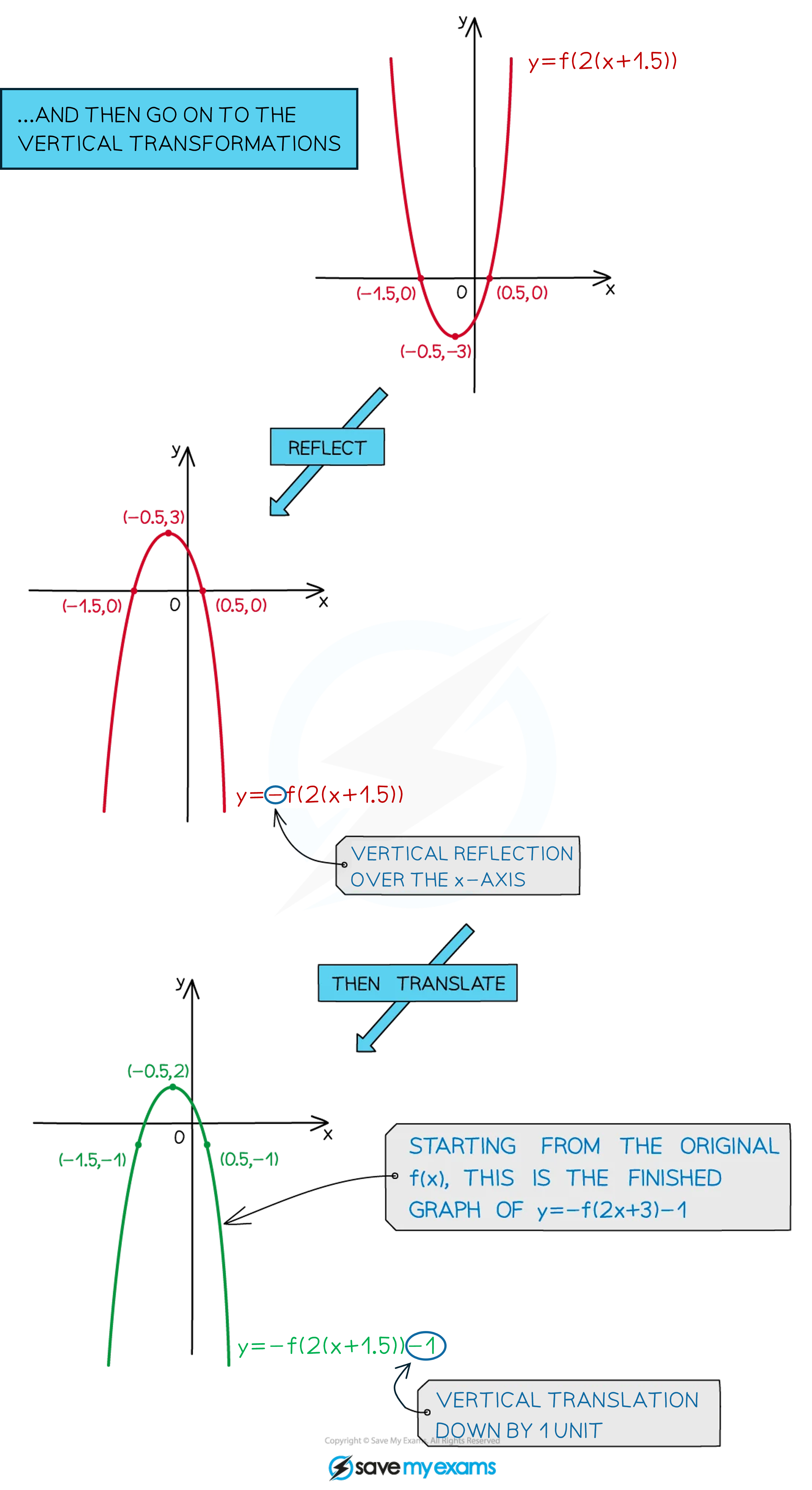
Examiner Tips and Tricks
If a combined transformation on the exam is not in factored form, rewrite it in factored form first. This helps makes the different parts of the transformation more clear.
If the question gives you a specific sequence of transformations and asks you to find the values of constants like , , and , work through each transformation one at a time and match it to the corresponding part of the expression.
Remember that, for a combined transformation in factored form, dilations and reflections are applied before translations
What if I need to apply transformations in a different order?
As long as dilations and reflections occur before translations
you can use the information above to write down a transformation in factored form
Similarly, a given combined transformation can always be rewritten in factored form
allowing you to describe the transformation with dilations and reflections preceding translations
But what if you need to find the analytical form of a transformation where translations are to be applied before dilations/reflections?
Any transformation can be created simply by
applying the appropriate individual transformations
in the specified order
Remember that horizontal and vertical transformations are independent of each other
So it is only within each category (horizontal or vertical) that the order makes a difference
E.g., the following transformations are to be applied to a function :
A horizontal translation by 5 units to the right
followed by a horizontal dilation with a scale factor of 2 and a reflection over the -axis
And a vertical translation by 4 units up
followed by a vertical dilation with a scale factor of 3
Start by subtracting 5 from the input variable
this applies the horizontal translation by 5 to the right
Then multiply the input variable by
applies the horizontal dilation by a factor of
and the minus sign gives the reflection over the -axis
Note that this doesn't affect the at all
Add 4 to the output (i.e., to the entire function)
this applies the vertical translation up by 4
Then multiply the output (i.e. the entire function) by 3
this applies the vertical dilation by a scale factor of 3
Note that that transformed function could now be rewritten in factored form
This shows that the combined transformation described above is equivalent to
a horizontal dilation by scale factor 2 with a reflection over the -axis
followed by a horizontal translation 10 units to the left
and a vertical dilation by scale factor 3
followed by a vertical translation up by 12 units
This is just another way of describing the same transformation!
Worked Example
The table gives values for a polynomial function at selected values of .
0 | 3 | 6 | |||
8 | 5 | 6 |
Let , where , , and are positive constants. In the -plane, the graph of is constructed by applying three transformations to the graph of in this order: a horizontal dilation by a factor of 3, a vertical dilation by a factor of 2, and a vertical translation by 5 units. What is the value of ?
(A)
(B)
(C)
(D)
Answer:
First, determine the constants from the given transformations:
and the scale factor of the horizontal dilation is 3
so
and the scale factor of the vertical dilation is 2
so
A vertical translation by 5 units means 5 is added to the output
So
Putting that all together
Now find
From the table , so
That is answer (C); but it's worth considering the incorrect answers as well
Option (A) is
this applies the vertical dilation but forgets the vertical translation
Option (B) is
this forgets both the vertical dilation and the vertical translation
Option (D) is
this applies the vertical translation but forgets the vertical dilation
(C)
Worked Example
The functions and are defined for all real numbers such that . Which of the following sequences of transformations maps the graph of to the graph of in the same -plane?
(A) A horizontal dilation of the graph of by a factor of 3, followed by a horizontal translation of the graph of by units
(B) A horizontal dilation of the graph of by a factor of 3, followed by a horizontal translation of the graph of by 15 units
(C) A horizontal dilation of the graph of by a factor of , followed by a horizontal translation of the graph of by 5 units
(D) A horizontal dilation of the graph of by a factor of , followed by a horizontal translation of the graph of by units
Answer:
The expression is in factored form
Reading the transformations from this form:
The factor of 3 multiplying the input means a horizontal dilation by a factor of
The inside the inner brackets means a horizontal translation by units (i.e. 5 units to the left)
With the expression in factored form, the correct order is: dilate first, then translate
You can verify this
Starting from , compress horizontally by to get
then translate left by 5 to get ✓
So (D) is the correct answer; but it's worth considering the incorrect answers as well
Options (A) and (B) use a dilation scale factor of 3 instead of
a horizontal dilation by a factor of 3 would mean the multiplier on is , not 3
Option (C) has the correct dilation but translates in the wrong direction (right instead of left)
(D) A horizontal dilation of the graph of by a factor of , followed by a horizontal translation of the graph of by units

Unlock more, it's free!
Join the 100,000+ Students that ❤️ Save My Exams
the (exam) results speak for themselves:

Was this revision note helpful?
Build on this topic