Graph of an Inverse Function (College Board AP® Precalculus): Revision Note

Roger B

Written by: Roger B

Reviewed by: Mark Curtis

Updated on

Graph of an inverse function

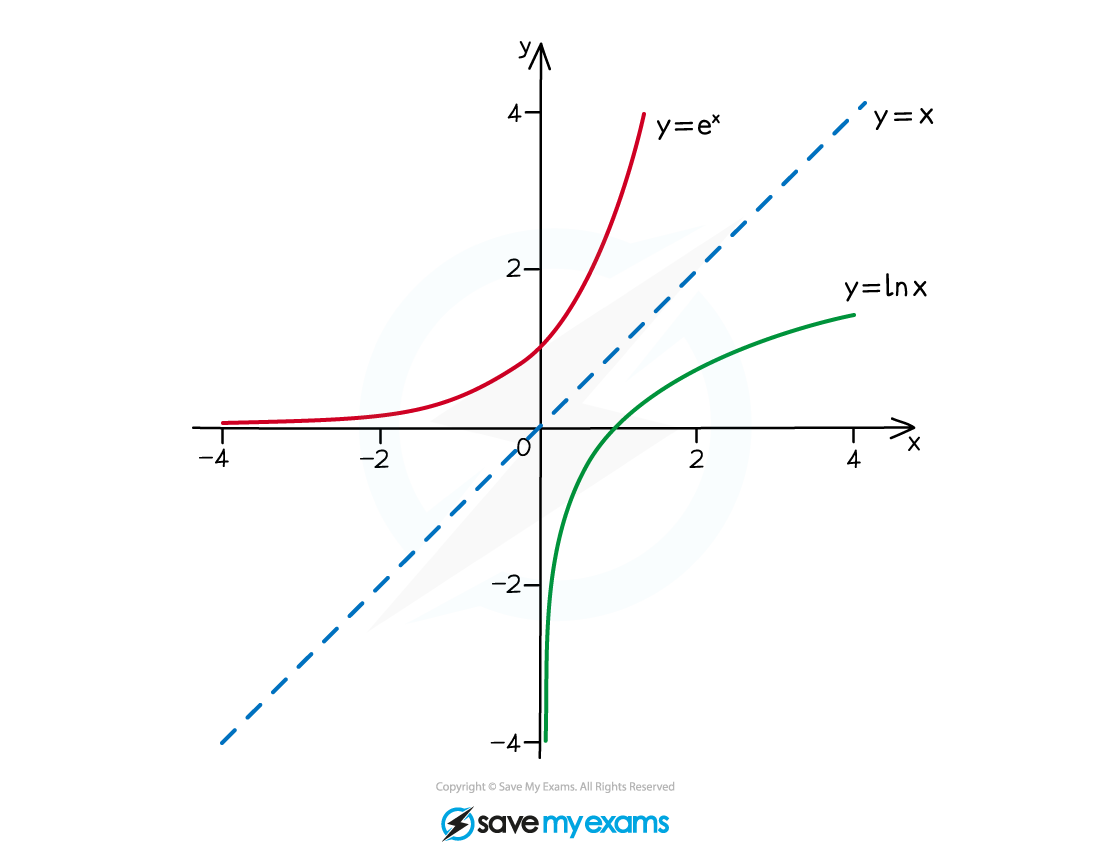
  • The graph of space y equals f to the power of negative 1 end exponent left parenthesis x right parenthesis is the reflection of the graph of space y equals f left parenthesis x right parenthesis

    • over the line space bold italic y bold equals bold italic x

  • This is because

    • reflecting a point (a, b) over the line y = x

    • gives the point (b, a)

      • which is exactly the swap of inputs and outputs that the inverse performs

  • If a point bold left parenthesis bold italic a bold comma bold italic b bold right parenthesis lies on the graph of space f,

    • then the point bold left parenthesis bold italic b bold comma bold italic a bold right parenthesis lies on the graph of space f to the power of negative 1 end exponent

  • Key features of the graph also swap:

    • x-intercepts of space f become y-intercepts of space f to the power of negative 1 end exponent

      • and vice versa

    • Vertical asymptotes of space f become horizontal asymptotes of space f to the power of negative 1 end exponent

      • and vice versa

    • If space f is increasing, then space f to the power of negative 1 end exponent is also increasing

Graph showing three curves: red curve y=e^x, green curve y=ln x, and blue dashed line y=x, all plotted on Cartesian axes from -4 to 4.
Graphs of the inverse functions e^x and lnx

Examiner Tips and Tricks

When reading inverse values from a graph of space f:

  • to find space f to the power of negative 1 end exponent left parenthesis k right parenthesis, locate k on the space y-axis (not the x-axis)

  • then read across to the curve and down to the x-axis

A common mistake is to look up k on the x-axis instead.

Worked Example

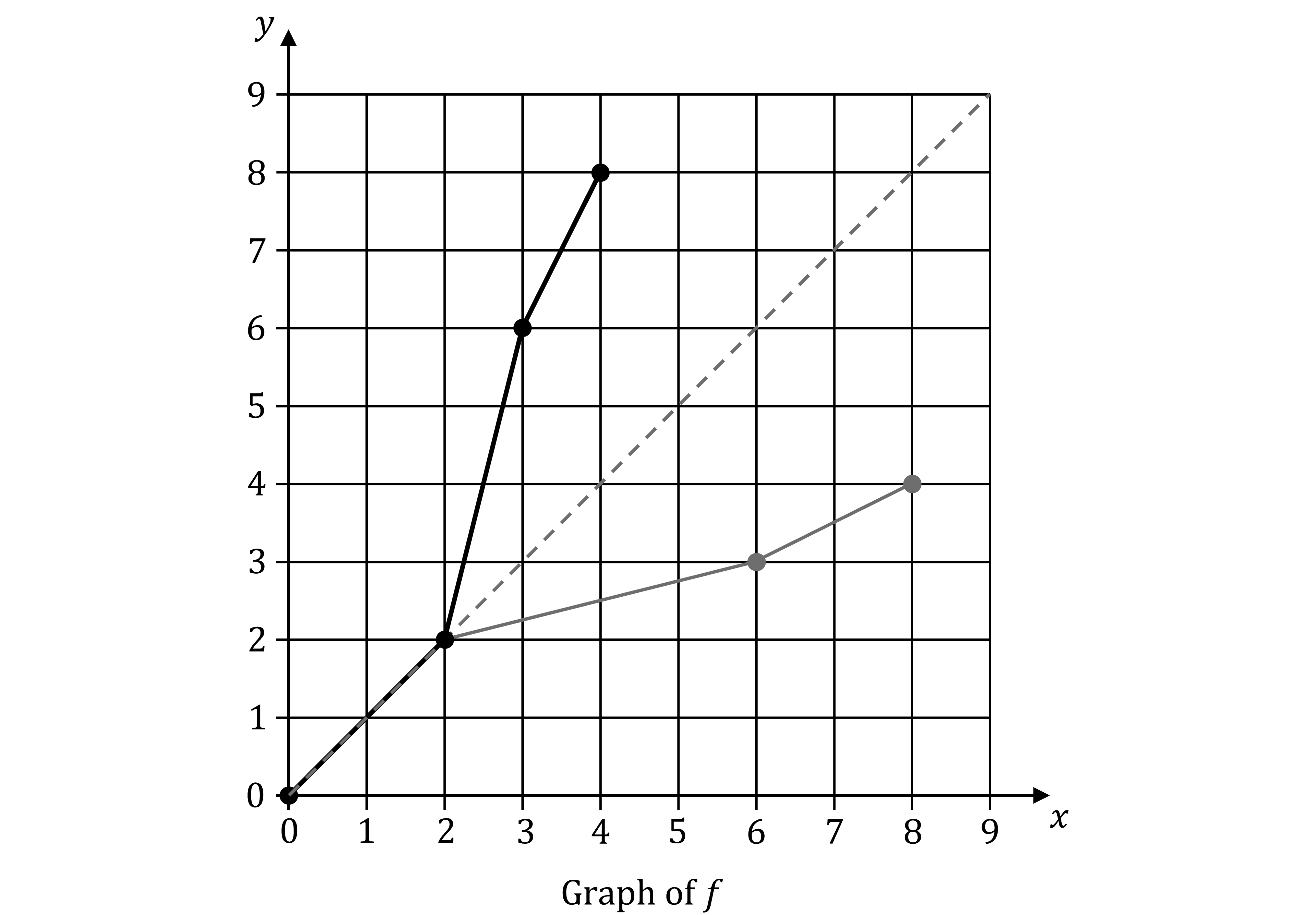
Line graph with points at (0,0), (2,2), (3,6), and (4,8) on a 9x9 grid, marked axes labelled x and y, showing an increasing trend.

The graph of the piecewise-linear function space f is shown in the figure. Let g be the inverse function of space f. What is the maximum value of g?

(A)  1 over 8

(B)  1 fourth

(C)  space 4

(D)  space 8

Answer:

The graph of an function's inverse is a reflection of the graph of the function over the line y equals x

  • Sketch the reflection of the graph of space f

    • point open parentheses 3 comma 6 close parentheses goes to open parentheses 6 comma 3 close parentheses

    • point open parentheses 4 comma 8 close parentheses goes to open parentheses 8 comma 4 close parentheses

The graph from the question, with the dashed line y=x added, along with line segments from (2,2) to (6,3), and from (6,3) to (8,4).

You can see from the sketch that the maximum value of g occurs at the point open parentheses 8 comma space 4 close parentheses

(C)  space 4

Unlock more, it's free!

Join the 100,000+ Students that ❤️ Save My Exams

the (exam) results speak for themselves:

Roger B

Author: Roger B

Expertise: Maths Content Creator

Roger's teaching experience stretches all the way back to 1992, and in that time he has taught students at all levels between Year 7 and university undergraduate. Having conducted and published postgraduate research into the mathematical theory behind quantum computing, he is more than confident in dealing with mathematics at any level the exam boards might throw at you.

Mark Curtis

Reviewer: Mark Curtis

Expertise: Maths Content Creator

Mark graduated twice from the University of Oxford: once in 2009 with a First in Mathematics, then again in 2013 with a PhD (DPhil) in Mathematics. He has had nine successful years as a secondary school teacher, specialising in A-Level Further Maths and running extension classes for Oxbridge Maths applicants. Alongside his teaching, he has written five internal textbooks, introduced new spiralling school curriculums and trained other Maths teachers through outreach programmes.