Inverse & Reciprocal Trigonometric Functions (College Board AP® Precalculus): Exam Questions

43 mins30 questions
1
Sme Calculator
1 mark

The function  f models the horizontal displacement, in centimeters, of a point on the edge of a rotating wheel from its center vertical axis as a function of the wheel's angle of rotation θ, in radians. Which of the following best describes the meaning of  f1(2.5) in this context?

  • The angle of rotation, in radians, for which the point has a horizontal displacement of 2.5 centimeters

  • The horizontal displacement, in centimeters, of the point when the angle of rotation is 2.5 radians

  • The reciprocal of the horizontal displacement, in centimeters, of the point when the angle of rotation is 2.5 radians

  • The time, in seconds, it takes for the wheel to rotate such that the point has a horizontal displacement of 2.5 centimeters

2
Sme Calculator
1 mark

What is the exact value of cot(7π6)?

  • 3

  • 33

  • 33

  • 3

3
Sme Calculator
1 mark

What is the exact value of csc(π6)?

  • 12

  • 33

  • 32

  • 2

4
Sme Calculator
1 mark

What is the exact value of cos1(12)?

  • π3

  • π3

  • 2π3

  • 4π3

5
Sme Calculator
1 mark

What is the exact value of cos1(sin(4π3)) ?

  • π6

  • 5π6

  • 7π6

  • 4π3

6
Sme Calculator
1 mark

An angle θ is in standard position in the xy-plane. It is known that sinθ=513 and the terminal ray of θ lies in Quadrant II. What is the exact value of cotθ ?

  • 125

  • 512

  • 512

  • 125

7
1 mark
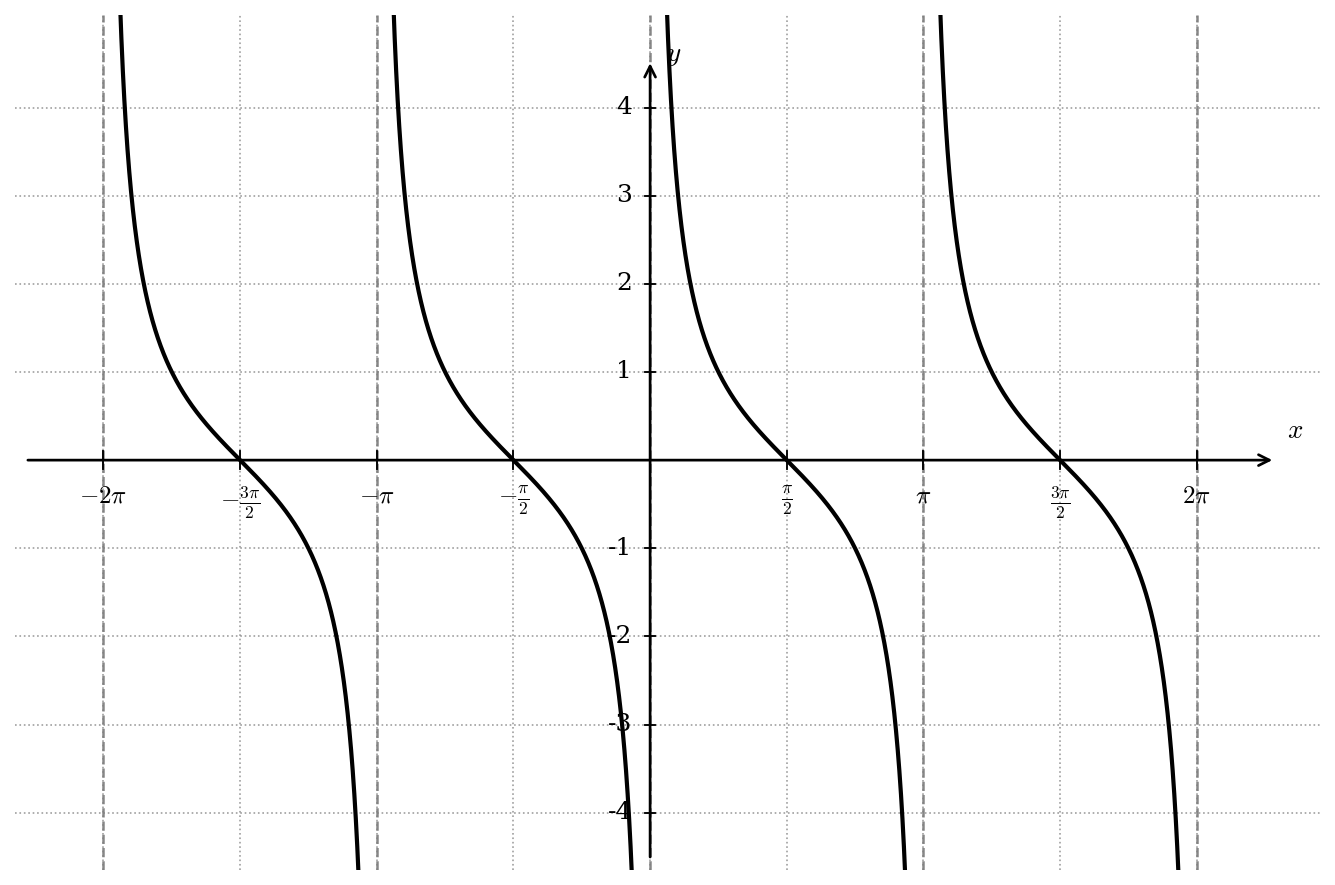
Graph of the cotangent function with vertical asymptotes at x = -2π,-π, 0, π and 2π; y-axis labelled -4 to 4, x-axis labelled -2π to 2π.
Graph of f

The figure above shows the graph of the function  f given by  f(x)=cot(x). Which of the following statements about the graph of  f is true?

  • The graph has vertical asymptotes for domain values where tan(x)=0, and  f is strictly decreasing between consecutive asymptotes.

  • The graph has vertical asymptotes for domain values where cos(x)=0, and  f is strictly decreasing between consecutive asymptotes.

  • The graph has vertical asymptotes for domain values where tan(x)=0, and  f is strictly increasing between consecutive asymptotes.

  • The range of f is (,1][1,), and  f is strictly increasing between consecutive asymptotes.

8
Sme Calculator
1 mark

What is the exact value of cos(sin1(35))?

  • 35

  • 34

  • 45

  • 54

9
Sme Calculator
1 mark

What is the exact value of tan(arcsin(35))?

  • 35

  • 34

  • 45

  • 43

10
Sme Calculator
1 mark

If secθ=54 and π2<θ<π, what is the value of cotθ?

  • 43

  • 34

  • 34

  • 43

11
Sme Calculator
1 mark

What is the exact value of sec(arctan(3))?

  • 12

  • 233

  • 3

  • 2

12
Sme Calculator
1 mark
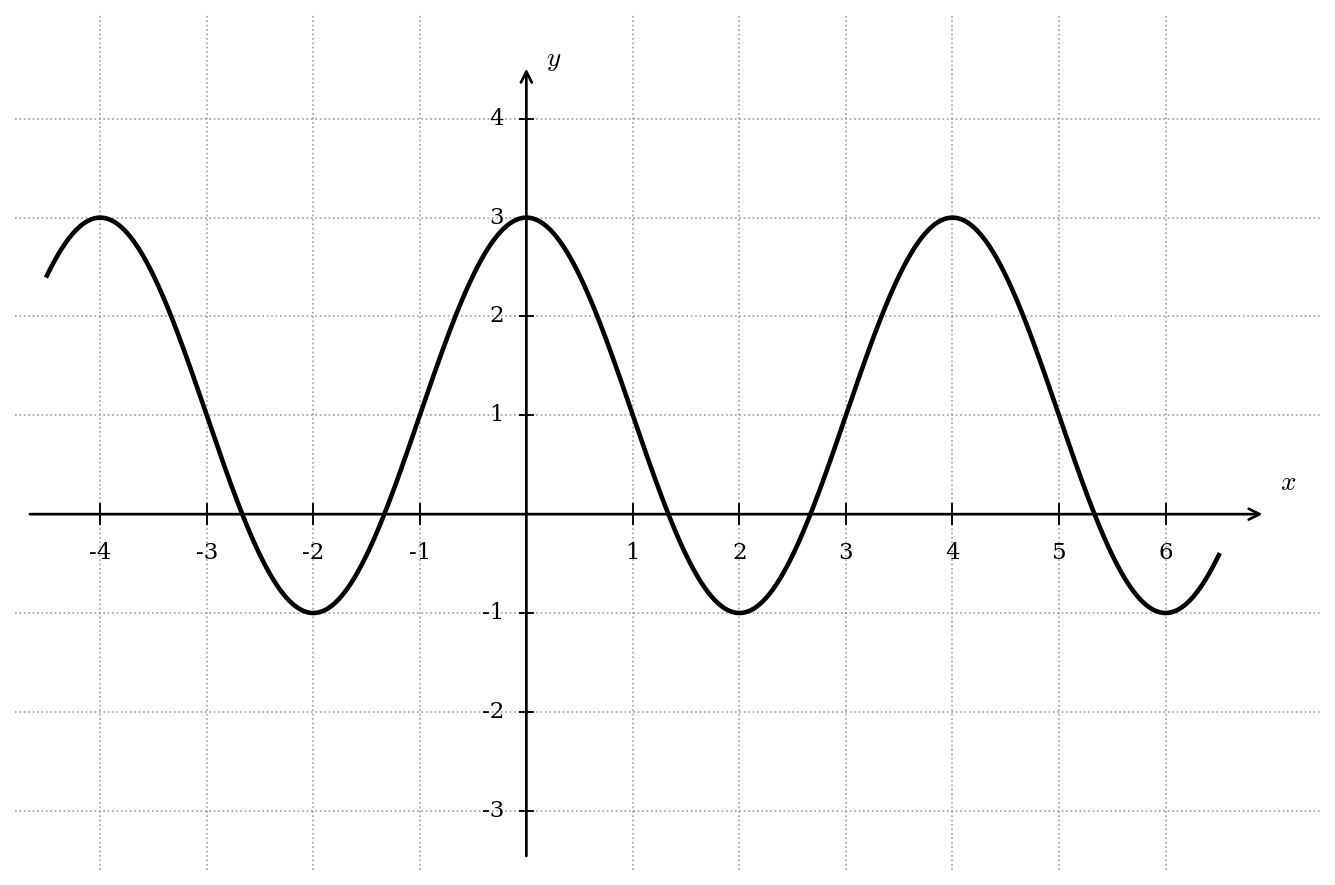
Graph of a sine wave with peaks at (-4, 3), (0, 3) and (4, 3), and troughs at (-2, -1), (2, -1) and (6, -1), oscillating along the x-axis from x=-5 to x=7, showing cycles and symmetry.
Graph of f

The figure above shows the graph of the sinusoidal function  f(x)=acos(bx)+d, where a, b, and d are constants. The function g is given by g(x)=asec(bx)+d. Which of the following gives the locations of the vertical asymptotes of the graph of g in the xy-plane?

  • x=2k, for any integer k

  • x=1+2k, for any integer k

  • x=43+4k and x=83+4k, for any integer k

  • x=2+4k, for any integer k

13
Sme Calculator
1 mark

The function  f is given by  f(x)=2cos(3x) and has a period of 2π3. In order to define the inverse function of  f, which of the following specifies a restricted domain for  f and provides a rationale for why  f is invertible on that domain?

  • 0xπ3, because all possible values of  f(x) occur without repeating on this interval

  • π6xπ6, because all possible values of  f(x) occur without repeating on this interval

  • 0xπ3, because the length of this interval is half of the period

  • π6xπ6, because the length of this interval is half of the period

14
Sme Calculator
1 mark

An angle θ in standard position satisfies 0θ<2π. The terminal ray of θ passes through the point (7,4). What is the value of θ, expressed in radians as a decimal approximation?

  • 0.519

  • 2.622

  • 3.661

  • 5.764

15
Sme Calculator
1 mark

Which of the following is equivalent to sin(2arctanx)?

  • xx2+1

  • 2xx2+1

  • 2x1x2

  • x21x2+1

16
Sme Calculator
1 mark

If cscθ=53 and θ is in quadrant III, what is the value of cotθ?

  • 34

  • 43

  • 54

  • 53

17
Sme Calculator
1 mark

What is the value of sec(arctan(2))?

  • 15

  • 52

  • 3

  • 5