Key Takeaways
A zone of inhibition is the clear area around an antibiotic or antiseptic disc on an agar plate where bacteria can't grow
Larger zones indicate that the substance is more effective at killing or preventing the growth of that specific bacterium
Zones are measured in millimetres and their area is calculated using the formula πr²
The disk diffusion method is the standard technique for testing how effective different antibiotics are against bacteria
Zone size alone doesn't tell you which antibiotic is "best" overall, because different substances diffuse through agar at different rates
Zone of Inhibition Meaning
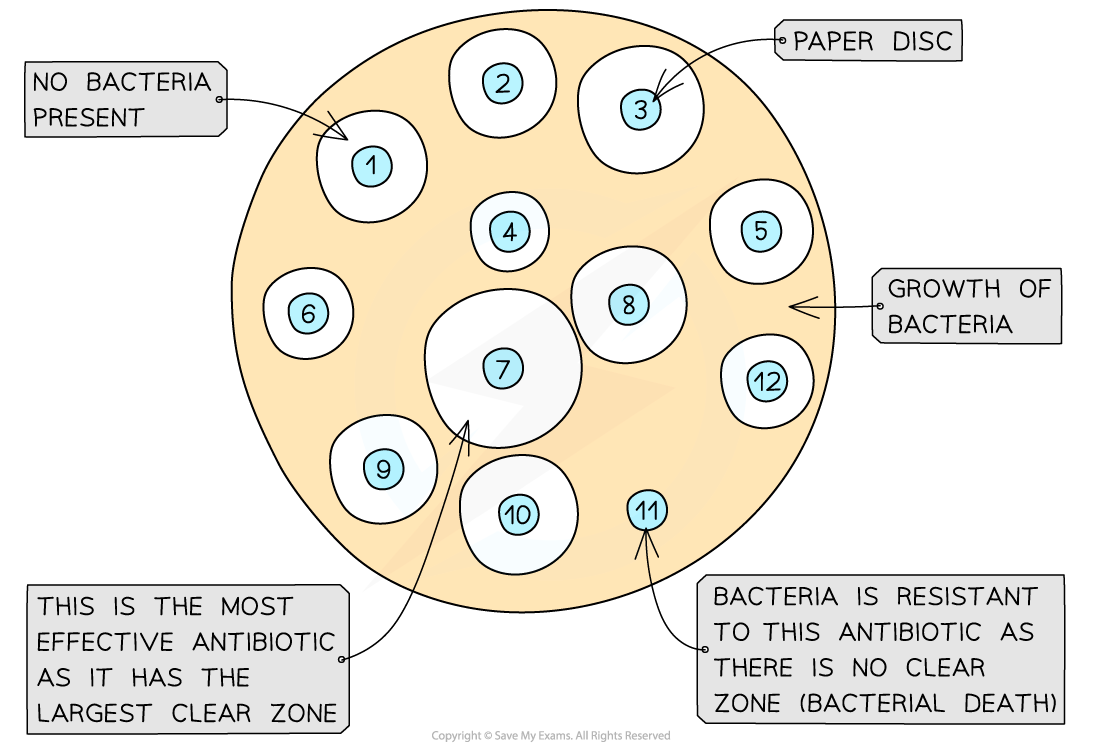
So what is a zone of inhibition? Put simply, it's the ring of clear space that forms around an antibiotic or antiseptic disc placed on an agar plate coated with bacteria. Within this ring, the concentration of the substance was high enough to either kill the bacteria or stop them from multiplying.
The substance soaks outward from the disc into the surrounding nutrient broth or agar. Its concentration drops the further it travels. At some distance, the concentration becomes too low to have any effect, and that's where bacterial growth resumes. The boundary between the clear zone and the cloudy bacterial growth marks the edge of the zone of inhibition.
What Does a Zone of Inhibition Tell Us?
The size of the zone indicates how effective that substance is against the specific pathogen being tested. A larger zone means the antibiotic or antiseptic was able to prevent bacterial growth across a wider area. A smaller zone suggests the bacteria are more resistant to that substance.
“I remind students that a larger zone of inhibition does not always mean a more effective antibiotic. The size of the zone also depends on how quickly the antibiotic diffuses through the agar and its concentration. A slow-diffusing antibiotic may produce a smaller zone even if it is effective.”
– Natalie Lawrence, Biology Tutor.
The Disk Diffusion Method
The disk diffusion method is the standard technique for testing antimicrobial effectiveness.
Here's how it works.
First, a petri dish containing nutrient agar is inoculated with the bacterium being tested. Paper discs, each soaked in an antibiotic or antiseptic, are then placed onto the surface of the agar using sterilised tweezers. One disc must be soaked in sterile distilled water only. This acts as the control, confirming that any clear zones are caused by the additional substance, not the disc itself.
Aseptic technique is used throughout. Work is carried out near a lit Bunsen burner, the petri dish lid is only lifted slightly during inoculation, and all equipment is sterilised before use. These steps prevent contamination by unwanted microorganisms. The plates are sealed with tape (not fully, so oxygen can still enter) and incubated at a maximum of 25°C in school laboratories. This temperature limit reduces the chance of growing harmful pathogens.
After incubation, clear zones appear around any discs containing effective substances.
How to Measure Zone of Inhibition
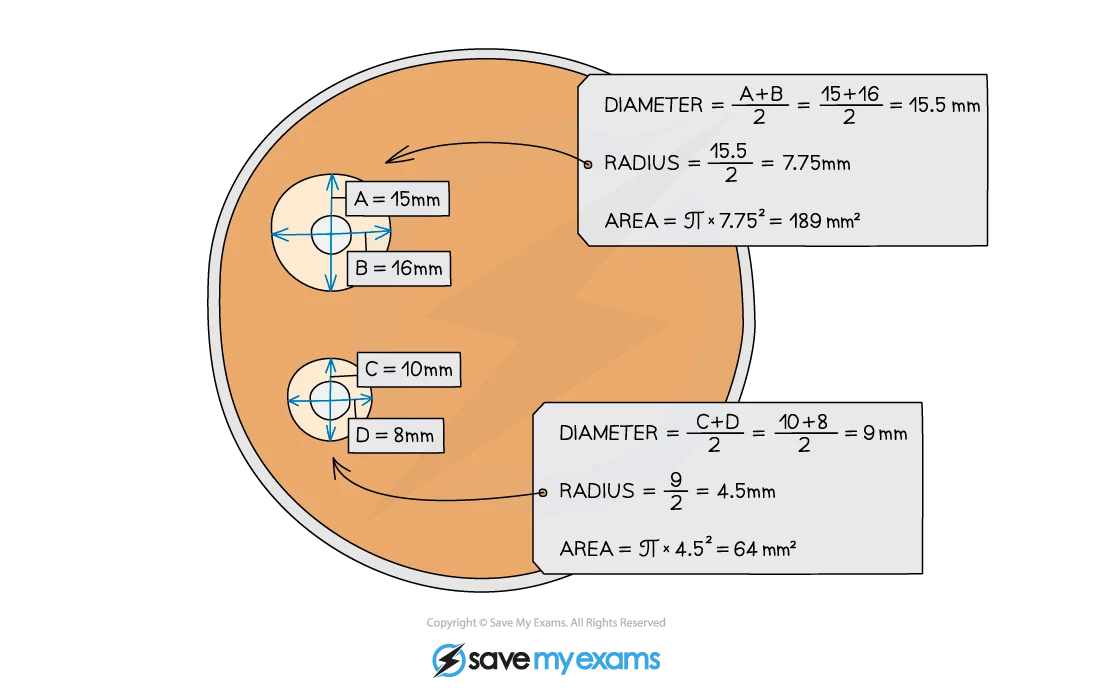
Measuring the zone accurately is straightforward but requires consistency. Use a ruler or callipers to measure the diameter of the clear zone in millimetres, from one edge of the zone to the opposite edge, passing through the centre of the disc.
Zones aren't always perfectly circular. When the shape is uneven, take two diameter measurements at right angles to each other (90° apart) and calculate the mean. Record all measurements to the nearest whole millimetre. This approach is far more reliable than trying to judge effectiveness by eye.
How to Calculate Zone of Inhibition Area
Once you have the mean diameter, halve it to find the radius. Then calculate the area using the standard formula:
Area = πr²
Disc | Diameter 1 (mm) | Diameter 2 (mm) | Mean Diameter (mm) | Radius (mm) | Area (mm²) |
|---|---|---|---|---|---|
Antibiotic A | 22 | 20 | 21 | 10.5 | 346.4 |
Antibiotic B | 14 | 16 | 15 | 7.5 | 176.7 |
Control (water) | 0 | 0 | 0 | 0 | 0 |
The results are then compared against published reference tables. These tables classify the bacterium as susceptible (killed effectively), intermediate (partially effective), or resistant (not effectively killed) for each antibiotic tested. The control disc should show no zone of inhibition at all, confirming the experiment is valid.
Factors That Affect the Zone of Inhibition
Several variables influence zone size, and understanding them explains why direct comparisons between different antibiotics, especially without controlled conditions, aren't always straightforward.
Factor | Effect on Zone Size |
|---|---|
Antibiotic concentration | Higher concentration in the disc produces a larger zone |
Rate of diffusion | Substances that diffuse quickly through agar produce larger zones, even if they aren't necessarily more potent |
Bacterial growth rate | Fast-growing bacteria may partially outpace slower-diffusing substances, producing a smaller zone |
Incubation temperature | Temperature affects both bacterial growth rate and diffusion rate |
Inoculum density | A heavier bacterial lawn can shrink the apparent zone size |
This is exactly why a large zone doesn't automatically mean a "better" antibiotic. Penicillin, for instance, diffuses readily through agar and often produces large zones. But a different antibiotic with a smaller zone might actually be more effective at lower concentrations.
Zone of Inhibition and Antibiotic Resistance
Zone of inhibition testing plays a direct role in tackling one of modern medicine's biggest challenges: antibiotic resistance.
When bacteria develop random mutations in their DNA, some of these mutations can make them resistant to specific antibiotics. If an antibiotic is used to treat an infection, resistant bacteria survive and multiply while non-resistant ones are killed. Over time, this leads to populations of bacteria that no longer respond to certain treatments. MRSA (methicillin-resistant Staphylococcus aureus) is one well-known example.
In hospitals and clinical laboratories, zone of inhibition testing helps doctors identify which antibiotics will actually work against a patient's specific infection. A small or absent zone for a particular antibiotic signals resistance, and the doctor can prescribe an alternative. This targeted approach avoids wasting time on ineffective treatments and helps slow the spread of resistance.
For a deeper look at how bacteria are grown and tested in the lab, including aseptic technique and the step-by-step practical method, explore the Save My Exams AQA GCSE revision notes on Culturing Microorganisms, or find the ones specific to your course. Written by experienced teachers and examiners, these notes cover everything from binary fission to calculating inhibition zone areas.
Frequently Asked Questions
What does no zone of inhibition mean?
No clear zone means the bacteria are resistant to that antibiotic or antiseptic. The substance had no measurable effect on bacterial growth at any concentration around the disc. In a clinical setting, this result would prompt the doctor to choose a different antibiotic for treatment.
How is the zone of inhibition used in hospitals?
Clinical microbiology laboratories use zone of inhibition testing (often called antibiotic susceptibility testing) to determine which antibiotics will work against a patient's infection. A sample of the infecting bacterium is cultured, tested against multiple antibiotics, and the results guide the doctor's prescription. This ensures patients receive effective treatment and reduces the risk of promoting further antibiotic resistance.
What is the difference between bactericidal and bacteriostatic zones?
A bactericidal zone is one where the antibiotic has killed the bacteria outright. A bacteriostatic zone is where the antibiotic has stopped the bacteria from growing and dividing without actually killing them. Both produce clear zones on an agar plate, and a standard disk diffusion test can't easily distinguish between the two. Further laboratory tests are needed to determine whether a substance is bactericidal or bacteriostatic.
Examiner-written GCSE Biology revision resources that improve your grades 2x
- Written by expert teachers and examiners
- Aligned to exam specifications
- Everything you need to know, and nothing you don’t

Was this glossary entry helpful?

Share this article

 written revision resources that improve your