Projectiles (Edexcel A Level Maths: Mechanics): Exam Questions

Exam code: 9MA0

5 hours38 questions
1a
2 marks

The constant acceleration equation s = ut + 12at2 is used to model the horizontal displacement  (s m) at time t seconds of a projectile, where u m s1 and a m s2 are respectively the initial velocity and acceleration of the projectile in the horizontal direction.

Show that s = ut,  justifying any assumptions you make.

1b
Sme Calculator
2 marks

A projectile is projected horizontally from a set height with a velocity of 16 m s1.

It reaches the ground 5 seconds later.

Find the horizontal displacement of the projectile when it reaches the ground.

1c
Sme Calculator
2 marks

Taking the downward direction to be positive, use the constant acceleration equation s = ut + 12at2 to show that, to 3 significant figures, the height from which the projectile was projected is 123 m.

2a
Sme Calculator
2 marks

A particle is projected horizontally from a height of 78.4 m  above the ground, with a velocity of 6 m s1.

Determine the time it takes for the particle to reach the ground.

2b
Sme Calculator
2 marks

Find the total horizontal distance covered by the particle from when it was projected, until it reaches the ground.

3
6 marks

By drawing diagrams of right-angled triangles rather than using a calculator, find the exact values of sin α and cos α for the following values of tan α.  It is given that 0 <α < 90°.

(i) tan α =512

(ii) tan α =43 

(iii) tan α =940


4
Sme Calculator
2 marks

A particle is projected with an initial speed of  24 m s1 at an angle of  30°  above the horizontal.  Find the horizontal and vertical components of the initial velocity, writing your answer in the form  (uxi+uyj) m s1.

5a
Sme Calculator
2 marks

A particle is projected with initial velocity u = (5i + 6j) m s1.

Find the angle of projection above the horizontal.

5b
Sme Calculator
2 marks

Find the initial speed of the particle, giving your answer in the form p m s1 where p is an integer.

6
Sme Calculator
2 marks

A particle is projected with initial velocity 7 m s1 at an angle of 18° below the horizontal.  

Find the horizontal and vertical components of the initial velocity, writing your answer in the form (uxi+uyj) m s1.  

You should give ux and uy each correct to three significant figures.

7a
Sme Calculator
3 marks

A particle is projected from ground level with velocity (8i + 6j) m s1.

(i) State the vertical component of the particle’s velocity when it reaches its greatest height.

[1]

(ii) Hence determine the greatest height (to the nearest centimetre) reached by the particle. Take g=9.8 ms2.

[2]

7b
Sme Calculator
3 marks

(i) State the vertical displacement of the particle when it returns to ground level.

[1]

(ii) Hence determine the particle’s time of flight, giving your answer to three significant figures.

[2]

7c
Sme Calculator
2 marks

Find the range of the particle (the distance between the point from which it is projected and the point at which it first hits the ground).

Give your answer to 3 significant figures.

8a
Sme Calculator
2 marks

The equation of the trajectory of a particle projected from the origin is given by

y = x tan α  gx2(1 + tan2 α)2U2

where x and y are respectively the horizontal and vertical displacements of the particle when projected with an initial speed of Um s1  at angle α above the horizontal. g is the constant of acceleration due to gravity.

Find the equation of the trajectory of a particle that is projected with an initial velocity of 20 m s1 at an angle of 30° above the horizontal.  Give the coefficients in your equation as exact values, and in terms of g where appropriate.

8b
Sme Calculator
2 marks

Hence find the horizontal distances that have been covered by the particle at the two instants when its y-coordinate is equal to 4.

Use g = 10 m s2 and give your answers correct to three significant figures.

1a
Sme Calculator
6 marks
Diagram showing a 25m vertical drop from O to N, a horizontal distance of 100m from N to A, with a vector pointing 45° upwards at O, labelled "U ms⁻¹".
Figure 2

A small ball is projected with speed U ms−1 from a point O at the top of a vertical cliff.

The point O is 25 m vertically above the point N which is on horizontal ground.

The ball is projected at an angle of 45° above the horizontal.

The ball hits the ground at a point A, where AN = 100 m, as shown in Figure 2.

The motion of the ball is modelled as that of a particle moving freely under gravity.

Using this initial model, show that U=28.

1b
Sme Calculator
3 marks

Find the greatest height of the ball above the horizontal ground NA.

1c
1 mark

In a refinement to the model of the motion of the ball from O to A, the effect of air resistance is included.

This refined model is used to find a new value of U.

How would this new value of U compare with 28, the value given in part (a)?

1d
1 mark

State one further refinement to the model that would make the model more realistic.

2a
Sme Calculator
4 marks
Projectile motion diagram showing an object projected at angle α with a speed of 65 m/s from point O, 70 m above ground, landing at point A.
Figure 3

A small stone is projected with speed 65 ms−1 from a point O at the top of a vertical cliff.

Point O is 70 m vertically above the point N.

Point N is on horizontal ground.

The stone is projected at an angle α above the horizontal, where tanα=512.

The stone hits the ground at the point A, as shown in Figure 3.

The stone is modelled as a particle moving freely under gravity.

The acceleration due to gravity is modelled as having magnitude 10 ms−2.

Using the model, find the time taken for the stone to travel from O to A.

2b
Sme Calculator
5 marks

Using the model, find the speed of the stone at the instant just before it hits the ground at A.

2c
1 mark

One limitation of the model is that it ignores air resistance.

State one other limitation of the model that could affect the reliability of your answers.

3a
Sme Calculator
2 marks

A particle is projected from a platform 5 m vertically above ground level with velocity (6i + 8j) m s1.

(i) Find the speed with which the particle is projected.

[1]

(ii) Find the angle above the horizontal at which the particle is projected.

[1]

3b
Sme Calculator
2 marks

Find the greatest height above the ground reached by the particle.

3c
Sme Calculator
3 marks

Find the time of flight of the particle.  Give your answer to three significant figures.

4a
Sme Calculator
2 marks

A particle is projected horizontally from a height of 15 m vertically above the ground with a speed of 8 m s1.

Find the time of flight of the particle.

4b
Sme Calculator
2 marks

Find the horizontal displacement of the particle when it reaches the ground.

5a
Sme Calculator
2 marks

A cannon points horizontally from the top of a castle wall.

A cannonball leaves the cannon with speed 150 ms-1 and hits the ground 2.0 seconds later.

Find the horizontal range of the cannonball.

5b
Sme Calculator
2 marks

Find the height of the castle wall above the ground.

6a
Sme Calculator
2 marks

A golfer strikes a ball from ground level with velocity  (353i+35j) ms1.

Find

(i) the initial speed of the golf ball,

(ii) the angle from the horizontal at which the golf ball is struck.

6b
Sme Calculator
3 marks

Find the time taken from when the golf ball is struck until it reaches the ground for the first time. Assume the ground is horizontal.

6c
Sme Calculator
2 marks

Find the maximum height reached by the golf ball above the ground.

7a
Sme Calculator
3 marks

A stuntperson rides a bicycle off a straight ramp inclined 30° to the horizontal at the end of a pier.  

The bicycle leaves the ramp with a speed of 14 m s1.

The bicycle and stuntperson are modelled as a single particle and land in the water at a horizontal distance of 28 m from the end of the pier.

Calculate the time (in seconds) for which the stuntperson and bicycle are in the air above the water.

7b
Sme Calculator
3 marks

Given that the end of the ramp was 50 cm above the pier, find the height of the pier, giving your answer to the nearest tenth of a metre.

8a
Sme Calculator
2 marks

A particle is launched from the the ground at an angle of 80° above the horizontal with an initial speed of 75 m s1.

Find

(i) the initial horizontal speed of the particle,

(ii) the initial vertical speed of the particle.

8b
Sme Calculator
4 marks

Find the times at which the particle is at a height of 200 m and hence find the length of time for which the particle is above 200 m.

9a
Sme Calculator
3 marks

A hot-air balloon is hovering 20 m above a school sports field.

A student standing in the basket gently throws a small bean-bag to their friends on the ground.

The bean-bag leaves the balloon with speed 5 ms⁻¹, directed at 10° below the horizontal.

Assume that g=9.8 ms2 and that air resistance is negligible.

Calculate the time taken for the bean-bag to reach the ground.

9b
Sme Calculator
2 marks

Show that the bean-bag lands within 10 m of the point on the ground directly below the hot-air balloon.

10a
Sme Calculator
3 marks

An ejector seat for a small aircraft is being tested. The ejector seat is launched from a stationary position 2 m vertically above the ground.  

The seat is fired with an initial velocity of 25 m s1 at an angle α above the horizontal, where tan α = 247.

To pass its first safety test the ejector seat must rise at least 16 m vertically above the position from which it was launched within 1 second.

Determine whether the seat passes its first safety test.

10b
Sme Calculator
5 marks

In another test, the ejector seat must deploy a parachute when it reaches its maximum height.

Find

(i) the height above the ground,

(ii) and the time after launch

at which the ejector seat should deploy its parachute.

11a
3 marks

A particle is projected from a point on a horizontal plane with initial velocity U m s1 at an angle of α° above the horizontal.  

The particle moves freely under gravity where g m s2 is the acceleration due to gravity.

Show that the time of flight of the particle, T seconds, is given by

 T=2Usinαg

11b
3 marks

Show that the range of the particle, R m, on the horizontal plane is given by

R=U2 sin(2α)g 

12
Sme Calculator
5 marks

In Toonland, a coyote is desperately trying to catch the very fast roadrunner bird.  In its latest effort to catch the roadrunner the coyote projects itself from a catapult at the top of a canyon which is 85 m high.  

The catapult projects the coyote with initial velocity (3i + 9j) m s1.

The roadrunner spots the coyote’s plan when the coyote is at its maximum height above the ground.  Using magic Toon-paint the roadrunner paints a hole on the ground at the spot where the coyote will land.

It takes the roadrunner 4 seconds to paint the hole on the ground, and once it is finished the paint will become a real hole.  

Determine whether or not the roadrunner will succeed in causing the coyote to land in the hole.

1a
Sme Calculator
6 marks
Diagram of a projectile path with angle alpha, starting from point A. The curved trajectory ends at point B, spanning a horizontal distance of 120m.
Figure 3

A golf ball is at rest at the point A on horizontal ground.

The ball is hit and initially moves at an angle α to the ground.

The ball first hits the ground at the point B, where AB=120 m, as shown in Figure 3.

The motion of the ball is modelled as that of a particle, moving freely under gravity, whose initial speed is U ms-1.

Using this model, show that U2sinαcosα=588.

1b
4 marks

The ball reaches a maximum height of 10 m above the ground.

Show that U2=1960.

1c
1 mark

In a refinement to the model, the effect of air resistance is included.

The motion of the ball, from A to B, is now modelled as that of a particle whose initial speed is V ms–1.

This refined model is used to calculate a value for V.

State which is greater, U or V, giving a reason for your answer.

1d
1 mark

State one further refinement to the model that would make the model more realistic.

2a
2 marks
Diagram of a projectile motion showing a parabolic path. It starts at point O, 28 m/s at angle α. Point A 40 m away horizontally, at a height of 20 m.
Figure 2

A small ball is projected with speed 28 ms–1 from a point O on horizontal ground.

After moving for T seconds, the ball passes through the point A.

The point A is 40 m horizontally and 20 m vertically from the point O, as shown in Figure 2.

The motion of the ball from O to A is modelled as that of a particle moving freely under gravity.

Given that the ball is projected at an angle α to the ground, use the model to show that T=107cosα.

2b
5 marks

Show that tan2α4tanα+3=0.

2c
Sme Calculator
3 marks

Find the greatest possible height, in metres, of the ball above the ground as the ball moves from O to A.

2d
1 mark

The model does not include air resistance.

State one other limitation of the model.

3a
Sme Calculator
4 marks

In Toon City, a coyote is desperately trying to catch the very fast roadrunner bird. 

In an effort to catch the roadrunner the coyote projects itself from a catapult at ground level.  The catapult projects the coyote with initial velocity (15i +8j) m s1.

Modelling the coyote as a projectile find

(i) the initial speed of the coyote

(ii) the exact values of sin α and cos α, where α is the angle above the horizontal at which the coyote is projected.

3b
Sme Calculator
3 marks

The variable x can be used to represent the horizontal displacement whilst y can be used to represent the vertical displacement.

Find the equation for the trajectory of the coyote in the form

y=axgbx2

where a and b are constants and g is the acceleration due to gravity.

3c
Sme Calculator
3 marks

Find the horizontal range of the coyote's motion.

3d
Sme Calculator
3 marks

There is a cactus plant of height 4 m located exactly halfway along the trajectory of the coyote. 

Determine whether the coyote will collide with the cactus.

4a
Sme Calculator
6 marks

A particle is projected from a point O on horizontal ground with speed U ms−1 at an angle of elevation β, where tan β=43​. The particle moves freely under gravity and strikes the ground at a point A, where OA = 120 m.

Show that U=35.

4b
Sme Calculator
3 marks

The particle passes through a point P which is at a horizontal distance of 42 m from O.

Find the height of P above the ground.

4c
Sme Calculator
5 marks

Find the direction of motion of the particle at the instant it passes through P, giving your answer as an angle in degrees relative to the horizontal.

5a
3 marks

A particle is projected horizontally from the point with coordinates ( 0 , 5 ) with an initial speed of 9 m s1.  The coordinates are expressed in metres.

Throughout this question leave any coefficients in expressions and equations as exact values, given in terms of g where appropriate.

(i) Find, in terms of time t seconds, expressions for sx and sy, the horizontal and vertical displacements of the particle from the point from which it was projected.

(ii) Write down an expression for hy, the vertical displacement of the particle from the origin.

5b
Sme Calculator
3 marks

Find an equation for the trajectory of the particle in the form y=f(x).

6a
Sme Calculator
7 marks

A stuntperson aims to perform a motorcycle jump over a row of buses.  

The take-off and landing ramps are both at the same height, and the take-off ramp is angled at 20° above the horizontal.  

Each bus is 2.55 m wide, and the heights of the buses are less than the heights of the take-off and landing ramps.  

The stuntperson and motorcycle are modelled as a single particle.

If the stuntperson leaves the end of the launch ramp with a speed of 18 m s 1, work out the maximum number of buses the stuntperson can clear, assuming they land on the landing ramp.

6b
Sme Calculator
5 marks

If the stuntperson wishes to jump over 16 buses using the same ramp, find the speed with which they should leave the ramp, giving your answer to three significant figures.

7a
Sme Calculator
5 marks

Deefa the dog is undergoing agility training, part of which involves jumping over a wall.  

The top of the wall sits 91 cm above the ground.  Deefa is modelled as a projectile jumping in a two-dimensional vertical plane that is perpendicular to the surface of the wall.

Deefa jumps with velocity (3i + 4j) m s1, leaving the ground at a distance 75 cm horizontally from the wall.  

Determine whether Deefa will clear the wall with this jump.

7b
Sme Calculator
4 marks

On another attempt Deefa clears the wall by jumping with velocity (4i +5j) m s1.

Deefa jumps at the latest possible moment in order to clear the wall.  

Find the distance between the wall and the point at which Deefa jumps off the ground.

8a
4 marks

The flight of a particle projected with an initial velocity of U m s1 at an angle α above the horizontal is modelled as a projectile moving under gravity only.  

The particle is projected from the point (0, h) with the upward direction being taken as positive, and with the coordinates being expressed in metres. 

g m s2 is the constant of acceleration due to gravity.

Find, in terms of U, α, h, g  and time t as appropriate, expressions for 

(i) the x-coordinate of the projectile at time t seconds,

(ii) the y-coordinate of the projectile at time t seconds.

8b
Sme Calculator
6 marks

For a particular projectile,

  • sinα=817

  • U=51 ms1

  • and the particle is projected from the point (0, 6).  

Find an expression for the trajectory of the particle, giving your answer in the form y=ax+bgx2+c where a,b and c are rational constants.

9
Sme Calculator
6 marks

For a particle modelled as a projectile with initial velocity U m s1 at an angle of α° above the horizontal, show that the equation of the trajectory of the particle is given by

y=(tanα) xgx22U2cos2α

10
Sme Calculator
5 marks

In this question, use g=10 ms2 for the acceleration due to gravity

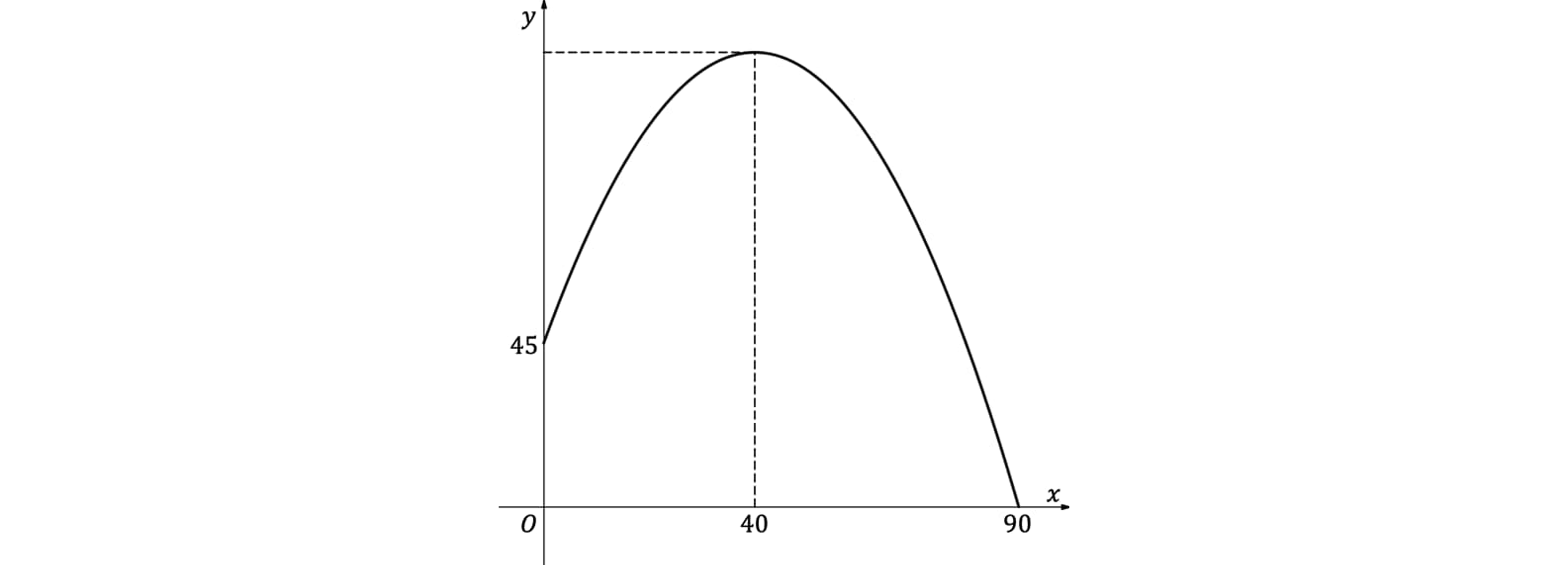
The graph below shows the trajectory of a projectile, with x and y being measured in metres.

Graph of a downward parabola peaking at coordinates (40, 45) with dashed lines indicating the peak on the x-axis and y-axis, covering 0 to 90 on x-axis.

Use the graph to help determine

(i) the time of flight of the projectile in seconds

(ii) the initial velocity of the projectile in the form (uxi + uyj) m s1

(iii) the speed, to three significant figures, of the projectile at launch

(iv) the angle to the horizontal at which the projectile was launched, giving your answer to one decimal place

(v) the maximum height reached by the projectile.

1a
2 marks
Projectile motion diagram showing an object launched from point A, 2m above ground, at angle α with velocity U, reaching 3m peak before landing at point T.
Figure 4

A boy throws a ball at a target. At the instant when the ball leaves the boy’s hand at the point A, the ball is 2 m above horizontal ground and is moving with speed U at an angle α above the horizontal.

In the subsequent motion, the highest point reached by the ball is 3 m above the ground.

The target is modelled as being the point T, as shown in Figure 4.

The ball is modelled as a particle moving freely under gravity.

Using the model, show that U2=2gsin2α.

1b
Sme Calculator
9 marks

The point T is at a horizontal distance of 20 m from A and is at a height of 0.75 m above the ground. The ball reaches T without hitting the ground.

Find the size of the angle α.

1c
1 mark

State one limitation of the model that could affect your answer to part (b).

1d
Sme Calculator
3 marks

Find the time taken for the ball to travel from A to T.

2a
Sme Calculator
6 marks
Diagram showing points A and B 50m apart. Vector P at 20m/s forms a 30° angle at A. Vector Q at u m/s forms angle θ at B.
Figure 3

The points A and B lie 50 m apart on horizontal ground.

At time t=0 two small balls, P and Q, are projected in the vertical plane containing AB.

Ball P is projected from A with speed 20 m s⁻¹ at 30° to AB.

Ball Q is projected from B with speed u m s⁻¹ at angle θ to BA, as shown in Figure 3.

At time t=2 seconds, P and Q collide.

Until they collide, the balls are modelled as particles moving freely under gravity.

Find the velocity of P at the instant before it collides with Q.

2b
Sme Calculator
6 marks

Find

(i) the size of angle θ,

(ii) the value of u.

2c
1 mark

State one limitation of the model, other than air resistance, that could affect the accuracy of your answers.

3a
Sme Calculator
5 marks

A particle is projected horizontally from the point with coordinates (0, 18) with an initial speed of 12 m s1

The coordinates are expressed in metres where the x and y coordinates are the horizontal and vertical displacements from the origin respectively.

Find the equation of the trajectory of the particle in the form y=a+bgx2 where a and b are constants to be found and g is the acceleration due to gravity.

3b
Sme Calculator
5 marks

Find the distance between the particle and the origin after two seconds of motion, giving your answer to three significant figures.

4a
Sme Calculator
4 marks

A golfer strikes a ball from ground level with velocity (20i + 28j) m s1.

Find the horizontal distance the golf ball will travel before first hitting the ground.

4b
Sme Calculator
5 marks

Show that by reducing the angle of the strike above the horizontal by 10 degrees the golfer can achieve approximately 7 m more distance before the ball lands. Assume that the ball is struck at the same speed.

5
Sme Calculator
7 marks

In this question, use g=10 ms2 for the value of acceleration due to gravity

In a field there are two ball-launchers, A and B, aimed at each other.  The ball-launchers are on the same horizontal plane 180 m apart.

Launcher A fires a ball with a velocity of 253 m s1 at an angle of α° to the horizontal such that tanα=34.

At exactly the same moment launcher B launches an identical ball with velocity (1215i+515j) m s1.

Assuming that the balls do not collide in mid-air, determine which, if any, of the launchers are struck by a ball. Show your full reasoning and working.

6a
Sme Calculator
6 marks

A science-team launches an experimental probe from an underground laboratory toward a research station on the surface 4 km away.

The ground-level is the same at both the station and the laboratory, but because the lab sits deep underground, the probe is launched from a point 600 m below the ground level of the station.

The probe’s initial velocity is (82.5i + 250j) m s1, and once released it can be modelled as a projectile moving under gravity alone.

Show that the probe will strike the ground within 1 m of its target and take less than 50 seconds to do so.

6b
Sme Calculator
5 marks

The launch shaft which the probe passes through when exiting the laboratory rises 400 m above ground level and can be modelled as a cylinder.

Given that the probe successfully exits the launch shaft, find the minimum possible radius of the shaft.

A simplified diagram of the scenario is shown below.

Projectile from bottom left of a cylinder, passing just over the top right edge and landing on a ground level outside the cylinder, which is lower than the cylinder, but higher than the original launch position
7a
Sme Calculator
2 marks

The flight of a particle projected with an initial velocity of U m s1 at an angle α above the horizontal is modelled as a projectile moving under gravity only.

The particle is projected from the point  (x0, y0) with the upward direction being taken as positive, and with the coordinates being expressed in metres. g m s2 is the constant of acceleration due to gravity.

Write down expressions for

(i) the x-coordinate of the projectile at time t seconds

(ii) the y-coordinate of the projectile at time t seconds.

7b
Sme Calculator
5 marks

For a particular projectile,  tan α= 34, U = 10 m s1 and the particle is projected from the point (3 , 8).  

Find an expression for the trajectory of the particle, giving your answer in the form

 y=ax2+bx+c128

where the constants a, b and c are expressed in terms of g.

8
Sme Calculator
5 marks

In a game of “Airwars” one player has to attempt to shoot down another’s toy aircraft in mid-air using a foam missile.  

In a particular game a player launches their aircraft from the origin with velocity (3i + 18.7j) m s1.  At the same instant their opponent launches their missile with velocity (5i + 18.7j) m s1  from the point with coordinates (24 , 0), where the coordinates are expressed in metres. 

The flight paths of both the aircraft and the missile occur in the same vertical plane, and i and j  and  are respectively the unit vectors in the positive horizontal and vertical directions (where in the vertical direction upwards is taken to be positive). 

Modelling the motion of both the model aircraft and the model missile as projectiles moving under gravity alone, find the coordinates at which the missile hits the aircraft and how long both had been airborne prior to colliding.