Listening Test: Completion Questions (IELTS Academic: Listening): Study Material

Form completion in the listening test
In these questions, you fill in gaps in a form with information given in the recording
The answers will normally be facts, such as phone numbers and dates
There are two types of questions:
You select your answers from a list of options, then type in the correct letter
You select words from the recording
If they are the second type, keep to the word limit given in the instructions – you will lose the mark if you write more words or numbers than required
How to answer a form completion question in the listening test
Quickly read the questions before listening
Try to predict what the answer for each gap might be
Use the grammar of the sentence to help you decide the part of speech (e.g. a verb or a noun)
You do not have to change the words in the recording in any way
The answers are in order of the recording
If you do not know the answer, just guess – it is better to put something down rather than leave a blank
Examiner Tips and Tricks
Native speakers often say “oh” instead of “zero” or “nought”. When there are two or three identical numbers in a row (44 or 555), they might say “double four” instead of “four four” or “triple five” instead of “five five five”. Listen carefully for these expressions.
Worked Example
Listening Part 1: University Study Centre Registration Form
Questions 1–5
Listen to the audio clip and complete the form below
Write NO MORE THAN TWO WORDS AND/OR A NUMBER for each answer
University Study Centre – Registration Form | |
Full Name: | Carlos Enrique (1) ......................... |
Student ID: | (2) ......................... |
Current Course: | Bachelor of (3) ......................... |
Workshop Selection | Academic Writing |
Interested in: | (4) ......................... afternoon |
Specific Focus: | Improving (5) ......................... skills |
Answers
Gomez
JX4402
Architecture
Thursday
Referencing
Note completion in the listening test
In this type of question, you fill in gaps in notes on a section or all of the recording
The form will focus on the main facts in the recording
There are two types of questions:
You select your answers from a list, then type in the correct letter
You select words from the recording
How to answer a note completion question in the listening test
Quickly read the notes before listening
Use the headings and subheadings as signposts to follow the recordings
Check whether the answer in each gap is likely to be a number, a name a place etc.
Check whether the missing word or phrase is a noun, verb or adjective
Do not change the words in the recording in any way
The answers are in order of the recording
If you do not know the answer, just guess – it is better to put something down rather than leave a blank
Worked Example
Listening Part 4: The Rugby World Cup: Facts and Trends
Questions 1–5
Listen to the audio clip and complete the notes below
Write NO MORE THAN TWO WORDS AND/OR A NUMBER for each answer
Early History
Inaugural tournament: Held in (1) .........................
Jointly hosted by New Zealand and Australia.
Signified a major change in the sport’s history.
Global Reach
The 2023 event reached a total (2) ......................... of 800+ million.
Hosts benefit from a significant (3) ......................... through the event.
Changing Dynamics
Success of (4) ......................... (e.g., Japan/Fiji) is challenging traditional teams.
Increased use of (5) ......................... has helped close the performance gap.
Answers
1987
Audience
Economic lift (or Economic boost)
Emerging nations
Sports technology (or Technology)
Flow chart completion in the listening test
These questions test your ability to summarise the stages of a process or cycle
Flow chart questions use arrows to show the direction of the process
There are two types of questions:
You select your answers from a list of options
You select words from the recording
How to answer a flow chart completion question in the listening test
Scan the flow chart before listening to understand what the different steps or stages are
Try to predict what the answer for each gap might be
Use the grammar of the sentence to help you decide the part of speech (e.g. a verb or a noun)
You do not have to change the words in the recording in any way
The answers are in order of the recording
Use the arrows between the steps to help you follow the recording
If you do not know the answer, just guess – it is better to put something down rather than leave a blank
Examiner Tips and Tricks
If you know the subject of the listening, do not rely on your own previous knowledge. Remember, what matters is what the speaker says, which might not be what you are expecting.
Worked Example
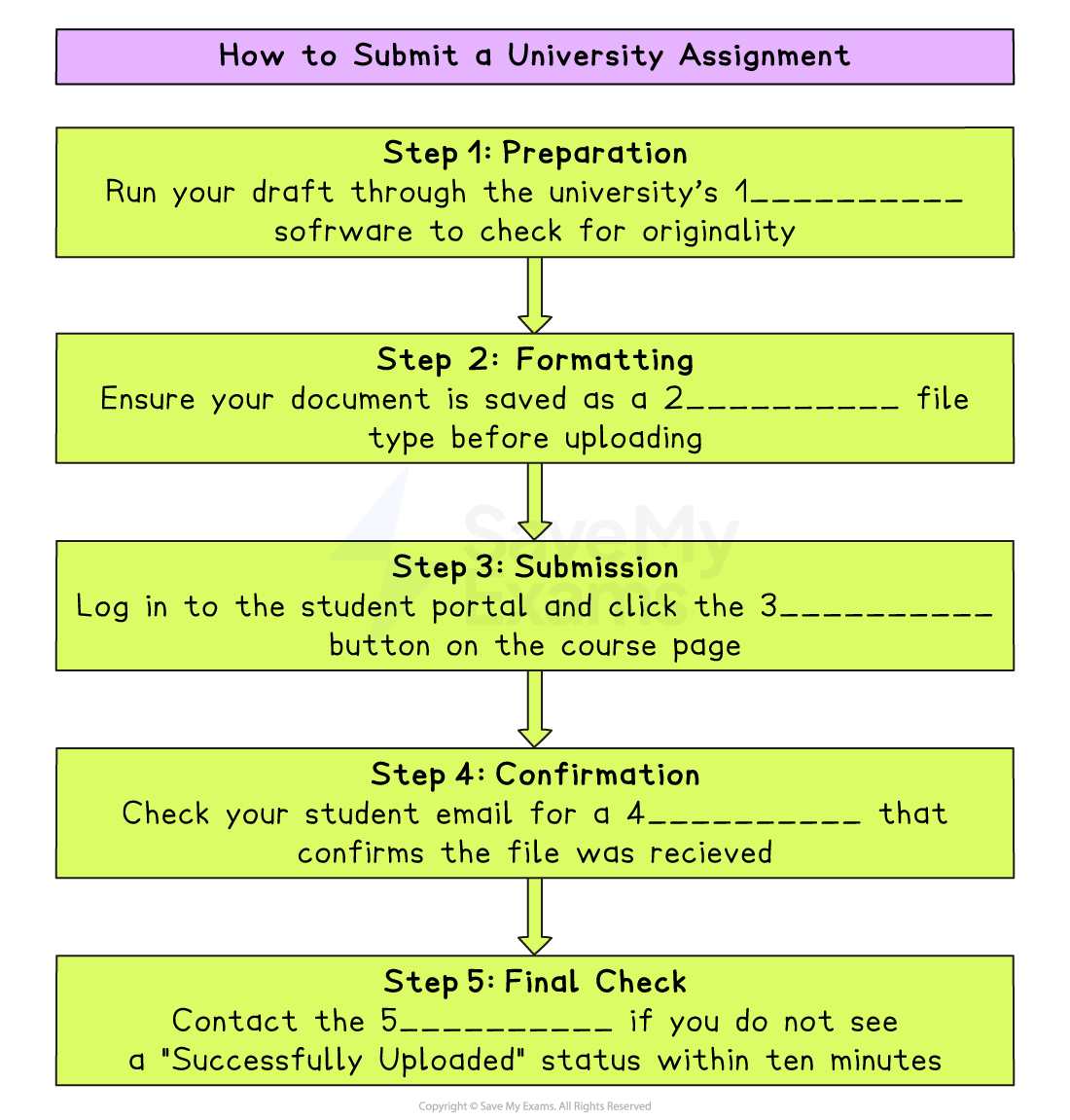
Listening Part 2: How to Submit a University Assignment
Questions 1–5
Listen to the audio clip and complete the flow chart below
Write NO MORE THAN TWO WORDS for each answer
How to Submit a University Assignment
Answers
Plagiarism
PDF
Blue
Receipt
IT Desk
Summary completion in the listening test
In this type of question, you fill in gaps in a summary of a section or all of the recording
The summary will focus on the main ideas (not details) in the recording
There are two types of questions:
You select your answers from a list, then type in the correct letter
You select words from the recording which fit into gaps
If they are the second type, keep to the word limit given in the instructions
You will lose the mark if you write more words or numbers than required
You do not have to change the words in the recording in any way
How to answer a summary completion question in the listening test
Quickly read the summary before listening to get the idea of the topic
Predict what the answer for each gap might be by using the grammar to decide the part of speech (e.g. a verb or a noun)
Is the answer likely to be a number? A name? A time period?
Try to focus on the main ideas, not the finer details
The answers are in order of the recording
If you do not know the answer, just guess – it is better to put something down rather than leave a blank
Remember the summary could be of the whole recording or just one part
Worked Example
Listening Part 4: The Future of "Sponge Cities"
Questions 1–5
Listen to the audio clip and complete the summary below
Write NO MORE THAN TWO WORDS for each answer.
The Future of "Sponge Cities"
Because of rising sea levels and more frequent storms, many coastal cities are adopting the “Sponge City” model. Unlike traditional concrete layouts that rely on 1 ......................... to move water away, these cities use permeable surfaces. The primary goal is to 2 ......................... rainwater where it falls rather than letting it run off into overloaded drains.
Key features include “rain gardens” and green roofs, which help to lower the 3 ......................... of the local area during summer months. Additionally, these spaces provide a natural 4 ......................... for local wildlife, increasing urban biodiversity. While the initial 5 ......................... of such projects can be high, experts argue they save money long-term by preventing flood damage.
Answers
Infrastructure (or Pipes)
Absorb
Temperature
Habitat
Cost
Table completion in the listening test
In this type of question, you fill in gaps in a table
Table completion questions usually come up:
in Part 2 (when one person is speaking about something specific, e.g. describing a place or a service)
or in Part 4 (when one person is giving a lecture on a subject)
The table is usually made up of rows or columns or both, and the recording will follow the organisation of the table
You do not have to change the words in the recording in any way
How to answer a table completion question in the listening test
Before listening quickly scan the table to get useful clues
Check the title to understand the topic
Read the row and column headings to what kind of information you need
Are there any gaps which you can predict in advance?
Use the grammar of the sentence to help you decide the part of speech (e.g. a verb or a noun)
Write the exact form of the word you hear
The answers are in order of the recording
Use the row and column headings to keep your place in the recording
If you do not know the answer, just guess – it is better to put something down rather than leave a blank
Worked Example
Listening Part 2: Chelsea Flower Show Schedule
Questions 1–6
Listen to the audio clip and complete the table below
Write NO MORE THAN TWO WORDS AND/OR A NUMBER for each answer
Event / Day | Time | Key Highlight |
Monday 18th May | Daytime | Press Day & (1) .................... Preview |
Tuesday 19th May | 8:00 am – 8:00 pm | First of two (2) .................... only days |
Thursday 21st May | 8:00 am – 8:00 pm | Show opens to the (3) .................... |
Friday 22nd May | 5:30 pm – 10:00 pm | The (4) .................... Late event |
Saturday 23rd May | (5) .................... | Official plant (6) .................... starts |
Answers:
Charity Gala
RHS Members
General Public
Chelsea
8:00 am – 5:30 pm
Sell-off
Sentence completion in the listening test
This type of question tests your ability to recognise the essential information in a recording
You read a sentence summarising part of the recording and fill the gap with information from the listening text
Sometimes the questions test your ability to see the relationship between different pieces of information (such as cause and effect)
The number of words you need to fill the gap can change so read the instructions carefully
The answers are in order in the recording
How to answer a sentence completion question in the listening test
Quickly read the sentences before listening
Try to predict what the answer for each gap might be
Use the grammar of the sentence to help you decide whether it is likely to be a verb, noun or adjective
Can you guess any possible answers from the context?
Remember to write the exact form of the word as you hear it in the recording
The answers are in order of the recording
Use any heading or subheadings to help you follow the recording
If you do not know the answer, just guess – it is better to put something down rather than leave a blank
Examiner Tips and Tricks
It is a mistake to think that the answer will always come after you hear the key words (or a paraphrase). In fact, the answer might come before or after you hear the key word.
Worked Example
Listening Part 4: The History of Quilting
Questions 1–6
Listen to the audio clip and complete the sentences below
Write NO MORE THAN TWO WORDS AND/OR A NUMBER for each answer
Historical Origins
Evidence suggests that early quilted garments were worn by soldiers as a form of .................... under their armour.
In medieval Europe, quilts were primarily seen as .................... items rather than everyday bedding.
The "Tristan Quilt" is a famous example of .................... quilting, used to tell a story through images.
Quilting in the Americas
Early American settlers reused scraps of fabric due to a severe .................... of new materials
During the 19th century, quilting meetings served an important .................... function for women in rural areas
The "Log Cabin" design is a classic pattern that features a small .................... in the centre, representing the hearth
Answers
protection
luxury
narrative
shortage
social
square
Sign up now for IELTS Academic
or
Was this study material helpful?