States of Matter & Thermal Capacity (Edexcel GCSE Physics): Exam Questions

Exam code: 1PH0

2 hours14 questions
1a
2 marks

Define specific heat capacity.

1b
3 marks

Figure 1 shows some equipment used to determine the specific heat capacity of aluminium. 

3-2-e-1b-specific-heat-capacity-experiment

Figure 1

Complete the missing labels using words or phrases from the box below. Each option is used once.

Electric heater

Insulating container

Thermometer

1c
3 marks

Figure 2 shows the reading before the heater was switched on. Figure 3 shows the reading at the end of the investigation. 

3-2-e-1c-thermometer-1-for-specific-heat-capacity

Figure 2

3-2-e-1cthermometer-2-for-specific-heat-capacity

Figure 3

Calculate the change in temperature.    

  change in temperature = ....................................°C  

1d
4 marks

Calculate the specific heat capacity of aluminium.

The following information may be useful:

  • Mass of block  = 0.850 kg 

  • Energy supplied  = 17 000 J

State the correct unit.

 specific heat capacity = ................................ unit.............

2a
3 marks

Describe the arrangement of the particles in a solid, a liquid and a gas.

2b
3 marks

Describe the motion of the particles in a solid, a liquid and a gas.

2c
1 mark

During a dry day, a puddle on a road dries up and disappears.

State the name of the process which causes this to happen.

2d
1 mark

Describe one change in the weather that would cause the puddle to dry up more quickly.

3a
1 mark

The volume of a piece of radium is 25 cm3

A student measures its mass using an electronic balance.

The mass of the brass is 125 g.

State the equation linking density, mass and volume.

3b
3 marks

Calculate the density of radium. Give the unit. 

 density = ................................ unit ...................

3c
2 marks

Radium is a solid at room temperature. State two facts about the structure of solids.

3d
5 marks

Materials can change state from solid to liquid or gas. Liquids and gases can also change state.

Complete the table below with the names of the changes of state.  

Initial state

Final state

Name of change

Solid

Liquid


Solid

Gas


Liquid

Solid


Liquid

Gas


Gas

Liquid


1a
2 marks

Describe, in terms of particles, two differences between a solid and a liquid of the same substance.

1b
3 marks

Figure 6 shows the dimensions of a solid block of concrete.

fig-6-paper2h-oct2021-edexcel-gcse-physics

Figure 6

Density of concrete, ρ, = 2100 kg/m3.

Calculate the mass of the concrete block.

Use the equation

m = ρ × V

mass of concrete block = ................................ kg

1c
2 marks

Figure 7 shows a shed made mostly of concrete blocks.

fig-7-paper2h-oct2021-edexcel-gcse-physics

Figure 7

State two practical ways to reduce heat loss from this shed.

1 ...............................................................................................

2 ...............................................................................................

1d
1 mark

On a very cold day, the temperature of the air is −4°C.

Calculate the value of this temperature on the kelvin scale.

temperature = .............................................................. K

2a
4 marks

A student measures the density of glass.

The student has

− a bag of marbles, all made from the same type of glass

− a weighing balance

− a plastic measuring cylinder containing water

Describe how the student could find, as accurately as possible, the density of the glass used for the marbles.

2b
7 marks

A beaker contains 0.25kg of water at room temperature.

The beaker of water is heated until the water reaches boiling point (100°C).

The specific heat capacity of water is 4200 J/kg°C.

The total amount of thermal energy supplied to the water is 84 000J.

(i) Calculate the temperature of the water before it was heated. Use an equation selected from the list of equations at the end of this paper.

      temperature before heating = .......................... °C [3]


(ii) The heating continues until 0.15 kg of the water has turned into steam. The thermal energy needed to turn the boiling water into steam is 0.34 MJ.

Calculate the specific latent heat of vapourisation of water.

Use an equation selected from the list of equations at the end of this paper.

        specific latent heat = ................................... MJ/kg [2]

(iii) The graph in Figure 13 shows how the volume of 1kg of water changes with temperature. 

fig-13-paper2h-june2019-edexcel-gcse-physics

Figure 13

Describe how the density of water changes with temperature over the range of temperature shown in Figure 13.

Calculations are not required.

[2]

3a
1 mark

Solid, liquid and gas are states of matter.

Which process describes the change from a solid to a liquid?

  • melting

  • freezing

  • evaporation

  • condensation

3b
5 marks

A student determines the density of a liquid.

The student puts an empty measuring cylinder on a balance (Figure 10a).

The student then adds liquid to the measuring cylinder (Figure 10b).

_wqUZ_Xa_fig-10a-10b-paper2f-june2019-edexcel-gcse-physics

Calculate the mass of liquid added and the volume of liquid added.

Use the information in Figures 10a and 10b.

Determine 

i) mass of liquid added = ............................................... g

[1]

ii) volume of liquid added = ............................................... cm3

[1]

iii) Which equation should the student use to calculate the density of the liquid?

A

density = mass + volume

B

density = mass - volume

C

density = mass × volume

D

text density =  end text mass over volume

[1]

iv) State two improvements the student could make to this investigation.

[2]

3c
5 marks

i) Figure 11 shows an electric kettle.

fig-11-paper2f-june2019-edexcel-gcse-physics

Figure 11

The kettle contains 1.5kg of water.

The kettle is switched on.

Calculate the energy needed to raise the temperature of the water by 50 °C.

Specific heat capacity of water = 4200 J/kg°C

Use the equation

italic increment Q italic equals m cross times c cross times italic increment theta

energy needed = ............................................... J[2]

ii) The amount of energy, E, needed to bring the water to boiling point is 670 000 J.

The kettle has a power of 3500 W.

Calculate the time, t, it takes to bring the water to boiling point.

Use the equation

P equals E over t

time to bring the water to boiling point = ....................... s[3]

4a
3 marks

Water vapour is contained in a lidded beaker.

Describe the movement of the particles in:

(i) The solid box

[1]

(ii) The water vapour

[2]

4b
4 marks

As the water vapour cools, the temperature is taken at regular intervals.

Sketch a graph to show the change in temperature with time.

4c
2 marks

Explain what is meant by the specific heat capacity of a substance.

4d
3 marks

A mass of 170 g of water is needed to make a cup of coffee which is brewed at an optimum temperature of 80 ºC. The water is heated in a kettle from a temperature of 55 ºC from the tap.

The specific heat capacity of water = 4200 J kg1 K1.

Calculate the energy needed to boil the water.

5a
2 marks

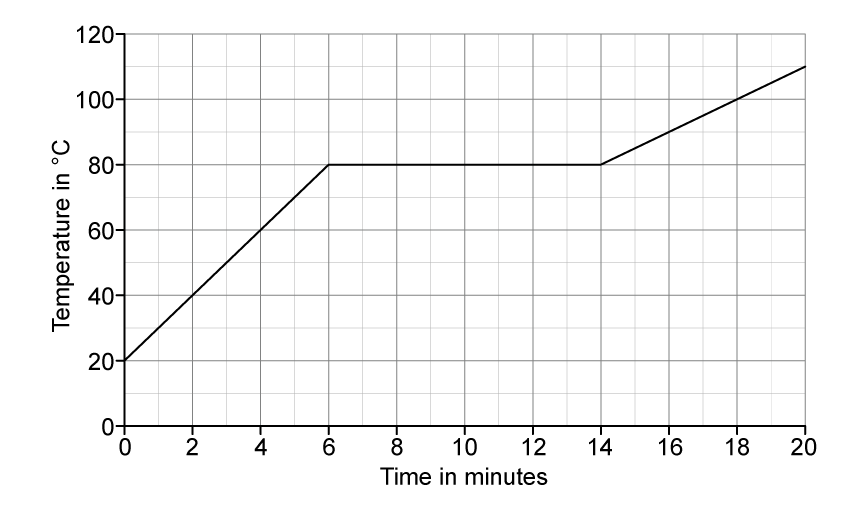
A student heats a solid substance at a constant rate.

Figure 5 shows how the temperature of the substance varies with time

Graph showing temperature in degrees Celsius on the y-axis ranging from 0 to 120 and time in minutes on the x-axis ranging from 0 to 20. Three sections: (1) straight line rising from (0, 20) to (6, 80); (2) horizontal line from (6, 80) to (14, 80); (3) straight line rising from (14, 80) to (20, 110)

Figure 5

Explain what happens to the molecules of substance between 6 and 14 minutes.

5b
Sme Calculator
3 marks

Between 6 and 14 minutes, 46 space 000 text  J end text of thermal energy is supplied to the substance.

The mass of the substance is 220 text  g end text.

Calculate the specific latent heat of fusion of the substance.

Give the unit.

Use the equation:

Q space equals space m cross times L

5c
2 marks

Some thermal energy was transferred to the surroundings while the substance was being heated.

Explain how this affected the student's value for the specific latent heat of fusion.

5d
2 marks

Explain why the graph in Figure 5 is steeper in the first 6 minutes than in the last 6 minutes.

6
Sme Calculator
2 marks

Figure 6 shows a sealed gas syringe containing a fixed mass of gas.

q10-cie-ol-physics-paper-1-2021-mcq

Figure 6

The gas in the syringe has a mass of 0.12 text  g end text and a volume of 100 text  cm end text cubed.

Calculate the density of the gas.

Give the unit.

Use the equation:

text density end text space equals space fraction numerator text mass end text over denominator text volume end text end fraction

1a
6 marks

A student uses the apparatus in Figure 3 to determine the specific heat capacity of water.

fig-3-paper2h-june2018-edexcel-gcse-physics

Figure 3

(i) State the measurements needed to calculate the specific heat capacity of water.

[4]

(ii) State two ways that the apparatus could be adapted to improve the procedure.

[2]

1b
1 mark

The student decides to measure the temperature of the water every minute while it is being heated.

Figure 4 shows a graph of the student’s results.

fig-4-paper2h-june2018-edexcel-gcse-physics

Figure 4

Predict the temperature of the water if the heating continues up to 8 minutes.

temperature of the water = ............................................... °C

1c
2 marks

Another student decides to melt some ice.

The student melts 380g of ice at 0°C.

The specific latent heat of fusion of ice is 3.34 × 10⁵ J/kg.

Calculate the thermal energy needed to melt the ice.

Select an equation from the list of equations at the end of this paper

thermal energy needed = ............................................. J

2a
Sme Calculator
6 marks

An electric kettle contains 1.41 kg of water at 25°C.

The kettle is switched on.

After a while, the water reaches boiling point at 100°C.

The specific heat capacity of water is 4200 J/ kg°C.

(i) Calculate the amount of thermal energy supplied to the water by the kettle.

Give your answer to the appropriate number of significant figures.

Use an equation selected from the list of equations at the end of the paper.

energy supplied = .............................................................. J[3]

(ii) The kettle is kept switched on and the water continues to boil.

After a while, the mass of the water in the kettle has decreased to 1.21 kg.

The thermal energy supplied to the water during this time was 450000 J.

Calculate the specific latent heat of vaporisation of water.

Use an equation selected from the list of equations at the end of the paper.

specific latent heat of vaporisation = ......................... J/ kg[3]

2b
Sme Calculator
6 marks

This question is about determining the specific heat capacity of aluminium.

An aluminium block is placed in boiling water as shown in Figure 21.

fig-21-paper2h-oct2021-edexcel-gcse-physics

Figure 21

The piece of string is tied to the aluminium block so the block can be transferred from the boiling water to the cold water.

Describe how a student could use this apparatus, and any additional items needed, to determine the specific heat capacity of aluminium.

Your answer should include how the student would

  • obtain the necessary measurements

  • use the measurements to calculate the specific heat capacity of aluminium.

3a
Sme Calculator
3 marks

A student investigates the density of a brick and the density of a small toy, as shown in Figure 1.

14-1-h-3a-brick-and-fish-toy

Figure 1

The student found the volume of the brick by multiplying the area of its base by its height. The fish toy does not have straight sides.

Describe how the student could measure the volume of the small toy.

You may use a diagram if it helps your answer.

3b
Sme Calculator
6 marks

The student uses the equipment shown in Figure 2 to measure the temperature of water as it is heated.

14-1-h-3b-specific-heat-capacity-experiment

Figure 2

Describe an experiment the student could carry out to determine the specific heat capacity of the water.

4a
1 mark

A student heats a solid substance at a constant rate.

Figure 15 shows how the temperature of the substance varies with time

Graph showing temperature in degrees Celsius on the y-axis ranging from 0 to 120 and time in minutes on the x-axis ranging from 0 to 20. Three sections: (1) straight line rising from (0, 20) to (6, 80); (2) horizontal line from (6, 80) to (14, 80); (3) straight line rising from (14, 80) to (20, 110)

Figure 15

The melting point of the substance is

  • 20 degree straight C

  • 50 degree straight C

  • 80 degree straight C

  • 110 degree straight C

4b
2 marks

Describe what happens to the molecules of substance between 6 and 14 minutes.

4c
3 marks

Between 6 and 14 minutes, 46 space 000 text  J end text of thermal energy is supplied to the substance.

The mass of the substance is 220 text  g end text.

Calculate the specific latent heat of fusion of the substance.

Give the unit.

Use the equation:

Q space equals space m cross times L

4d
2 marks

Some thermal energy was transferred to the surroundings while the substance was being heated.

Explain how this affected the student's value for the specific latent heat of fusion.

4e
6 marks

Figure 16 shows some of the equipment a student uses to determine the specific heat capacity of an aluminium block.

An aluminium block with an electrical heater and a thermometer inserted into drilled holes.

Figure 16

Describe the method the student should use to determine the specific heat capacity of the aluminium block.

Your description should include:

  • any other equipment needed

  • the measurements the student must take

  • how the measurements are used to calculate the specific heat capacity.

You may add to the diagram or draw your own if it helps your answer.

5a
Sme Calculator
3 marks

A student has a rectangular block of aluminium. The block has a mass of 0.54 \text{ kg}.

The block measures 10.0 \text{ cm} \times 5.0 \text{ cm} \times 4.0 \text{ cm}

Calculate the density of the aluminium.

Give the unit.

5b
2 marks

The student wants to determine the density of an irregularly shaped piece of aluminium.

Describe a method the student could use to measure the volume of the aluminium.

5c
1 mark

The student heats a beaker of water using an electric heater. As the water is heated, its internal energy increases.

Which of these correctly describes the internal energy of the water?

  • The total kinetic energy of the water particles

  • The total potential energy of the water particles

  • The total kinetic energy and potential energy of all the particles in the water

  • The average kinetic energy of the water particles

5d
6 marks

The student continues to heat the water until it boils and turns into steam.

The density of water is 1000 text  kg/m end text cubed. The density of steam is approximately 0.60 text  kg/m end text cubed.

A block of ice is heated at a constant rate until it has all turned into steam.

Explain, using ideas about particles, what happens during this process.

Your answer should include:

  • how the arrangement and movement of particles changes

  • why the temperature stays constant during each change of state

  • why the density of steam is much lower than the density of liquid water