Placebo - GCSE Biology Definition
Reviewed by: Dr Natalie Lawrence
Last updated
Key Takeaways
A placebo is a treatment with no active ingredient, such as a sugar pill or saline injection, given during a clinical trial
Placebos allow scientists to compare the effects of a real drug against an inactive treatment
The ‘placebo effect’ occurs when patients experience genuine improvements in symptoms despite receiving an inactive treatment
In a double-blind trial, neither the patient nor the doctor knows who is receiving the placebo
Placebos are one of the most reliable tools in science for testing whether a new drug actually works
Placebo Meaning
A placebo is a simulated treatment that contains no active ingredient. It's designed to look, taste and feel identical to the active treatment being tested. Common examples include sugar pills, saline injections and capsules filled with starch.
Placebos aren't meant to treat the patient. They exist to satisfy the conditions of a fair test. Scientists use placebos during clinical trials to create a comparison group. Without one, researchers can't tell whether a patient improved because of the drug itself or because of other factors like natural recovery or expectation.
Types of Placebos
Placebos come in several forms, depending on what's being tested:
Type | Description | Used when testing... |
|---|---|---|
Sugar pill | A tablet made of sugar or starch with no active drug | Oral medications |
Saline injection | A sterile saltwater solution injected into the body | Injectable drugs |
Sham procedure | A fake surgical procedure where no real operation occurs | Surgical interventions |
The key feature across all types is the same: the patient receives something that mimics the real treatment but contains no active therapeutic ingredient.
What Is a Placebo Group?
In a clinical trial, participants are split into two groups. One group receives the drug being tested. The other receives a placebo. The placebo group is sometimes called the control group.
By comparing outcomes between the two groups, scientists can identify whether any improvements are genuinely caused by the drug. If both groups improve at similar rates, the drug likely isn't effective. If the drug group improves significantly more, researchers have evidence the treatment works.
This comparison is the backbone of evidence-based medicine. Without a placebo group, it's impossible to separate the drug's real effect from coincidence, natural healing or patient expectation.
Double-Blind Trials
A double-blind trial adds another layer of rigour. In this setup, neither the patient nor the doctor knows who is receiving the real drug and who is getting the placebo. Assignments are coded and only revealed after the trial concludes.
Why go this far? Because expectations influence outcomes on both sides. A patient who knows they're taking the real drug might report feeling better simply because they believe it will work. A doctor who knows which patients are on the drug might unconsciously interpret their results more favourably.
Double-blind trials remove both of these biases, producing results that scientists can trust.
The Placebo Effect
The placebo effect is one of the strangest phenomena in medicine. It happens when a patient experiences a genuine, measurable improvement in their condition after receiving a treatment that contains no active ingredient.
Brain scans have shown that placebo treatments can trigger the release of endorphins, the body's natural painkillers. Patients given a placebo for pain relief have shown real changes in brain activity that mirror what happens with actual painkillers.
The effect tends to be strongest in conditions involving pain, nausea, fatigue and mood. It's weaker for conditions with clear biological markers, like infections caused by pathogens or broken bones.
Placebo Effect Examples
Here are three well-documented cases:
Pain relief studies: Patients given sugar pills labelled as painkillers reported significant reductions in pain. Their brains released endorphins in response to the expectation of relief [1].
Sports performance: Athletes told they were taking a performance-enhancing supplement (which was actually a placebo) performed better in trials. Their belief changed their output [2].
Knee surgery trials: In a landmark 2002 study, patients who received sham knee surgery (where surgeons made incisions but performed no actual procedure) reported the same level of improvement as those who had real surgery [3].
These examples show that belief and expectation can produce measurable physical changes, even without any active treatment.
Why Placebos Matter in Science
Placebos exist to answer one question: does this treatment actually work, or are patients just getting better on their own?
The human body recovers from many conditions naturally over time. Patients in trials also may improve simply because they're receiving attention and care. Without a placebo group, these confounding factors would be indistinguishable from genuine drug effects.
There are ethical boundaries, though. If an effective treatment already exists for a condition, giving some patients a placebo instead could cause harm. In these cases, trials compare the new drug against the existing treatment rather than a placebo. Not every trial uses them, and medical ethics committees review each study before it begins.
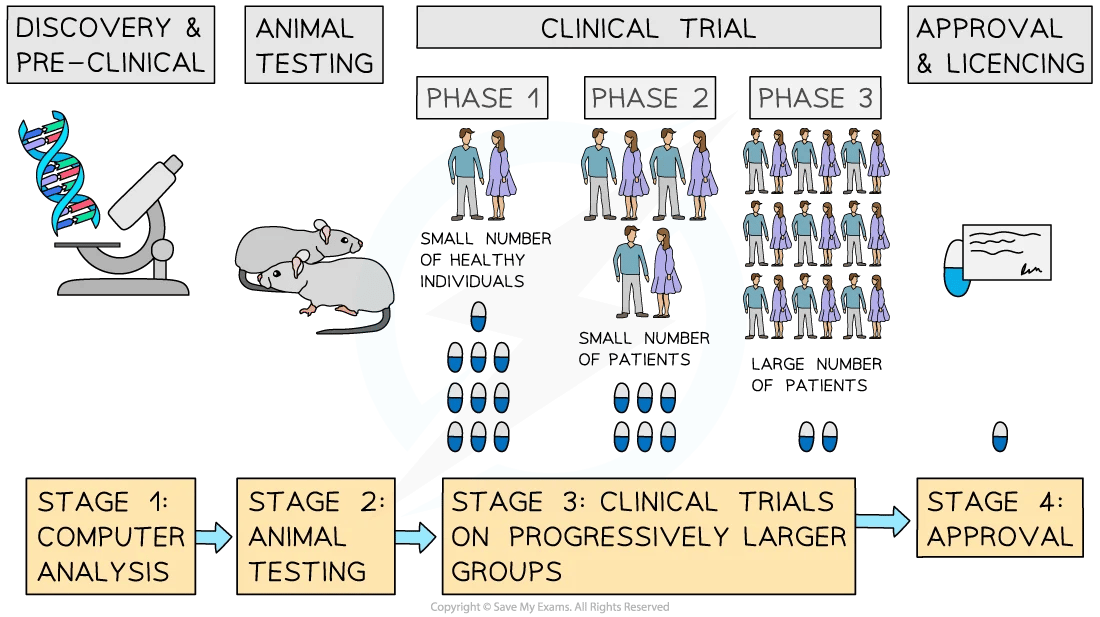
Save My Exams covers the full drug testing process, from preclinical laboratory testing through to clinical trials, in their revision notes on Discovery & Development of Drugs for AQA GCSE or find the notes for your specific course. Written by experienced teachers and examiners, these notes walk through each stage of how new medicines are developed and tested, including how placebos are used in double-blind studies to find the optimum dose.
Frequently Asked Questions
Is a placebo a real drug?
No. A placebo contains no active ingredient and has no direct pharmacological effect on the body. It's made to look identical to the real treatment so that patients can't tell the difference during a trial.
Can the placebo effect cure illness?
The placebo effect can relieve symptoms like pain, nausea and anxiety, but it doesn't treat the underlying cause of a disease. It won't kill bacteria, shrink a tumour or fix a broken bone. Its effects are primarily linked to perception and expectation.
Do doctors sometimes use placebos?
In clinical practice, placebos are rarely prescribed deliberately. Their main role is in research, where they help scientists determine whether a new drug is genuinely effective. Some studies have explored "open-label placebos" (where patients know they're taking a placebo), and even these have shown small benefits in certain conditions.
What happens if you know you are taking a placebo?
Surprisingly, the effect doesn't always disappear. Open-label placebo studies have found that patients who knowingly take a placebo can still experience symptom relief. The reasons aren't fully understood, but the ritual of taking a pill and expecting care may play a role.
Are placebos used in every clinical trial?
Placebo-controlled trials are common, but they aren't always appropriate. If a proven treatment already exists, it would be unethical to deny it to patients in the placebo group. In those situations, the new drug is tested against the existing standard of care instead.
References
[1] Bernstein MH, Blease C and Vase L (2022) Editorial: Placebo Effect in Pain and Pain Treatment. (opens in a new tab) Front. Pain Res. 3:884055.
[2] Hurst P, Foad A, Coleman D, Beedie C. Athletes Intending to Use Sports Supplements Are More Likely to Respond to a Placebo (opens in a new tab). Med Sci Sports Exerc. 2017 Sep;49(9):1877-1883.
[3] Baylor College Of Medicine. "Study Finds Common Knee Surgery No Better Than Placebo (opens in a new tab)." ScienceDaily. 12 July 2002.
Examiner-written GCSE Biology revision resources that improve your grades 2x
- Written by expert teachers and examiners
- Aligned to exam specifications
- Everything you need to know, and nothing you don’t
Was this glossary entry helpful?


Share this article
 written revision resources that improve your