Teacher Shortage Statistics 2026: Key Stats & Impact on Students

Written by: Emma Dow
Reviewed by: Holly Barrow
Published
Contents
Teacher shortages in the UK have been climbing the political agenda for years. But most of the debate focuses on:
Training targets missed
Vacancy rates rising
Teachers burning out and leaving
What this means for the students sitting in those classrooms is very rarely discussed.
That's the gap this report sets out to fill.
Save My Exams surveyed 2,315 UK students - studying GCSEs, A Levels, the IB, and the IGCSE - to find out how teaching disruptions are affecting:
Their learning
Their revision
Their exam confidence
We combined those findings with the most up-to-date workforce data from the Department for Education, NFER, the NAO, and others to build the most complete picture of teacher shortages and their student impact available in 2026.
Key Takeaways: Top Teacher Shortage Statistics
63% of students say they have fallen behind in a subject due to a lack of consistent teaching.
62% have missed important lessons or topics because their teacher was absent or changed mid-year.
1 in 2 students feel less confident going into exams because of disruptions to their teaching.
70% of students have had two or more different teachers for the same subject in a single academic year.
73% have experienced a teacher leaving their school partway through the year.
59% have had a long-term substitute teacher for several weeks or more.
81% turn to online revision resources when their teaching is disrupted.
The unfilled teacher vacancy rate is six times higher than before the pandemic (NFER).
90% of teachers considering leaving cite high workload as a key factor (NFER Classroom).
The Impact of Teacher Shortages on UK Students (Primary Data)
This section draws entirely on our original survey data to capture what the crisis actually feels like from inside the classroom.
Who We Surveyed: Student Demographics
Our survey captured responses from 2,315 UK-based students. Here's how the sample broke down:
Level of study:
52% GCSE
37% A Level
9% IGCSE
1% IB
1% other
School type:
56% state school
22% private/independent
19% grammar school
3% other
Gender:
60% female
38% male
1% prefer not to say
1% non-binary
Location:
97% England, with further responses from Wales (0.9%), Scotland (0.8%), and Northern Ireland (0.1%).
Classroom Disruption
For many students, cover lessons and self-study sessions have become a normal - if frustrating - part of school life.
49% of students have cover teachers sometimes, often, or very often - meaning roughly 1 in 2 students is regularly taught by someone other than their usual teacher.
13% say cover lessons happen often or very often.
Just 10% say they have never had a cover teacher this academic year.
When it comes to working independently due to a lack of a teacher, the figures are even higher: 60% of students are sometimes, often, or very often asked to work alone during lesson time.
24% say this happens often or very often, meaning nearly 1 in 4 students is regularly left to manage their own learning during taught lessons.
For a significant proportion of students, gaps in teaching are a recurring feature of their school week.
Teacher Availability & Turnover
73% of students have experienced a teacher leaving their school partway through the year.
59% have had a long-term substitute or temporary teacher in place for several weeks or more.
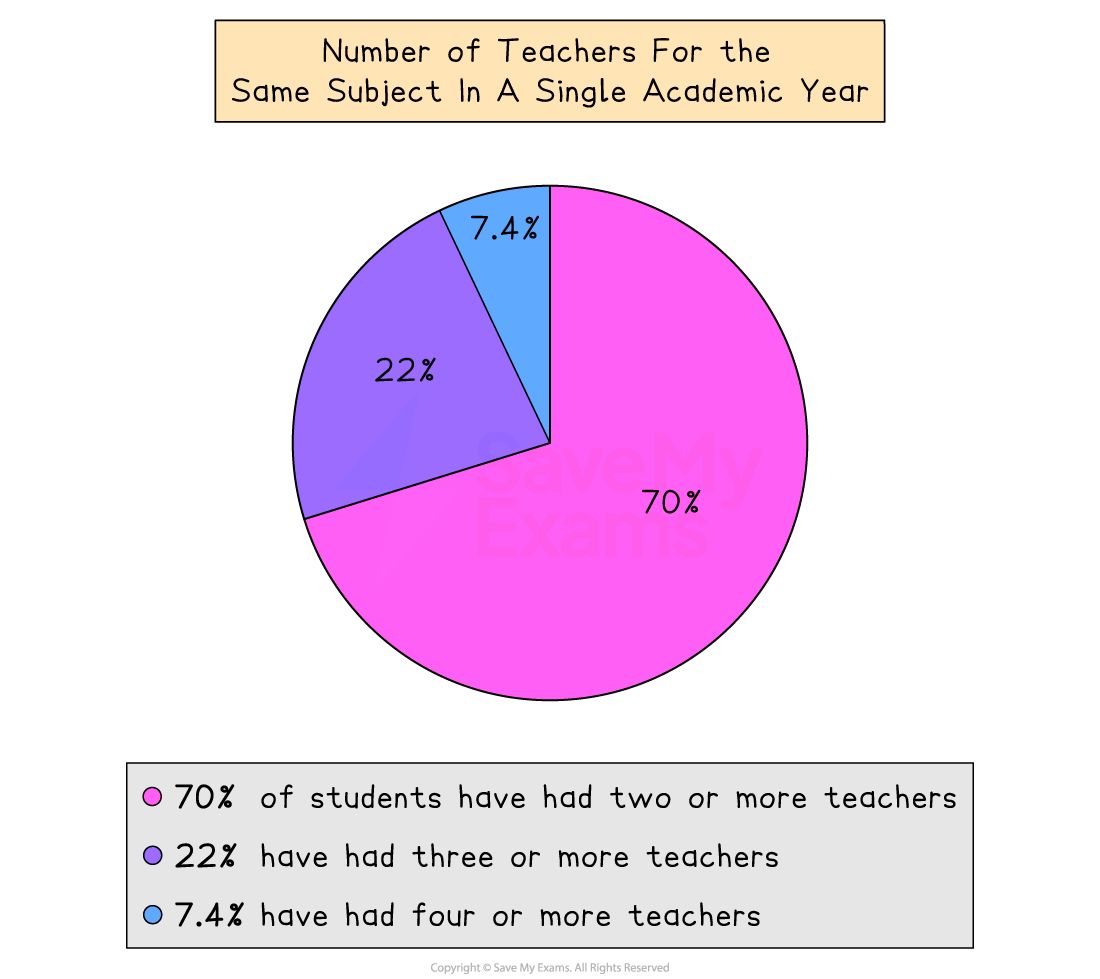
70% of students have had two or more different teachers for the same subject in a single academic year.
22% have had three or more teachers for the same subject, and 7.4% have had four or more.
The difference between school types is notable.
State school students are more likely to have experienced long-term substitute teachers (61%) than those at private or independent schools (53%).
Impact on Learning
Our data shows the impact of teaching inconsistencies.
63% of students say they have fallen behind in at least one subject due to a lack of consistent teaching.
62% have missed important lessons or topics because a teacher was absent or left mid-year.
State school students were most likely to report falling behind: 68% said they had, compared to 53% of private school students and 59% of grammar school students
That gap between state and independent school students is significant. It reflects:
The higher rates of teacher turnover in state schools.
The reduced access to safety nets like private tutors, well-resourced parents, premium.
Revision tools, that can help independent school pupils bridge learning gaps.
The impacts of teacher shortages tend to be more acute in schools with a higher proportion of pupils from disadvantaged backgrounds, where vacancy and turnover rates are consistently the highest (NFER, 2025).
Exam Readiness & Confidence
A student who has missed key content, or been taught by a string of cover teachers all year, often feels underprepared.
50% of students feel less confident going into exams because of disruptions to their teaching.
GCSE students feel the impact most acutely: 54% said teaching disruptions had dented their exam confidence, compared to 46% of A Level students.
Only 36% of students say teaching disruptions have had no effect on their exam confidence at all.
Access to Teaching & Subject Support
Students also have clear views on whether their school is sufficiently staffed to meet their needs.
28% of students say their school does not have enough teachers to support students properly.
A further 17% are not sure, meaning around 45% either doubt or can't confirm that their school is adequately staffed.
55% of students are confident their school has enough teachers.
The divide by school type is stark:
70% of private school students say their school has enough teachers.
That figure drops to just 49% of state school students and 59% of grammar school students.
More than 1 in 3 state school students (32%) say their school does not have enough teachers. For independent school students, that figure is a much lower 19%.
How Students Are Coping
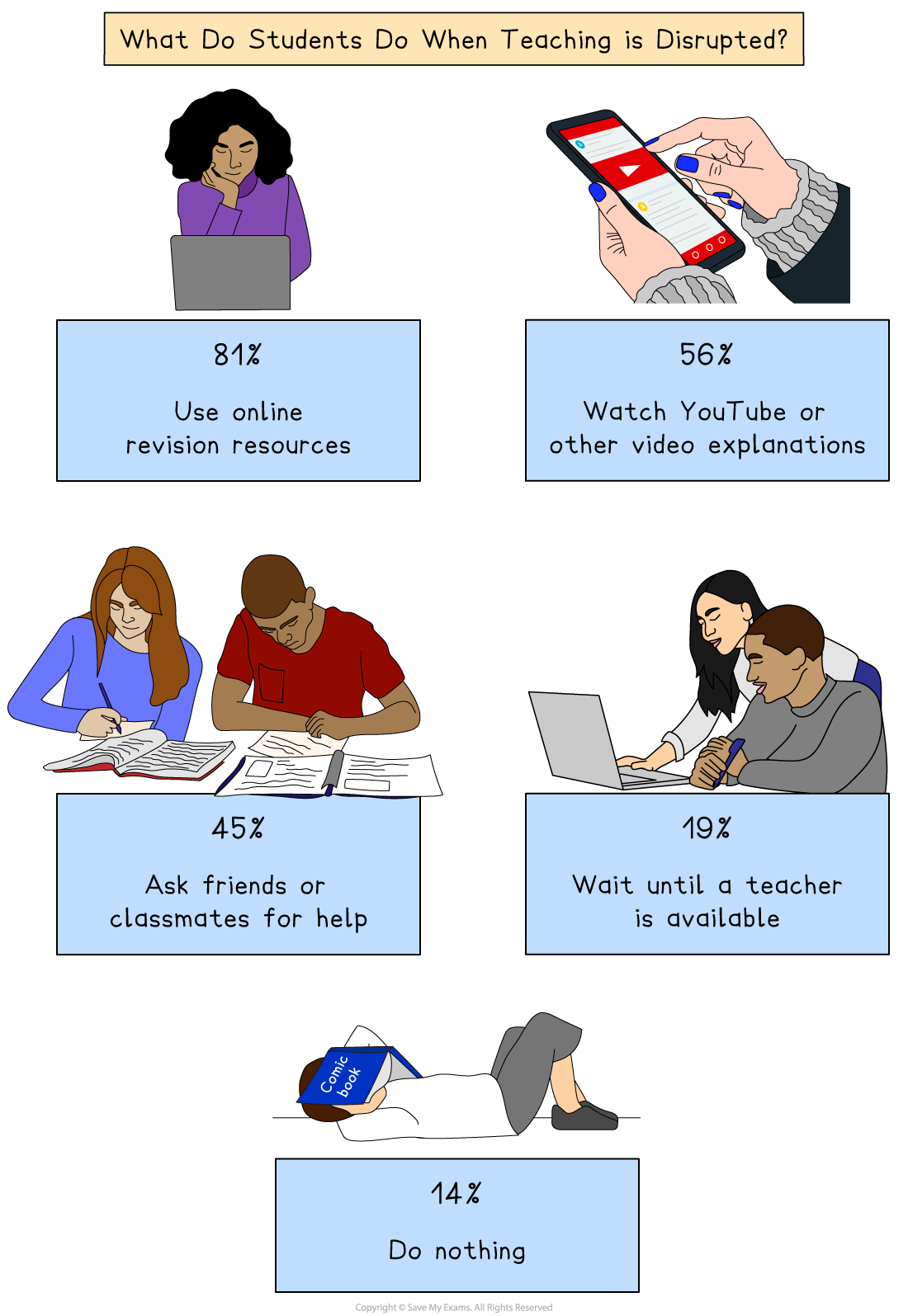
When their teaching is disrupted, students said they:
Use online revision resources - 81%
Watch YouTube or other video explanations - 56%
Ask friends or classmates for help - 45%
Wait until a teacher is available - 19%
Do nothing - 14%
Only 9% of students said that teaching hasn’t been disrupted.
Four in five students are turning to the internet when their classroom teaching falls short, and more than half are using YouTube as a substitute for specialist teaching.
Teacher Shortage Statistics in the UK
Teacher Recruitment & Retention Crisis
The scale of the teacher shortage in England is well documented, and despite some marginal improvements in vacancy numbers, the underlying picture remains concerning.
The unfilled teacher vacancy rate is six times higher than pre-pandemic levels (NFER).
Teacher vacancies peaked at 2,800 in November 2023, falling slightly to 2,200 in November 2024 (DfE School Workforce Census).
Physics recruitment reached just 17% of its target in 2024/25, while Modern Foreign Languages hovered at 33% (HEPI).
58% of GCSE Physics lessons in England are taught by non-Physics specialists (Institute of Physics).
60% of schools struggle to recruit specialist MFL teachers (British Council).
The five-year teacher retention rate has dropped to around 57% (Schools in England).
Save My Exams' own Classrooms in Crisis campaign revealed that:
66% of UK teachers have experienced abuse on some level from students (Save My Exams Classrooms in Crisis Campaign).
Two-fifths (41%) of teachers have left or contemplated leaving teaching due to abuse from students (Save My Exams Classrooms in Crisis Campaign).
Two in three (66%) teachers have been subject to abuse from parents (Save My Exams Classrooms in Crisis Campaign).
The government has pledged to recruit 6,500 additional teachers by the end of the current parliament (National Audit Office). But this is a challenging target, especially when you factor in the increasingly difficult situations teachers experience in the classroom.
Teacher Workload & Burnout
The average primary teacher worked 53.2 hours in a typical week in 2025, and the average secondary teacher worked 51.2 hours (House of Commons Library).
76% of teachers reported feeling stressed in the 2025 Teacher Wellbeing Index, (Education Support).
72% of teachers feel the pressure of Ofsted negatively affects their wellbeing (NEU).
Only 60% of teachers now expect to remain in the profession for the next three years (The Gatsby Foundation).
Every teacher who burns out and leaves is a teacher who needs to be replaced. And as the recruitment figures make clear, replacement is far from guaranteed.
Rise of Self-Directed Learning
Our survey found that 81% of students turn to online revision resources when their teaching is disrupted, and 56% use YouTube.
Students are increasingly using:
Online revision platforms — structured, syllabus-matched resources that cover content step by step like those at Save My Exams.
YouTube videos (opens in a new tab) - free, accessible, and available at any hour.
AI tools - increasingly used to explain concepts, generate practice questions, and check understanding.
Risks of Replacing Teaching with Independent Study
Self-directed learning has real limits and is no replacement for specialist teachers.
Qualitative research has demonstrated that AI is not yet the same calibre as a specialist teacher (Contemporary Educational Technology).
40% of teaching tasks (admin, data analysis, rather than subject teaching) could be augmented by AI to some extent (World Economic Forum).
Inequality & the Teacher Shortage Crisis
Disadvantaged Students Are Hit Hardest
The more disadvantaged the school, the worse the staffing, and the greater the impact on students.
In the least disadvantaged schools in 2023/24, around 1 in 100 posts are either vacant or temporarily filled, compared to 2.6 in 100 posts in the most disadvantaged schools - and the gap is widening (NFER Blog).
In 2023/24, secondary schools with the highest percentage of disadvantaged pupils had just over a third of teachers with five years or less experience, compared with 20% in schools with the lowest percentage of disadvantaged pupils (NAO).
Nearly a third of pupils from poorer backgrounds lack access to Computer Science at A Level due to teacher shortages (Teach First).
Private vs State School Divide
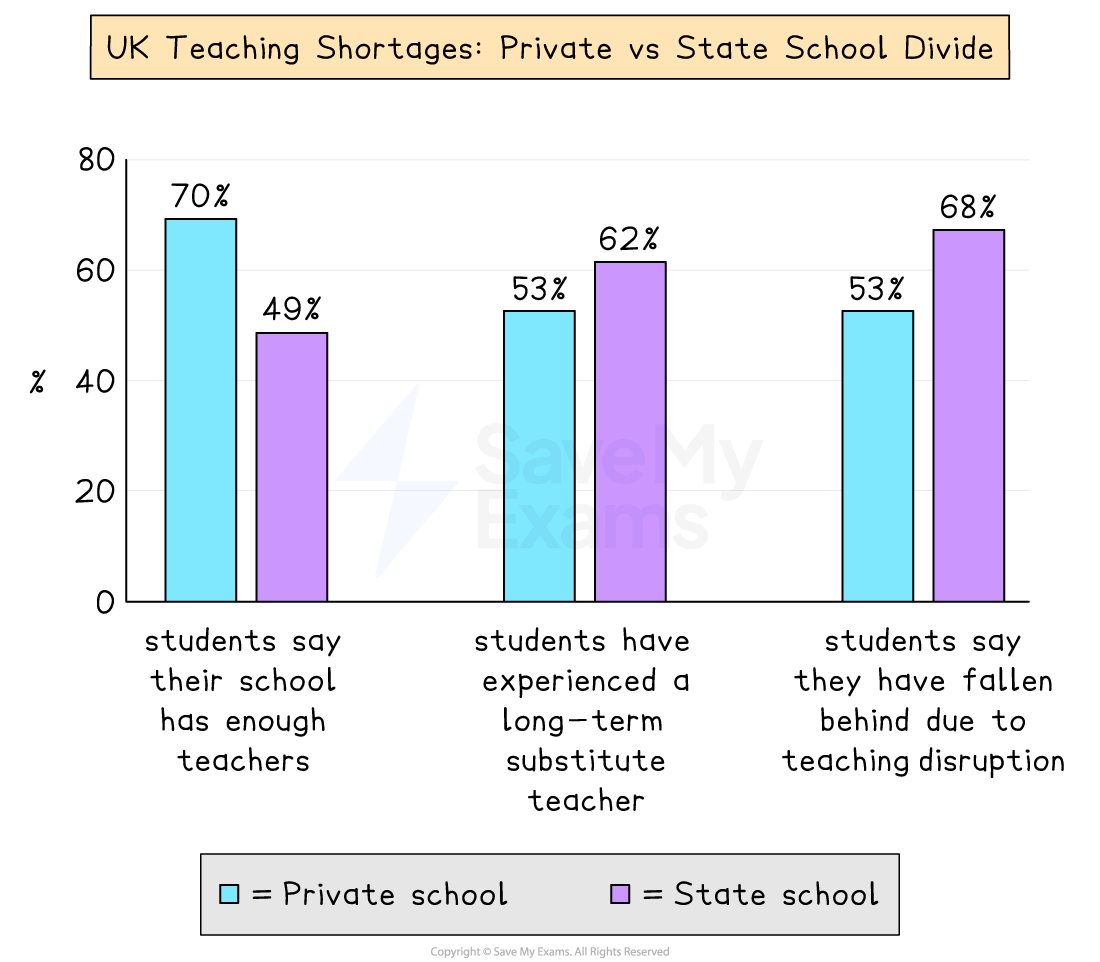
The contrast between the independent and state school sectors, when it comes to teacher stability, is one of the starkest inequalities in English education. Our data shows the following:
70% of private school students say their school has enough teachers, compared to just 49% of state school students.
53% of private school students have experienced a long-term substitute teacher, versus 62% of state school students.
53% of private school students say they have fallen behind due to teaching disruption versus 68% of those in state schools.
The Future of Teaching in the UK
The data from this survey is hard to ignore.
The government's 6,500-teacher recruitment pledge (National Audit Office) is a serious attempt to address the crisis.
But for students caught in the middle, the most important thing to know is this: the gap in your classroom doesn't have to become a gap in your knowledge.
High-quality, syllabus-matched resources exist to help you stay on track, and Save My Exams is built specifically for that moment when you need to understand something, and your teacher isn't there.
Every student deserves the same shot at exam success, regardless of who taught their last lesson.
Appendix: Full List of Teacher Shortage Statistics
Here's every statistic referenced in this article, in one place.
49% of students have cover teachers sometimes, often, or very often (Save My Exams Survey, 2026)
13% say cover lessons happen often or very often (Save My Exams Survey, 2026)
10% have never had a cover teacher this academic year (Save My Exams Survey, 2026)
60% are sometimes, often, or very often asked to work independently due to a lack of a teacher (Save My Exams Survey, 2026)
24% say this happens often or very often (Save My Exams Survey, 2026)
73% have experienced a teacher leaving their school partway through the year (Save My Exams Survey, 2026)
59% have had a long-term substitute or temporary teacher (several weeks or more) (Save My Exams Survey, 2026)
62% of state school students have had a long-term substitute teacher, vs 53% of private school students (Save My Exams Survey, 2026)
70% of students have had two or more teachers for the same subject this academic year
22% have had three or more teachers for the same subject (Save My Exams Survey, 2026)
7% have had four or more teachers for the same subject (Save My Exams Survey, 2026)
63% have fallen behind in a subject due to a lack of consistent teaching (Save My Exams Survey, 2026)
68% of state school students have fallen behind, vs 53% of private school students (Save My Exams Survey, 2026)
62% have missed important lessons or topics due to teacher absence or mid-year change (Save My Exams Survey, 2026)
1 in 2 students feel less confident going into exams because of teaching disruptions (Save My Exams Survey, 2026)
54% of GCSE students feel less confident, vs 46% of A Level students (Save My Exams Survey, 2026)
36% say teaching disruptions have had no effect on their exam confidence (Save My Exams Survey, 2026)
55% of students say their school has enough teachers to support students properly (Save My Exams Survey, 2026)
28% say their school does not have enough teachers (Save My Exams Survey, 2026)
17% are not sure whether their school has enough teachers (Save My Exams Survey, 2026)
70% of private school students say their school has enough teachers, vs 49% of state school students (Save My Exams Survey, 2026)
32% of state school students say their school does not have enough teachers, vs 19% of private school students (Save My Exams Survey, 2026)
81% turn to online revision resources when teaching is disrupted (Save My Exams Survey, 2026)
56% watch YouTube or other videos (Save My Exams Survey, 2026)
45% ask friends or classmates for help (Save My Exams Survey, 2026)
19% wait until a teacher is available (Save My Exams Survey, 2026)
14% do nothing when teaching is disrupted (Save My Exams Survey, 2026)
9% say their teaching has not been disrupted (Save My Exams Survey, 2026)
The unfilled teacher vacancy rate is six times higher than pre-pandemic levels (NFER)
90% of teachers considering leaving cite high workload as a key factor (NFER Classroom)
Teacher vacancies fell from a peak of 2,800 in November 2023 to 2,200 in November 2024 (DfE School Workforce Census)
Physics recruitment reached just 17% of its target in 2024/25, while Modern Foreign Languages hovered at 33% (HEPI)
58% of GCSE Physics lessons in England are taught by non-Physics specialists (Institute of Physics)
60% of schools struggle to recruit specialist MFL teachers (British Council)
The five-year teacher retention rate has dropped to around 57% (Schools in England)
The government has pledged to recruit 6,500 additional teachers by the end of the current parliament (National Audit Office)
66% of UK teachers have experienced abuse on some level from students (Save My Exams Classrooms in Crisis Campaign).
Two-fifths (41%) of teachers have left or contemplated leaving teaching due to abuse from students (Save My Exams Classrooms in Crisis Campaign)
Two in three (66%) teachers have been subject to abuse from parents (Save My Exams Classrooms in Crisis Campaign)
The average primary teacher worked 53.2 hours in a typical week in 2025, and the average secondary teacher worked 51.2 hours (House of Commons Library)
76% of teachers reported feeling stressed in the 2025 Teacher Wellbeing Index, (Education Support)
72% of teachers feel the pressure of Ofsted negatively affects their wellbeing (NEU)
Only 60% of teachers now expect to remain in the profession for the next three years (The Gatsby Foundation)
Qualitative research has demonstrated that AI is not yet the same calibre as a teacher (Contemporary Educational Technology)
40% of teaching tasks (admin, data analysis, rather than subject teaching) could be augmented by AI to some extent (World Economic Forum)
In the least disadvantaged schools in 2023/24, around 1 in 100 posts are either vacant or temporarily filled, compared to 2.6 in 100 posts in the most disadvantaged schools - and the gap is widening (NFER Blog)
In 2023/24, secondary schools with the highest percentage of disadvantaged pupils had just over a third of teachers with five years or less experience, compared with 20% in schools with the lowest percentage of disadvantaged pupils (NAO)
Nearly a third of pupils from poorer backgrounds lack access to Computer Science at A Level due to teacher shortages (Teach First)
References
Primary Data
Save My Exams Student Experience Survey (2026) - 2,315 UK students
Secondary Data
NFER (opens in a new tab)
DfE School Workforce Census (opens in a new tab)
NFER Classroom (opens in a new tab)
HEPI (opens in a new tab)
Institute of Physics (opens in a new tab)
British Council (opens in a new tab)
Schools in England (opens in a new tab)
National Audit Office (opens in a new tab)
Education Support (opens in a new tab)
NEU (opens in a new tab)
The Gatsby Foundation (opens in a new tab)
Contemporary Educational Technology (opens in a new tab)
World Economic Forum (opens in a new tab)
NFER Blog (opens in a new tab)
NAO (opens in a new tab)
Teach First (opens in a new tab)
Was this article helpful?
Sign up for articles sent directly to your inbox
Receive news, articles and guides directly from our team of experts.

Share this article

 written revision resources that improve your