Synoptic Exam Questions (Paper 1 & 2) (AQA A Level Physics): Exam Questions

Exam code: 7408

2 hours10 questions
1a
1 mark

Figure 1 shows a single gas particle of an ideal gas with mass m travelling at a velocity u subscript x in the x-direction of a rectangular box. The particle travels backwards and forwards within the box, repeatedly colliding with the shaded faces.

Figure 1

6-6-s-q--q4a-medium-aqa-a-level-physics

The box has dimensions L subscript x, L subscript y, and L subscript z.

Write an expression, in terms of L subscript x and u subscript x, for the time interval t between collisions.

1b
1 mark

Explain why the change in momentum of a particle during one collision with a shaded face is negative 2 m u subscript x.

1c
3 marks

The box contains N particles of the ideal gas which have a mean square speed of stack u subscript x superscript 2 with bar on top in the x-direction.

Show that the average force F exerted by the particles on one of the shaded faces is given by fraction numerator N m stack u subscript x superscript 2 with bar on top over denominator L subscript x end fraction, stating one assumption you make.

2a
2 marks

The core of a thermal nuclear reactor contains a number of components that are exposed to moving neutrons. 

State what happens to a neutron that is incident on: 

  • the moderator

  • a control rod.

2b
3 marks

A slow-moving neutron collides with a nucleus of an atom of the fuel which induces nuclear fission. 

Describe what happens in the process of induced fission.

2c
3 marks

A student sets up the arrangement, shown in Figure 8, to demonstrate the principle of moderation in a nuclear reactor.

Figure 8

8-4-s-q--q3c-medium-aqa-a-level-physics

A golf ball of mass m is initially hanging vertically and just touching a hockey ball of mass 3 m. The golf ball is pulled up to the side and released. After the collision, the balls move in opposite directions with equal speeds.

Explain, with numerical detail, how this arrangement demonstrates the moderation process in a reactor.

2d
2 marks

A thermal nuclear reactor produces radioactive waste.

State the main source of the most dangerous waste and describe one problem faced in dealing with the waste.

3a
2 marks

Thin films of carbon are sometimes used in electronic systems. 

Typical dimensions of such a film are shown in Figure 7.

Figure 7

WYi3oQ4L_5-2-s-q--q2a-hard-aqa-a-level-physics

Calculate the current which passes through the carbon film shown in Figure 7 for an applied voltage of 2.5 mV. 

The resistivity of carbon = 4.0 × 10⁻⁵ Ω m

3b
3 marks

The applied voltage is kept constant, but the current is now directed through the carbon film as shown in Figure 8.

Figure 8

5-2-s-q--q2b-hard-aqa-a-level-physics

Show that the current is approximately 6 magnitudes larger when directed through the carbon film, as shown in Figure 8.

3c
4 marks

A tensile force is applied to the carbon film in Figure 8 in a plane that is normal to the current. 

Without performing any calculations, state and explain how the resistance of the carbon film changes as a result of the applied tensile force, stating one assumption you make.

4a
2 marks

The International Space Station (ISS) orbits travels around the Earth once every 93 minutes. 

Calculate the angular speed of the ISS.

4b
3 marks

Calculate the distance of the ISS above the Earth’s surface.

4c
3 marks

The Soyuz is a Russian spacecraft that carries astronauts to and from the international space station (ISS). The ISS has a mass of approximately 4.2 × 10⁵ kg. 

Calculate the change in kinetic energy of a Soyuz travelling from the Earth’s surface to the ISS.

4d
2 marks

Without performing any further calculations, explain how the change in kinetic energy relates to the change of the potential energy when the Soyuz travels from the Earth’s surface to the ISS. 

5a
1 mark

Cyclotrons are used to accelerate particles, such as protons, for a number of applications. 

A cyclotron has two D-shaped regions called ‘dees’ where the magnetic flux density is constant. The dees are separated by a small gap. An alternating electric field between the dees accelerates charged particles. The magnetic field causes the charged particles to follow a circular path. 

Figure 5 shows the path followed by a proton that starts from O.

 Figure 5

screenshot-2023-10-02-094308

State the direction the magnetic field acts over the dees in Figure 5.

5b
2 marks

Explain why it is not possible for the magnetic field to alter the speed of a proton while it is in one of the dees.

5c
3 marks

Show that the time taken by a proton to travel around one semi-circular path is independent of the radius of the path.

5d
2 marks

The maximum radius of the path followed by the proton is 0.46 m and the magnetic flux density of the uniform field is 0.88 T. 

Calculate the maximum speed of a proton when it leaves the cyclotron. 

Ignore any relativistic effects.

5e
2 marks

The protons leave the cyclotron when the radius of their path is equal to the outer radius of the dees. 

Determine the radius required for the cyclotron to produce protons with a maximum kinetic energy of 25 MeV. 

Ignore any relativistic effects.

6a
2 marks

A student investigates the refraction of light using a semicircular glass block. The refractive index of the glass is 1.52.

State the two conditions required for total internal reflection to occur at a boundary.

6b
Sme Calculator
2 marks

A ray of light strikes the flat surface of the block at an angle of 50° to the normal, as shown in Figure 2.

Figure 2

A semicircular glass block with an arrow indicating a light ray hitting the straight edge at a 50-degree angle.

Complete, on Figure 2, the path of the ray of light.

Support your answer with a suitable calculation.

6c
2 marks

The flat surface of the glass block is now placed in contact with water.

Explain how the student could use the glass block to measure the refractive index of water.

6d
Sme Calculator
3 marks

The student then uses a diffraction grating to analyse the light from a sodium lamp. The sodium lamp emits two closely spaced wavelengths known as the sodium doublet:

lambda subscript 1 equals 589.0 text  nm end text      lambda subscript 2 equals 589.6 text  nm end text

The diffraction grating has 600 lines per mm.

Calculate the angle of diffraction for the second-order maximum of lambda subscript 1.

6e
3 marks

The student wants to resolve the sodium doublet and is considering two options:

  • Option 1: observe the second-order spectrum (n = 2) using the original 600 lines per mm grating

  • Option 2: observe the first-order spectrum (n = 1) using a different grating with 1200 lines per mm

Discuss which option the student should choose.

7a
Sme Calculator
2 marks

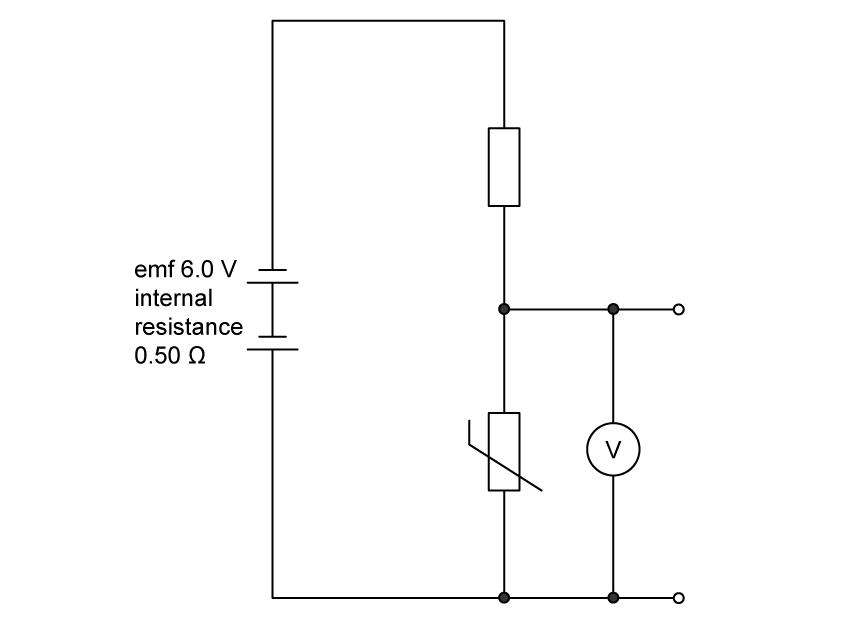
Figure 4 shows part of a circuit used to detect temperature changes.

A fixed resistor of resistance 2.5 space straight capital omega is connected in series with a thermistor of resistance 12 space straight capital omega at room temperature. The battery has an emf of 6.0 space straight V and an internal resistance of 0.50 space straight capital omega.

Figure 4

Circuit diagram showing a battery of emf 6.0 volts and internal resistance 0.50 ohms connected in series with a fixed resistor and a thermistor. A voltmeter is connected in parallel across the thermistor.

Calculate the current in the circuit.

7b
Sme Calculator
2 marks

Calculate the expected reading on the voltmeter.

7c
2 marks

The actual voltmeter reading is 4.6 V.

Suggest one reason for the difference between the expected and actual readings.

7d
Sme Calculator
3 marks

The fixed resistor is made from a wire of length 0.80 space straight m and diameter 0.28 space mm.

Calculate the resistivity of the wire.

7e
Sme Calculator
3 marks

The thermistor is heated so that its resistance decreases to 3.0 space straight capital omega. A warning LED is to be connected in parallel with either the fixed resistor or the thermistor. The LED illuminates when the potential difference across it exceeds 2.0 space straight V.

Determine which component the LED should be connected across so that it acts as a high-temperature warning. Support your answer with calculations.

8a
Sme Calculator
2 marks

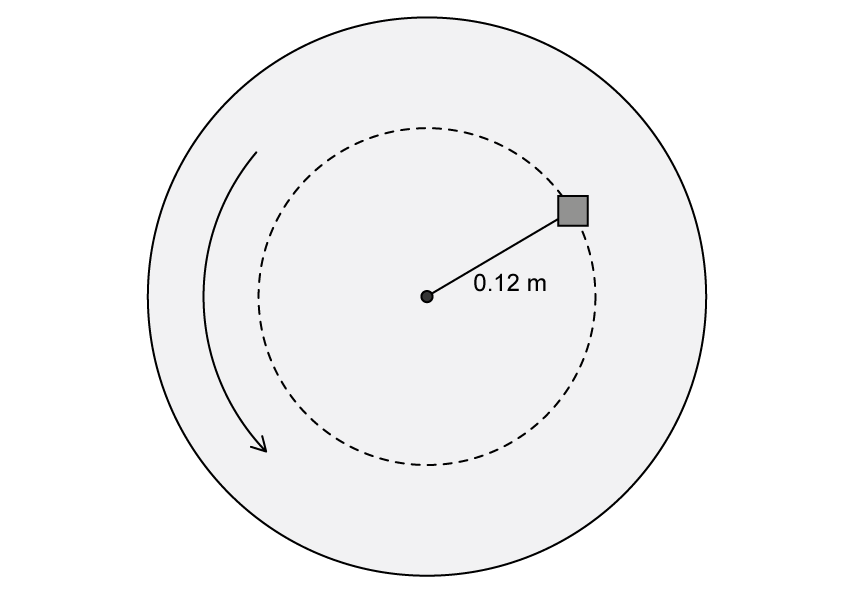
A turntable rotates at a constant angular speed. A small block of mass 0.050 space kg is placed on the turntable at a distance of 0.12 space straight m from the centre, as shown in Figure 6.

Figure 6

Top-down view of a circular turntable with a small block at distance 0.12 metres from the centre. Arrow showing direction of rotation (anticlockwise)

The block is on the verge of sliding when the turntable completes one revolution every 0.85 space straight s.

Calculate the angular speed of the turntable.

8b
Sme Calculator
2 marks

Show that the frictional force acting on the block is approximately 0.3 space straight N.

8c
Sme Calculator
2 marks

The block is now moved to a distance of 0.20 space straight m from the centre. The turntable continues to rotate at the same angular speed. The maximum frictional force between the block and the turntable surface does not change.

Determine whether the block will slide at this new position.

8d
1 mark

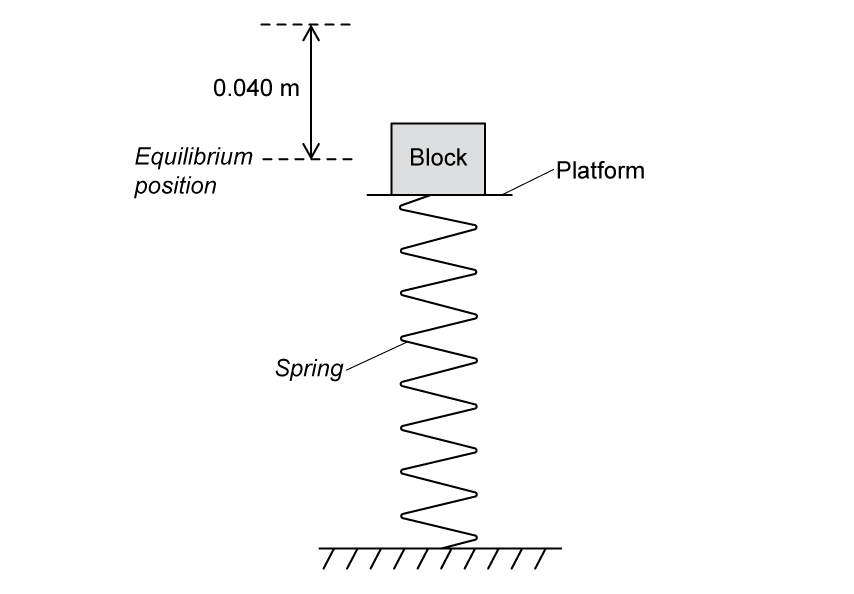
The block is placed on a horizontal platform that is attached to a vertical spring, as shown in Figure 7. The platform oscillates vertically with simple harmonic motion. At a frequency of 2.5 space Hz, the mass just loses contact with the platform at the highest point of the oscillation when the amplitude is 0.040 space straight m.

Figure 7

Side view of a vertical spring attached to a horizontal platform. A small block sits on top of the platform. The distance between the equilibrium position and the highest point of oscillation is 0.040 metres.

Suggest the condition required for the mass to lose contact with the platform at the highest point.

8e
Sme Calculator
2 marks

Calculate the maximum amplitude at a frequency of 4.0 space Hz for which the block remains in contact with the platform throughout the oscillation.

9a
1 mark

State what is meant by the internal energy of an ideal gas.

9b
Sme Calculator
2 marks

A sealed glass flask of volume 0.020 text  m end text cubed contains air at 27 degree straight C. The pressure of air in the flask is 1.5 cross times 10 to the power of 5 text  Pa end text.

Calculate the number of molecules of air in the flask.

9c
3 marks

Explain, using the kinetic theory model, why the pressure of an ideal gas increases when it is heated at constant volume.

9d
Sme Calculator
2 marks

The temperature of the air is increased from 27 degree straight C to 127 degree straight C.

Calculate the change in the mean kinetic energy of a molecule of air in the flask.

9e
Sme Calculator
3 marks

When an ideal gas is heated at constant volume, all of the energy supplied by heating is used to increase the mean kinetic energy of the particles.

When air is heated at constant volume, its specific heat capacity is 720 \text{ J kg}^{-1} \text{ K}^{-1}.

Deduce whether air behaves as an ideal gas when heated at constant volume.

molar mass of air = 2.9 cross times 10 to the power of negative 2 end exponent space text kg mol end text to the power of negative 1 end exponent

10a
Sme Calculator
4 marks

An isolated solid conducting sphere of radius 0.10 text  m end text is positively charged.

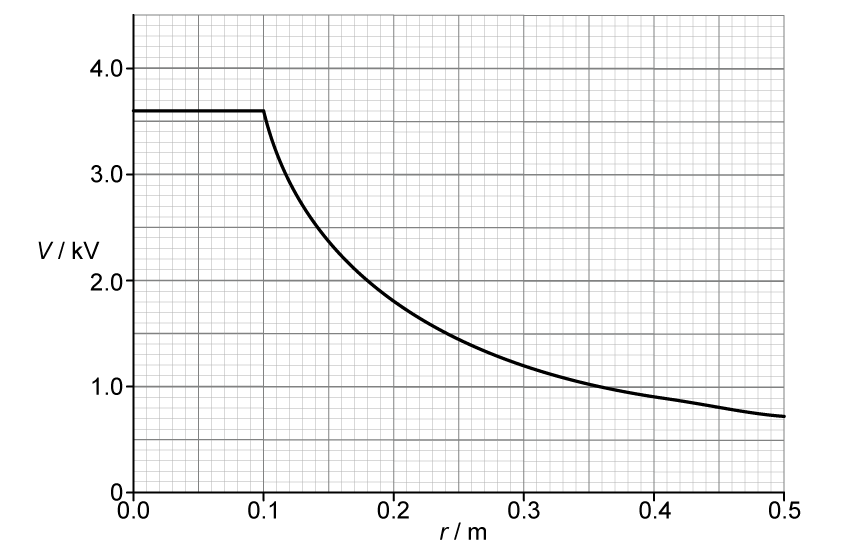
Figure 1 shows how the electric potential V varies with distance r from the centre of the sphere.

Figure 1

Graph of electric potential V in kilovolts against distance r in metres from the centre of a charged conducting sphere. Vertical axis: V / kV, from 0 to 4 kV, with major gridlines every 1 kV and minor gridlines every 0.5 kV. Horizontal axis: r / m, from 0 to 0.50 m, with major gridlines every 0.10 m and minor gridlines every 0.05 m. The curve begins at  (0.10,3.60) and decreases following an inverse relation between V and r: key points at (0.15,2.40), (0.20,1.80), (0.25,1.44), (0.30,1.20), (0.40,0.90), (0.50,0.72). Smooth continuous curve (no data points marked), clearly non-linear and concave upward. A straight horizontal line is plotted for r<0.10 m. Both axes labelled with quantity and unit.

Determine the magnitude of the electric field strength at a distance of 0.20 \text{ m} from the centre of the sphere.

State an appropriate SI unit for your answer.

10b
Sme Calculator
3 marks

The sphere acts as a capacitor because it stores charge at an electric potential.

Show that the capacitance of the sphere is approximately 1 cross times 10 to the power of negative 11 end exponent text  F end text.

10c
3 marks

The charged sphere momentarily touches an identical uncharged conducting sphere. The two spheres are then separated.

Explain why the total energy stored by the two spheres after separation is less than the energy stored by the single sphere before contact.