Changes in Economic Sectors (Edexcel IGCSE Geography): Revision Note
Exam code: 4GE1

Causes of change in employment
As countries develop, the number of people employed in each economic sector changes
This can be seen in the Clark-Fisher Model or pie charts
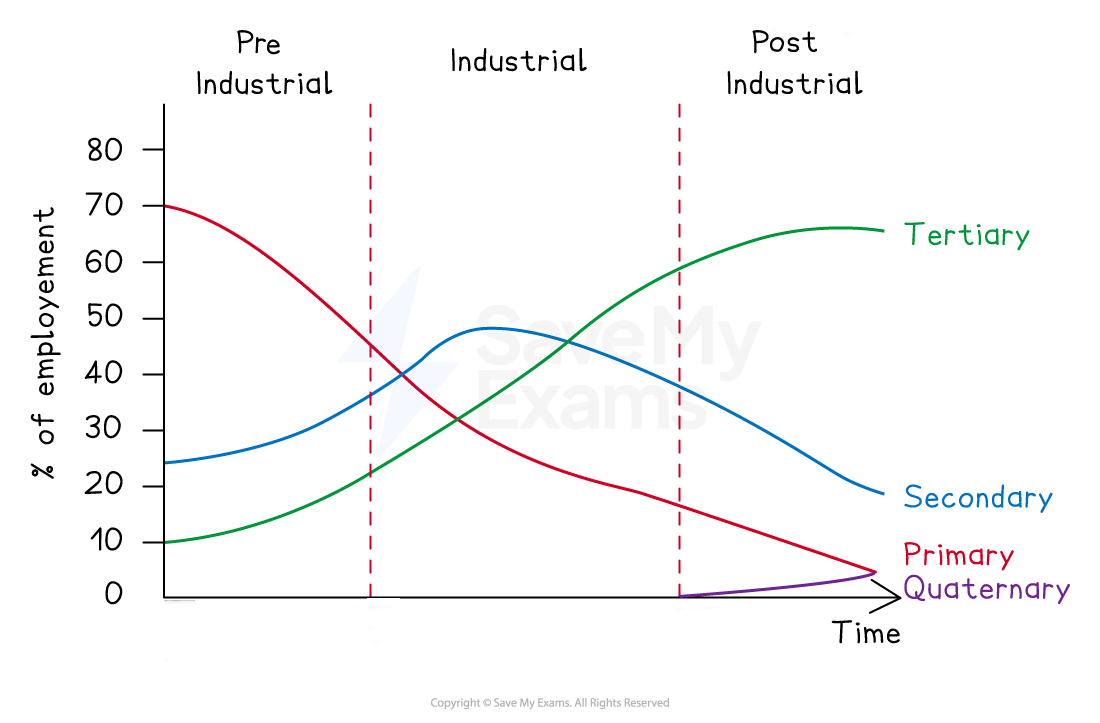
How levels of development affect employment in different sectors
In developing countries, such as Kenya, more people are employed in the primary sector because:
A significant percentage of the rural population are subsistence farmers
The countries depend on exporting raw materials to developed and emerging countries to gain income
In emerging countries, such as China, more people are employed in secondary economic activities
This is because:
Factories are located in emerging countries due to lower costs
More raw materials may be available in these countries
Government policies aim to attract companies to locate there
In developed countries, such as the UK, more people are employed in tertiary sector activities:
Education levels are higher, so people want tertiary sector jobs, which are, on average, higher paid than secondary and primary jobs
Deindustrialisation means there are fewer jobs in secondary economic activities
Mechanisation means there are fewer jobs in primary and secondary economic activities
There is a higher demand for services because people have more disposable income

Summary of the causes of changing employment in economic sectors
The main factors which affect the number of people employed in the different economic sectors include:
Availability of raw materials
Globalisation
Technology
Demographic changes
Government policies
Availability of raw materials
Raw materials may have run out or be economically unviable to obtain
Crop production and livestock may be reduced due to drought, flood, pest/disease or soil erosion
Improvements in technology may reduce the amounts of raw materials needed
Globalisation
Transnational corporations (TNCs) have factories and offices in many countries
Lower costs tend to be in developing and emerging countries
The internet and improved communication mean that service activities such as call centres can be located anywhere in the world
Industries such as textiles and steel manufacturing are increasingly located in emerging countries
Technology
There are fewer jobs in farming, mining and many factories due to mechanisation
The Internet means companies can manage factories and offices located in many different countries
Improvements in transport have reduced the friction of distance
Demographic change
An increasing population means that there is a greater demand for products and services
People have more disposable income to spend on leisure and other services
The demand for goods and services is affected by the age structure of the population
An increasing population means there are more workers available
Government policies
Government policies target particular economic activities to locate in their country using :
Tax incentives
infrastructure improvements (new railways, airports)
grants/cheap rent
International treaties impact what countries can trade
In communist countries, governments have much more control over industry types and location
Examiner Tips and Tricks
For 3-mark 'suggest' or 'explain' questions regarding changes in employment sectors (such as the secondary sector):
Identify the change first: Start by identifying a specific change in employment that is explicitly shown in the provided resource
Use "double development": These questions can be challenging because they require you to develop your ideas twice to earn full marks.
For example, identify a decrease in a sector, link it to a broader geographical concept (like a global shift in manufacturing), and then further develop the point by suggesting where the employment has moved.

Unlock more, it's free!
Join the 100,000+ Students that ❤️ Save My Exams
the (exam) results speak for themselves:

Was this revision note helpful?