Organic Synthesis (OCR A Level Chemistry A): Exam Questions

Exam code: H432

3 hours33 questions
1
1 mark

CN ions react with haloalkanes and with carbonyl compounds.

Which row gives the correct mechanisms for the reactions?


Reaction of CN- with haloalkanes

Reaction of CN- with carbonyl compounds 

A

Electrophilic substitution 

Electrophilic addition

B

Electrophilic substitution 

Nucleophilic addition

C

Nucleophilic substitution 

Electrophilic addition

D

Nucleophilic substitution 

Nucleophilic addition

    2
    1 mark

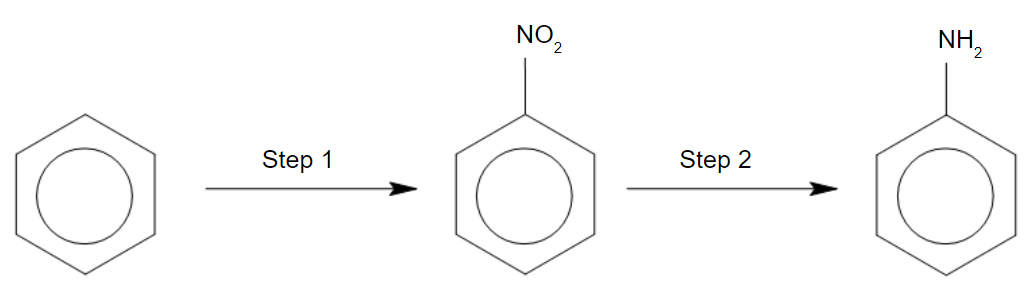
    Phenylamine can be produced in the two-stage synthesis shown below.

    Chemical reaction sequence with benzene to nitrobenzene (NO₂) as Step 1, then aniline (NH₂) in Step 2, shown with arrows.

    What is the correct classification of the steps?


    Step 1

    Step 2

    A

    Electrophilic substitution

    Reduction

    B

    Nucleophilic addition

    Reduction

    C

    Nitration

    Oxidation

    D

    Nucleophilic addition

    Oxidation

      3
      1 mark

      Propanal can be converted to propanoyl chloride via the two-stage synthesis route shown below.

      propanal  rightwards arrow with Step space 1 on top  propanoic acid  rightwards arrow with Step space 2 on top  propanoyl chloride

      What are the correct reagents for steps 1 and 2?


      Step 1

      Step 2

      A

      H2O / HCl

      SOCl2

      B

      NaBH4 / H2O

      H2O / HCl

      C

      K2Cr2O7 / H+

      SOCl2

      D

      K2Cr2O7 / H+

      H2O

        4
        1 mark

        Many organic products can be synthesised from a few starting compounds using the correct reagents and conditions.

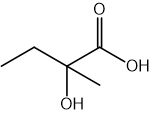
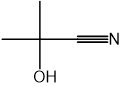
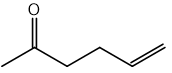
        Which skeletal formula shows the functional groups stated?

        • Alcohol and nitrile:

          Chemical structure of 2-hydroxy-2-methylbutanoic acid.
        • Alcohol and nitrile:

          Chemical structure of 2-hydroxy-2-methylpropanenitrile.
        • Ester and alkene:

          Chemical structure of hex-5-en-2-one.
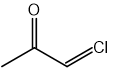
        • Carbonyl and haloalkane:

          Chemical structure of 1-chloropropan-2-one, with a C=Cl bond.
        5
        1 mark

        Which of the following compounds can not be formed directly from an alcohol?

        • Amine

        • Ester

        • Alkene

        • Ketone

        1
        1 mark

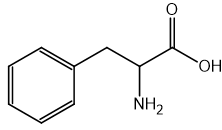
        The structure of the amino acid phenylalanine is shown below.

        Chemical structure of phenylalanine, showing a benzene ring connected to a carbon chain with an amine group and a carboxylic acid group.

        Which functional group(s) is/are in a molecule of phenylalanine?

        1. Amine

        2. Amide

        3. Alcohol

        • 1, 2 and 3

        • Only 1 and 2

        • Only 2 and 3

        • Only 1

        2
        1 mark

        Which statement about melting point tests is not correct?

        • Impurities can raise or lower the melting point of organic solids

        • The melting point tubes must be heated slowly

        • Organic solids with high melting points can decompose before melting

        • The organic solid must be finely powdered and dry

        3
        1 mark

        The synthesis of ethyl butanoate can be carried out using the reaction scheme shown below.

                                C4H9Br   rightwards arrow with Step space 1 on top  C4H9OH  rightwards arrow with Step space 2 on top  C3H7COOH  rightwards arrow with Step space 3 on top  C3H7COOC2H5  

        What is the correct classification of the steps?


        Step 1

        Step 2

        Step 3

        A

        Substitution

        Oxidation

        Condensation

        B

        Addition

        Substitution

        Condensation

        C

        Oxidation

        Substitution

        Condensation

        D

        Substitution

        Oxidation

        Substitution

          4
          1 mark

          Propanone can be converted to 2-bromopropane using the three step synthetic scheme shown below. 

          Propanone rightwards arrow with Step space 1 on top propan-2-ol rightwards arrow with Step space 2 on toppropene rightwards arrow with Step space 3 on top2-bromopropane

          What are the correct reagents for each step?


          Step 1

          Step 2

          Step 3

          A

          K2Cr2O7 / H2SO4

          Conc. NaOH

          HBr

          B

          NaBH4

          Al2O3

          HBr

          C

          H2O / H2SO4

          Al2O3

          Br2

          D

          NaBH4

          K2Cr2O7 / H2SO4

          HBr

            5
            1 mark

            Butylamine can be prepared in two steps from 1-bromopropane

            CH3CH2CH2Br → X → CH3CH2CH2CH2NH2

            What is the structural formula of X?

            • CH3CH2CH2OH

            • CH3CH=CH2

            • CH3CH2CH2CN

            • CH3CH2CH2CHO

            1
            1 mark

            Which row contains the correct number of minimum steps to convert an aldehyde into the given compound?

            Amide

            Primary amine

            Dihalogenoalkane

            A

            2 steps

            3 steps

            4 steps

            B

            4 steps

            2 steps

            3 steps

            C

            3 steps

            4 steps

            2 steps

            D

            2 steps

            3 steps

            3 steps

              2
              1 mark

              Propyl 4-aminobenzoate or risocaine is a local anesthetic that can be synthesised from 4-nitrobenzaldehyde via the following three step synthesis.

              nwnKtwWD_7-8-h-q1-mcq-aqa-al-chemistry

              Which row contains the correct molecular formulae of compounds X and Y?

              Compound X

              Compound Y

              A

              C7H6NO3

              C9H11NO4

              B

              C7H6NO4

              C10H11NO3

              C

              C7H5NO4

              C10H11NO4

              D

              C7H5NO3

              C9H11NO3

                3
                1 mark

                Which statement about the purification of an organic solid is not correct?

                • Recrystallisation uses a solvent in which the organic solid dissolves when hot but will crystallise out when cold. 

                • Hot filtration can be used after recrystallisation to remove any solid impurities that remain. 

                • Impurities tend to lower the melting point of organic solids such as aspirin. 

                • A water bath can be used to determine the melting point of the organic solid. 

                4
                1 mark

                Below is a sequence of reactions from the starting molecule bromopropane.

                l4hQIC9o_ocr-a2-6-8h-mcq-q2-reaction-sequence

                Which reagent or type of mechanism is not correct for the indicated step?

                • Step 1 NaCN / Nucleophilic substitution

                • Step 2 H2O/HCl / Hydrolysis

                • Step 3 SOCl2 / Chlorination 

                • Step 4 methylamine / Nucleophilic substitution 

                5
                1 mark

                A reaction sequence starting from ethene is shown below.

                ocr-a2-6-8h-mcq-q3-reaction-sequence

                Which statement(s) is/are correct?

                1. Two of the molecules belong to the same homologous series.

                2. Reaction 4 produces a compound that will conduct electricity in the molten state.

                3. Reactions 1, 2, 3 and 5 require sulfuric acid.

                • 1, 2 and 3

                • Only 1 and 2

                • Only 2 and 3

                • Only 1