Carbonyl Compounds (OCR A Level Chemistry A): Exam Questions

Exam code: H432

2 hours29 questions
1
1 mark

Carbonyl compounds have distinctive smells. Menthone smells of peppermint.
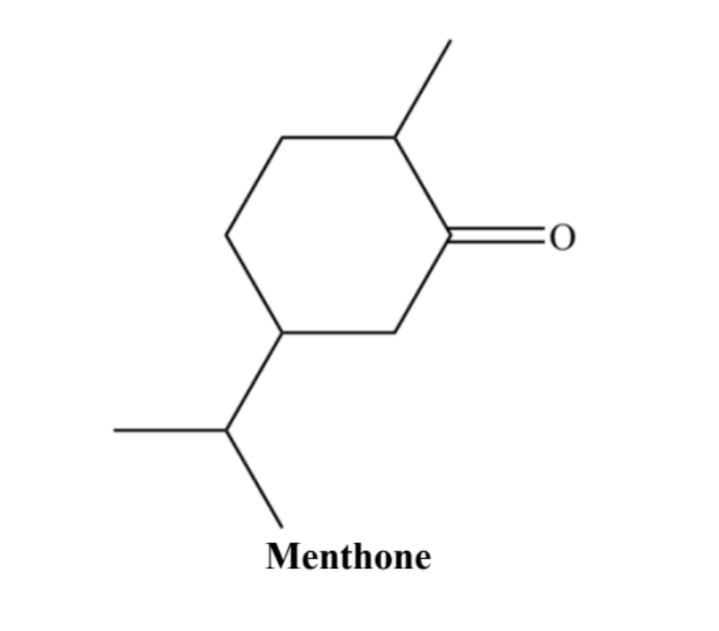
Chemical structure of menthone.

Menthone is reacted in a two-step synthesis:

Step 1: A sample of menthone is added to hot acidified aqueous dichromate(VI) ions.

Step 2: The resulting mixture from Step 1 is added to NaBH4 in water.

What happens to the smell of the reaction mixture during the process?


Step 1

Step 2

A

Smell of peppermint remains

Smell of peppermint is lost

B

Smell of peppermint is lost

Smell of peppermint returns

C

Smell of peppermint remains

Smell of peppermint remains

D

Smell of peppermint is lost

Smell of peppermint does not return

    2
    1 mark

    Primary alcohols can be oxidised to aldehydes.

    Which row shows the correct reagents and observations for this reaction?

    Reagent

    Observation

    A

    Acidified silver nitrate solution

    White precipitate forms

    B

    Fehling's solution

    Brick-red precipitate forms

    C

    Tollens' reagent

    Silver mirror forms

    D

    Acidified potassium dichromate

    Colour change from orange to green

      3
      1 mark

      Aldehydes can undergo oxidation reactions to form carboxylic acids.

      Which equation shows the correct oxidation of an aldehyde to its corresponding carboxylic acid?

      • CH3CH2OH + [O] → CH3COOH + H2

      • CH3CHO + [O] → CH3CHCOOH

      • CH3CH2CHO + [O] → CH3CH2COOH

      • CH3COCH3 + [O] → CH3CH2COOH

      4
      1 mark

      Aldehydes and ketones can both react with HCN to form hydroxy nitrile compounds. 

      Which is the correct mechanism for this reaction?

      • Electrophilic addition

      • Electrophilic substitution

      • Nucleophilic addition

      • Nucleophilic substitution

      5
      1 mark

      Which reagents and conditions are required to reduce a ketone to a secondary alcohol?

      • Reflux with acidified potassium dichromate solution

      • Heat with aqueous sodium tetrahydridoborate

      • Hydrogen gas at 60 oC with a nickel catalyst

      • Reflux with concentrated hydrochloric acid and a tin catalyst

      1
      1 mark

      The functional group in an organic compound, W, was identified by carrying out two chemical tests. The results of the tests are shown below.

      Test

      Observation

      Refluxing with acidified sodium dichromate(VI) (aq)

      Orange solution turns green

      Addition of 2,4-dinitrophenylhydrazine (aq)

      Yellow / orange precipitate formed

      What is the identity of compound W?

      • CH3CH2CH2OH

      • CH3COCH3

      • CH3CH(OH)CH3

      • CH3CH2CHO

      2
      1 mark

      What is the organic product when butanone reacts with aqueous NaBH4?

      • Butane

      • Butan-1-ol

      • Butan-2-ol

      • Butanal   

      3
      1 mark

      Which carbonyl compounds produce a carboxylic acid when they are treated with acidified K2Cr2O7 or Tollens’ reagent?

      • CH3CH2CH2CHO and CH3CH2COCH3

      • CH3CH2CH2CHO and CH3CH2CH(OH)CH3

      • CH3COCH3 and CH3CH2CH2CHO

      • CH3CH2CH2CHO and CH3CH2CHO

      4
      1 mark

      The colour of warm acidified sodium dichromate(VI) changes from orange to green when added to compound Y.

      1 mol of Y reacts with 2 mol of hydrogen cyanide in the presence of potassium cyanide.

      What could Y be?

      • H2C=CHCH2CHO

      • CH3CH2CH2CHO

      • OHCCH2CH2CHO

      • CH3COCH2COCH3

      5
      1 mark

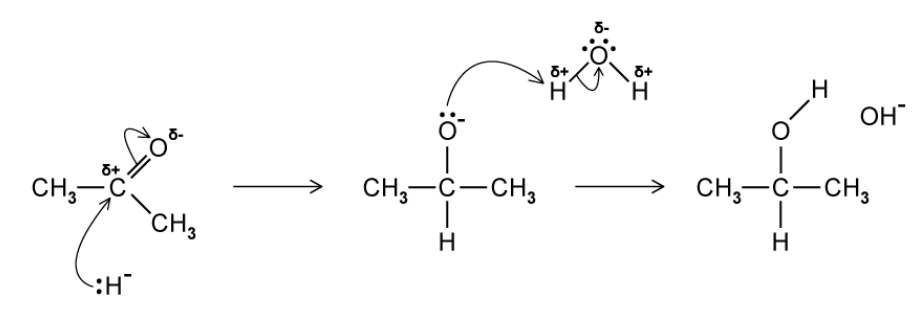
      The mechanism for the reaction between propanone and hydride ions is shown below

      Propanone and hydride ion mechanism

      Which row correctly describes the roles of the hydride ions and propanone? 


      Role of hydride ions

      Role of propanone

      A

      Electrophile

      Nucleophile

      B

      Nucleophile

      Electrophile

      C

      Oxidising agent

      Reducing agent

      D

      Brønsted-Lowry acid

      Brønsted-Lowry base

        1
        1 mark

        Which row is correct?

        Molecule

        Reaction

        Test on product

        Observation of test on product

        A

        3-methyl butan-2-ol

        Reflux with acidified K2Cr2O7

        Tollens' reagent

        Silver mirror

        B

        3-ethyl pentan-1-ol

        Distillation with acidified K2Cr2O7

        Tollens' reagent

        Silver mirror

        C

        2,2-dimethyl propan-1-ol

        Hot Al2O3 catalyst

        Bromine water

        Purple to colourless

        D

        2-methyl butan-2-ol

        Reflux with acidified K2Cr2O7

        2,4-DNPH

        Orange precipitate

          2
          1 mark

          How many structural isomers with the molecular formula C6H12O react with Tollens' reagent?

          • 6

          • 7

          • 8

          • 9

          3
          1 mark

          Which statements is/are correct about the reduction of 3-methylbutanoic acid?

          1. C4H9COOH (aq) + 4[H] → C5H11OH (aq) + H2O (l)

          2. If insufficient LiAlH4 is added, 2,4-DNPH can be used to show that the reduction is incomplete.

          3. 3-methylbut-1-ene will be reduced more easily due to the higher electron density of the C=C bond.

          • 1, 2 and 3

          • Only 1 and 2

          • Only 2 and 3

          • Only 1

          4
          1 mark

          Which statements about the addition of the CN- nucleophile is/are correct?

          1. KCN is used instead of HCN because it is not a toxic gas.

          2. Pentan-2-one and propanal would each form a racemic mixture.

          3. It allows the maintenance of the carbon chain length.

          • 1, 2 and 3

          • Only 1 and 2

          • Only 2 and 3

          • Only 1

          5
          1 mark

          A student carried out different tests on the following four organic compounds.

          Compound A

          2-oxopropanoic-acid

          2-oxopropanoic acid

          Compound B

          2-chloropropan-2-ol

          2-chloropropan-2-ol

          Compound C

          2-chloro-2-hydroxypropanoic-acid

          2-chloro-2-hydroxypropanoic acid

          Compound D

          prop-2-en-1-ol

          Prop-2-en-1-ol

          Which row describes the correct results for each test performed on the organic compound?

          Compound

          Test 1

          Result of test 1

          Test 2

          Result of test 2

          A

          Tollens' reagent

          Colourless solution

          Acidified potassium dichromate

          Green solution

          B

          2,4-DNPH

          No precipitate

          Warmed with NaOH followed by acidified silver nitrate

          Cream precipitate

          C

          Aqueous sodium carbonate

          Effervescence

          Warmed with NaOH followed by acidified silver nitrate

          White precipitate

          D

          2,4-DNPH

          Orange solution

          Bromine water

          Orange solution