Optical Isomerism (OCR A Level Chemistry A): Exam Questions

Exam code: H432

2 hours30 questions
1
1 mark

Which statement about optical isomers is correct?

  • Four different atoms or groups of atoms around a carbon atom cause optical isomerism

  • Optical isomerism occurs as a result of restricted rotation about a carbon–carbon double bond

  • Optical isomers are superimposable mirror images of each other called enantiomers

  • Optical isomers are molecules that have the same structural formula but have the atoms arranged differently in space

2
1 mark

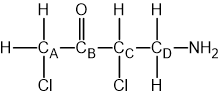
Which carbon atom is the chiral centre in 4-amino-1,3-dichlorobutan-2-one, shown below?

Chemical structure of 4-amino-1,3-dichlorobutan-2-one, with the carbons labelled A, B, C, D.
    3
    1 mark

    Which compound contains a chiral carbon?

    • Butanone

    • Butan-2-ol

    • Cyclopentanol

    • Propanal

    4
    1 mark

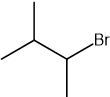
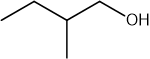
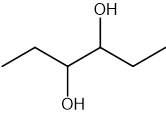
    Which compound does not contain a chiral carbon?

    • Structural formula of 2-bromo-3-methylbutane.
    • Chemical structure of 2-methylbutan-1-ol.
    • Chemical structure of hexane-3,4-diol.
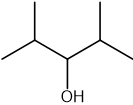
    • Chemical structure of 2,4-dimethylpentan-3-ol.
    5
    1 mark

    Some transition metal complexes show optical isomerism, depending on their geometry and the type of ligands they contain.

    Which complex will not exhibit optical isomerism?

    • An octahedral complex with six identical monodentate ligands

    • An octahedral complex with three identical bidentate ligands

    • A tetrahedral complex with four different monodentate ligands

    • An octahedral complex with two different bidentate ligands

    1
    1 mark

    Which statement about optical isomerism is correct?

    • Optical isomers have a different arrangement of carbon atoms in the skeleton of the molecule

    • Optical isomers have a different boiling point

    • Optical isomers have the same structural formula

    • Optical isomers have four different atoms attached to the chiral carbon

    2
    1 mark

    Which statement about 2,3-dihydroxybutanedioic acid, shown below, is correct?

    Chemical structure of 2,3-dihydroxybutanedioic acid
    • There are four asymmetric carbon atoms

    • The structure shown rotates plane polarised light to the right

    • 2,3-dihydroxybutanedioic acid is a racemate

    • The molecule has two chiral centres

    3
    1 mark

    Which organic compound will produce optical isomers when it undergoes reduction?

    • CH3COCH3

    • CH3CH=CH2

    • CH3CH2COCH3

    • CH3CH2COOH

    4
    1 mark

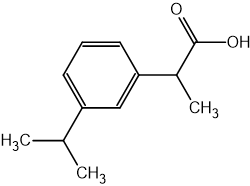
    The structure of ibuprofen is shown below.

    Chemical structure of ibuprofen, showing a benzene ring with isobutyl and propanoic acid groups attached.

    How many chiral centres are present in an ibuprofen molecule?

    • 1

    • 2

    • 3

    • 4

    5
    1 mark

    Ethanal reacts with hydrogen cyanide followed by hydrochloric acid to make 2-hydroxypropanoic acid in the two-step reaction sequence below.

    Two-step reaction sequence for ethanal reacting with hydrogen cyanide (Step 1)  followed by hydrochloric acid (step 2) to make 2-hydroxypropanoic acid.

    Which row describes the reactants and products of each step?


    Reactant

    Product of step 1

    Product of step 2

    A

    Optically active

    Optically active

    Optically active

    B

    Optically inactive

    Mixture of optical isomers

    Mixture of optical isomers

    C

    Optically active

    Optically inactive

    Optically active

    D

    Optically active

    Mixture of optical isomers

    Mixture of optical isomers

      1
      1 mark

      Which compound forms a reduction product capable of exhibiting optical isomerism?

      • CH3CH2CH2COCH3 

      • CH(CH3)2CH2CHO

      • C(CH3)3CHO

      • CH3CH2COCH2CH3 

      2
      1 mark

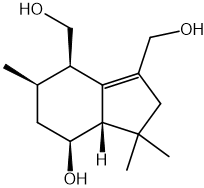
      Arthrinin-F, shown below, is a relatively novel compound isolated from fungus.

      Chemical structure of Arthrinin-F.

      How many chiral centres are present in an Arthrinin-F molecule?

      • 4

      • 6

      • 11

      • 14

      3
      1 mark

      Which statement about but-1-en-3-ol, CH2CHCHOHCH3, is not correct?

      • It has E/Z isomers

      • It will turn an acidified potassium dichromate(VI) solution green

      • It contains a peak at 1650 cm−1 on its IR spectrum

      • It has optical isomers

      4
      1 mark

      N,N-Dimethyl-2-hydroxy-3-methylbutanamide can exist as a pair of optical isomers.

      Which is the correct structure for an N,N-dimethyl-2-hydroxy-3-methylbutanamide enantiomer?

      • nn-dimethyl-2-hydroxy-3-methylbutanamide-option-a
      • nn-dimethyl-2-hydroxy-3-methylbutanamide-option-b
      • nn-dimethyl-2-hydroxy-3-methylbutanamide-option-c
      • nn-dimethyl-2-hydroxy-3-methylbutanamide-option-d
      5
      1 mark

      Which compound forms a stereoisomeric product when reduced?

      • CH3CH2CH2=CHCH3

      • CH3CH2CH2CH2CHO

      • CH3CH2C(CH3)=CHCH3

      • CH3CH2CH2COCH3