Key Takeaways
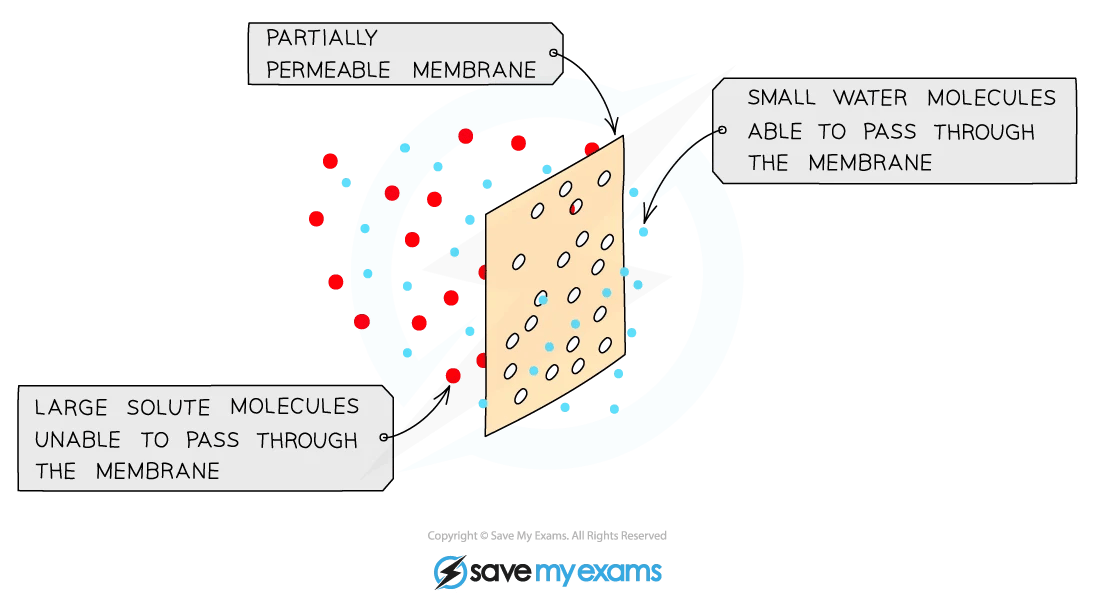
A partially permeable membrane is a barrier that allows some molecules to pass through more easily than, particularly small molecules, while restricting larger or charged molecules.
The cell membrane is a key biological example of a partially permeable membrane
Osmosis can only happen across a partially permeable membrane, but diffusion doesn't always need one
"Partially permeable", "semi permeable", and "selectively permeable" describe the same basic concept, though each term has slightly different usage in science
Visking tubing and egg membranes are common lab examples used to demonstrate how partially permeable membranes work
Partially Permeable Membrane Meaning
In biology, a partially permeable membrane lets certain molecules through but stops others, depending on their size, charge, or polarity.
Small, uncharged molecules like water and oxygen slip through easily. Larger molecules, such as starch or proteins, can't get through. This selective behaviour is what makes the membrane "partially" permeable.
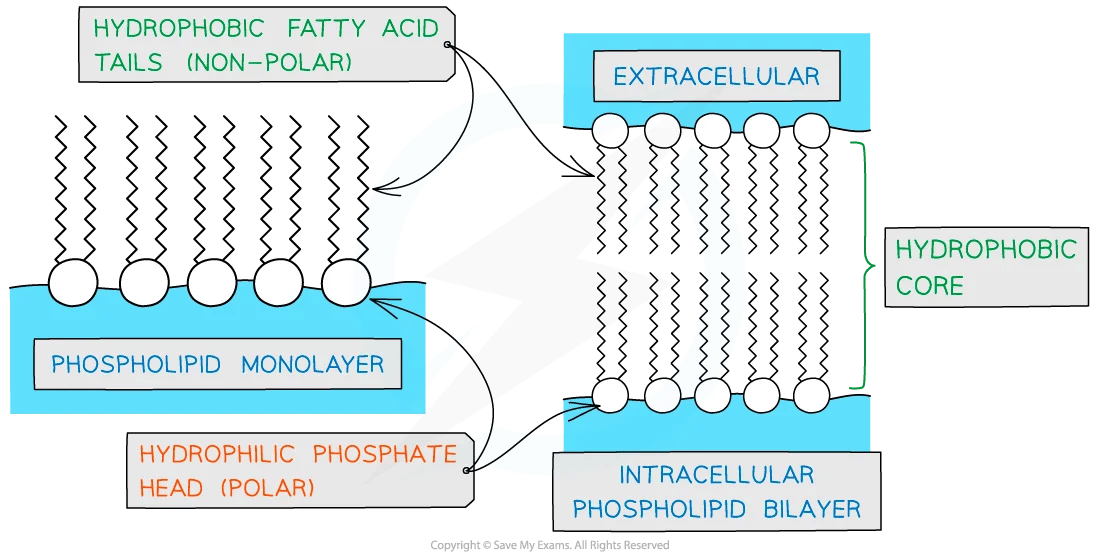
The cell membrane surrounding every living cell is partially permeable. It's made up of a phospholipid bilayer: two layers of phospholipid molecules arranged tail-to-tail. This structure creates a barrier that blocks large, water-soluble molecules while allowing small, non-polar ones to pass.
How a Partially Permeable Membrane Works
Each phospholipid in the membrane’s phospholipid bilayer has a water-attracting, or hydrophilic, head and a water-repelling, or hydrophobic, tail. Arranged in two layers, the tails face inward, forming a hydrophobic core that blocks most charged particles and large molecules.
Water molecules are polar but are small enough to squeeze between the phospholipids. Oxygen and carbon dioxide pass through for the same reason. But glucose, amino acids, and ions generally need help from transport proteins embedded in the membrane to get across.
It's not strictly a size-only filter – polarity matters too. Small non-polar molecules cross freely, while small, charged molecules like ions struggle without protein channels. The membrane is selective in more ways than one.
The Role of Partially Permeable Membranes in Osmosis and Diffusion
Osmosis is specifically defined as the net movement of water molecules from a region of higher water potential (a more dilute solution) to a region of lower water potential (a more concentrated solution) through a partially permeable membrane.
In contrast, diffusion is the net movement of particles from an area of higher concentration to an area of lower concentration. It happens in gases, liquids, and across membranes. Perfume spreading through a room, for example, is diffusion with no membrane involved.
Diffusion across a partially permeable membrane is common in living organisms. Oxygen diffuses into cells and carbon dioxide diffuses out through the cell membrane during gas exchange. The membrane acts as a selective barrier, letting small molecules through while keeping larger ones where they are.
Feature | Osmosis | Diffusion |
|---|---|---|
Requires a partially permeable membrane | Yes, always | No, but can occur across one |
What moves | Water molecules only | Any particles (gases, dissolved substances) |
Direction | High water potential to low water potential | High concentration to low concentration |
Energy required | No (passive) | No (passive) |
If you're revising osmosis in more depth, Save My Exams has revision notes written by experienced teachers and examiners that walk through the process step by step, including practical experiments. Check out the AQA GCSE Osmosis revision notes for a full breakdown, or find the notes specific to your course.
Semi Permeable Membrane vs Partially Permeable vs Selectively Permeable Membrane
These three terms can cause confusion. Here's what each one means and when you'll see it used.
Partially permeable is the term most commonly used in biology courses. It describes a membrane that allows some molecules through based on their size. You'll find this wording in most exam board specifications.
Semi permeable means essentially the same thing. It's used more widely in chemistry and in international textbooks. If you see "semi permeable membrane" in a question, treat it as identical to "partially permeable" for exam purposes.
Selectively permeable takes the idea further. It emphasises that the membrane actively controls what crosses, not just through physical gaps but through protein channels and carrier molecules that pick specific substances. This term is more accurate for the cell membrane, which uses both passive gaps and active protein transport. You'll encounter it more at advanced levels.
“It’s hard to overestimate the importance of the selectivity of biological membranes. They act as the interface between a cell and its environment, and allow it to modulate what goes in and out of the cell in a dynamic way.”
– Natalie Lawrence, Biology Tutor
For most biology courses, "partially permeable" is the safest term to use. But knowing all three means you won't be thrown by different wording in past papers or textbooks.
Partially Permeable Membrane Examples
Beyond the cell membrane, several other structures act as partially permeable membranes.
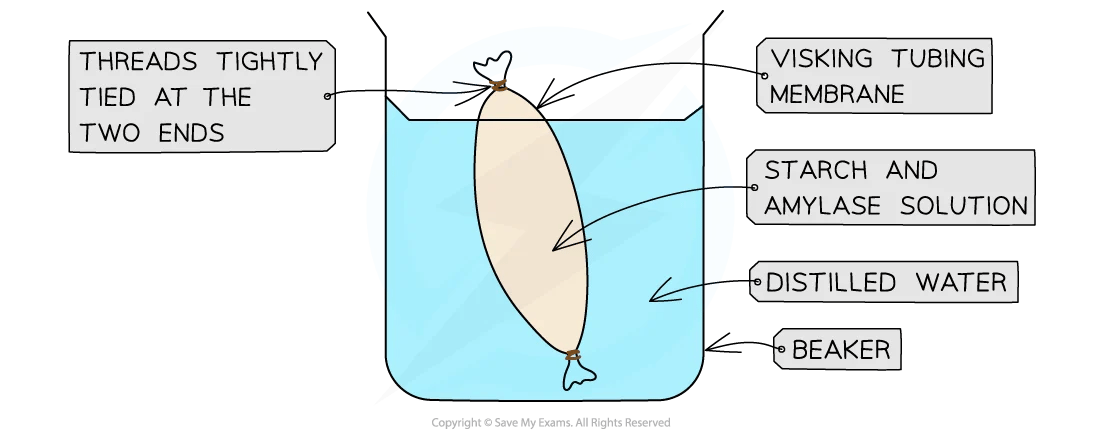
Visking (dialysis) tubing is the classic lab example. It's made from a synthetic material with tiny pores that let water and small molecules like glucose through but block larger molecules like starch. In osmosis practicals, students fill Visking tubing with sugar solution, place it in water, and observe the tubing swelling as water moves in by osmosis. The starch stays trapped inside.
Egg membranes offer a simple demonstration too. If you dissolve the shell of a raw egg in vinegar, the thin membrane underneath is partially permeable. Place the de-shelled egg in water and it swells. Place it in concentrated salt solution and it shrinks. The water moves in or out by osmosis, but the proteins inside stay put.
Kidney dialysis machines rely on the same principle. In patients whose kidneys can't filter blood properly, blood flows past an artificial partially permeable membrane. Waste products like urea (small molecules) pass through into the dialysis fluid, while blood cells and proteins (large molecules) stay in the bloodstream. The membrane does the job that healthy kidneys would normally handle.
In general, small molecules cross more easily than larger ones. The membrane's structure determines what can pass through. In living cells, the situation gets more complex because protein channels add another layer of selectivity, but the underlying principle of partial permeability stays consistent.
Plant cells depend on this principle. When plant cells take in water by osmosis, it's the partially permeable cell membrane that controls the flow. Too much water loss through osmosis causes plasmolysis, where the cell membrane pulls away from the cell wall.
Frequently Asked Questions
What is the difference between a permeable and a partially permeable membrane?
A permeable membrane lets all molecules pass through freely, regardless of size. A partially permeable membrane is selective, allowing small molecules like water through while blocking larger ones like proteins or starch. Cell membranes are partially permeable, which is why they can control what enters and leaves a cell.
What would happen if a cell membrane was fully permeable?
The cell would lose control over its internal environment. Waste products, ions, enzymes, and essential molecules would move freely in and out based only on concentration gradients. The cell couldn't maintain the specific conditions needed for enzyme activity and chemical reactions. In practice, the cell would die.
Can you see a partially permeable membrane under a microscope?
The cell membrane itself is too thin (about 7 nanometres) to see with a standard light microscope. You can observe its effects, though. In osmosis experiments, you can watch plant cells becoming turgid or plasmolysed under a microscope, which shows the membrane responding to water movement. Electron microscopes can reveal the membrane's structure directly.
How do scientists test whether a membrane is partially permeable?
The standard method is an osmosis experiment. Place the membrane between two solutions of different concentrations and measure whether water moves from the dilute side to the concentrated side. If it does, the membrane is partially permeable. In school practicals, Visking tubing filled with sugar solution and placed in water demonstrates this clearly when the tubing gains mass.
Examiner-written GCSE Biology revision resources that improve your grades 2x
- Written by expert teachers and examiners
- Aligned to exam specifications
- Everything you need to know, and nothing you don’t

Was this glossary entry helpful?

Share this article

 written revision resources that improve your