Osmosis - GCSE Biology Definition
Reviewed by: Dr Natalie Lawrence
Last updated
Key Takeaways
Osmosis is the diffusion of water molecules from a dilute solution to a more concentrated solution through a partially permeable membrane.
It's a passive process, so it doesn't need energy from respiration.
Only water moves by osmosis. Larger solute molecules, such as sucrose, can't pass through the membrane.
Animal cells placed in pure water can swell and burst because they have no cell wall.
Plant cells that gain water become turgid, which holds the plant upright. When they lose water, the plant wilts.
What Is Osmosis in Biology?
Osmosis is the diffusion of water molecules from a dilute solution to a concentrated solution through a partially permeable membrane. It's the process that moves water into and out of cells. The osmosis definition used in biology has three parts:
Water molecules are the only particles that move by osmosis.
The direction is from a dilute solution to a concentrated one. A dilute solution has a high concentration of water molecules and a low concentration of solute.
A partially permeable membrane must separate the two solutions.
Osmosis is a special type of diffusion, so it's passive. Water molecules move about randomly, and the net movement happens without any energy from respiration.
What a partially permeable membrane does
A partially permeable membrane lets small molecules, such as water, pass through but stops larger molecules, such as sucrose. The cell membrane around every cell is partially permeable. In a model using a membrane permeable to water but not sucrose, water can cross while sucrose remains on its original side.
How Osmosis Works: An Osmosis Diagram Explained
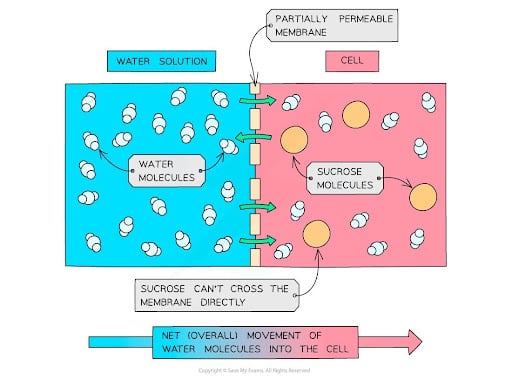
A typical osmosis diagram shows two solutions separated by a partially permeable membrane. The dilute side has lots of water molecules and few solute particles. The concentrated side has fewer water molecules and more solute particles, such as sucrose.
Water molecules move randomly in both directions across the membrane. More of them cross from the dilute side to the concentrated side than the other way, so there's a net movement of water into the concentrated solution. The sucrose molecules are too large to pass through, so they stay where they are.
Net movement continues until the concentration of water molecules is equal on both sides. At equilibrium, water continues to cross the membrane in both directions at equal rates, so there is no net movement.
The clearest way to describe the direction is with the words dilute and concentrated. Saying water moves "from high to low concentration" is ambiguous, because it isn't clear whether you mean water or solute.
“For students that aren’t clear on what ‘net’ means, I use the example of a shop. A shop buys stock to sell. The net profit is all the money they take in from customers minus the cost of the stock they sold.”
– Natalie Lawrence, Biology Tutor
Check out our specification-tailored osmosis revision notes to consolidate what you have learned here, for example AQA GCSE Osmosis Revision. They're written by experienced teachers and examiners, with labelled diagrams of osmosis in cells and its effect on plant tissue.
Osmosis in Plant and Animal Cells
Cells gain or lose water by osmosis depending on the solution around them. What happens next depends on whether the cell has a cell wall.
Solution around the cell | Animal cell (e.g. a red blood cell) | Plant cell |
More dilute than the cell contents (e.g. pure water) | Gains water, swells and can burst | Gains water and becomes turgid |
Same concentration as the cell contents | No net movement of water | No net movement of water |
More concentrated than the cell contents (e.g. strong sugar solution) | Loses water and shrivels | Loses water and becomes flaccid, then plasmolysed |
Plant cells
Water entering a plant cell by osmosis makes the vacuole bigger and pushes the cell membrane against the cell wall. The cell becomes turgid, meaning rigid and firm. The pressure of the cytoplasm pushing on the wall is called turgor pressure, and the wall stops the cell from bursting.
When a plant cell loses water, its vacuole shrinks and the cell becomes flaccid. If it loses a lot of water, the cell membrane pulls away from the cell wall and the cell is plasmolysed.
Turgid cells help support leaves and non-woody stems. A plant that doesn't get enough water can't keep its cells turgid, so it wilts.
Animal cells
Animal cells have no cell wall, so osmosis affects them more severely. In pure water, an animal cell gains water and may swell and burst. In a strong sugar solution, it loses water and shrivels up. In red blood cells, this is called crenation.
Osmosis Examples
Osmosis moves water between cells and their surroundings. A drooping houseplant is one of the most familiar osmosis examples. If it’s drooping, its cells have lost water and are no longer turgid. Watering the plant lets the root take water back in by osmosis. Water enters root hair cells by osmosis when the soil solution is more dilute than the cell contents.
Investigating osmosis with plant tissue
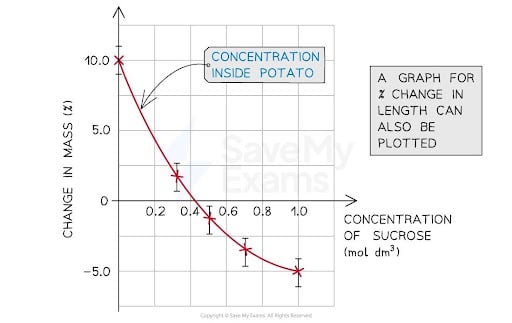
Osmosis can be measured by placing equal-sized cylinders of potato into sugar or salt solutions of different concentrations. Each cylinder is blotted dry and weighed before and after, and the percentage change in mass is calculated.
Percentage change in mass = (final mass − initial mass) ÷ initial mass × 100
The change in mass shows which way water moved:
A cylinder that gains mass has taken in water, so the solution around it was more dilute than the potato cells.
A cylinder that loses mass has lost water, so the solution was more concentrated than the cells.
A cylinder with no change in mass was in a solution with the same concentration as its cells.
Plotting percentage change in mass against concentration gives a line or curve of best fit that crosses the x-axis. That crossing point estimates the concentration producing no net water movement.
Questions on this investigation come up often, so practise them with our AQA GCSE Transport in Cells Exam Questions. Every question is written by expert teachers and examiners to match the specification, with step-by-step mark schemes to check your answers.
Difference Between Osmosis and Diffusion
The main difference between osmosis and diffusion is what moves. Diffusion is the net movement of particles of any substance in a solution or gas, from a higher to a lower concentration. Osmosis is the diffusion of water only, and it needs a partially permeable membrane. Both are passive, unlike active transport, which uses energy from respiration.
Diffusion | Osmosis | Active transport | |
What moves | Particles of any substance in a solution or gas, e.g. oxygen and carbon dioxide | Water only | Substances such as mineral ions and glucose |
Direction | Higher to lower concentration | Dilute solution to more concentrated solution | Lower to higher concentration (against the gradient) |
Partially permeable membrane needed | No | Yes | Yes, it happens across the cell membrane |
Energy from respiration needed | No | No | Yes |
Water moving by osmosis is still travelling down its own concentration gradient. It moves from where water molecules are more concentrated, the dilute solution, to where they're less concentrated.
Frequently Asked Questions
Does osmosis need energy?
No. Osmosis is a passive process, so it doesn't need energy from respiration. Water molecules move randomly, and the net movement comes from the difference in concentration across the membrane.
Is osmosis a type of diffusion?
Yes. Osmosis is a special type of diffusion that applies only to water molecules crossing a partially permeable membrane. Like any diffusing particle, water molecules move about randomly.
Why do plants wilt when they are not watered?
Plants wilt because their cells lose water and are no longer turgid. Turgid cells press against their cell walls and keep the stem and leaves firm. Without enough water, the cells become flaccid and the plant can't hold itself upright.
What happens if you put a red blood cell in pure water?
The red blood cell gains water by osmosis, swells and eventually bursts. Pure water is more dilute than the cell's contents, so there's a net movement of water into the cell. Animal cells have no cell wall, so nothing stops the membrane stretching until it breaks.
Why does putting salt on a slug harm it?
Salt dissolves in the moisture on a slug's skin and forms a very concentrated solution outside its cells. Water leaves the slug's cells by osmosis, moving from the more dilute cell contents into the salt solution. The cells shrivel as they lose water, which damages the slug.
Examiner-written GCSE Biology revision resources that improve your grades 2x
- Written by expert teachers and examiners
- Aligned to exam specifications
- Everything you need to know, and nothing you don’t
Was this glossary entry helpful?


Share this article
 written revision resources that improve your