Plasmolysis - GCSE Biology Definition
Reviewed by: Dr Natalie Lawrence
Last updated
Key Takeaways
Plasmolysis is the shrinking of a plant cell's membrane away from its cell wall when the cell loses water by osmosis in a hypertonic solution
It only occurs in plant and fungal cells because animal cells lack a rigid cell wall (animal cells undergo crenation instead)
A flaccid cell still has its membrane touching the cell wall, while a plasmolysed cell does not
Plasmolysis can be reversed by placing the cell back into a dilute solution, unless the membrane has been chemically damaged
What Is Plasmolysis?
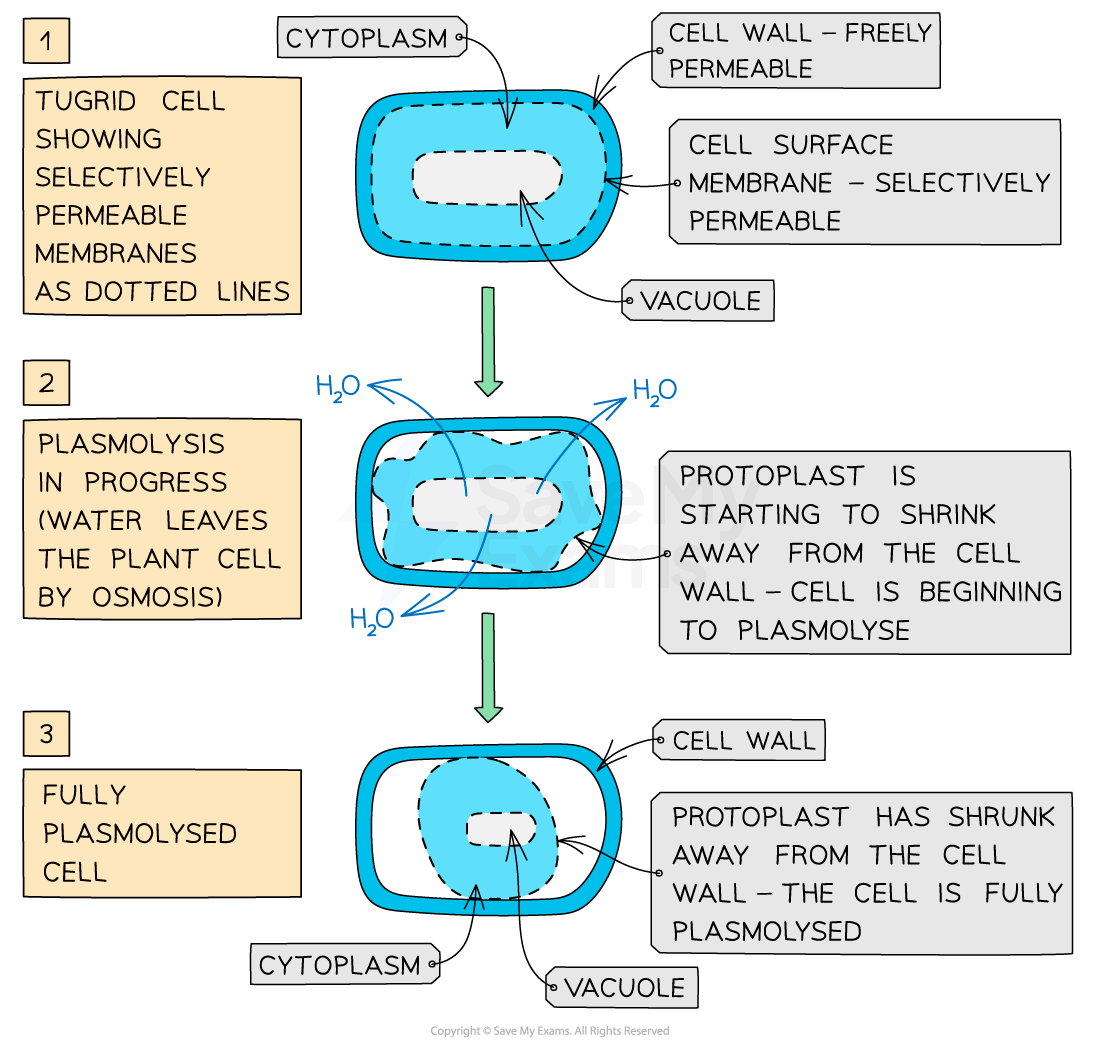
Plasmolysis is what occurs when a plant cell is placed into a solution with a lower water potential than its cytoplasm. Water leaves the cell by osmosis, moving down the water potential gradient through the partially permeable membrane. As water moves out, the vacuole shrinks.
Unlike the flexible cell membrane, the cell wall is rigid. It doesn't shrink along with everything else. So as the cell loses water, the membrane peels inward and away from the wall. That gap between membrane and wall is the hallmark of plasmolysis.
This only happens in plant cells. Animal cells don't have a cell wall, so when they lose water in a hypertonic solution, the entire cell shrivels up. That process has its own name: crenation.
How Plasmolysis Happens
A plant cell is in a hypertonic solution (one with a higher solute concentration than the cell's cytoplasm)
Water molecules move out of the cell by osmosis, passing through the partially permeable membrane toward the region of lower water potential
The vacuole loses water and shrinks
The cytoplasm contracts, pulling the cell membrane away from the rigid cell wall
The cell is now plasmolysed, with visible gaps between the membrane and the wall
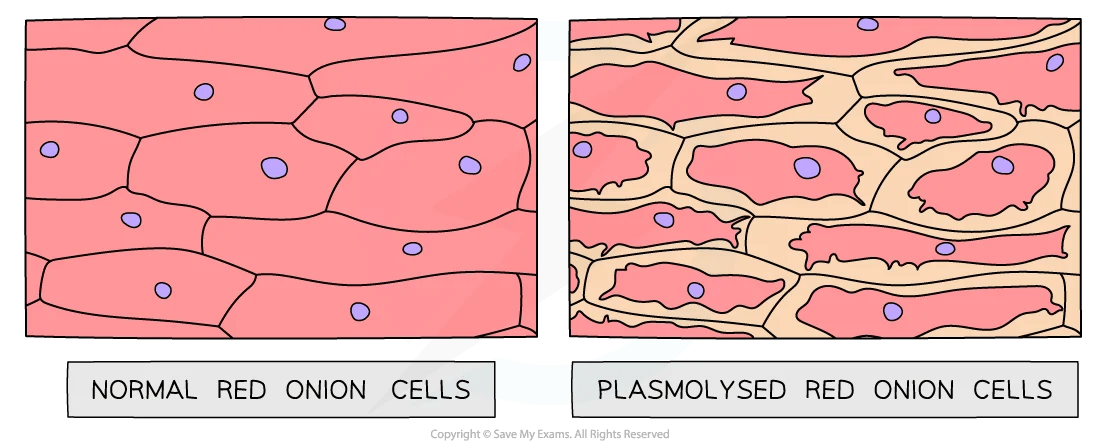
You can watch this happen in real time under a microscope. Red onion cells are a helpful choice for this because their pigmented vacuoles make the shrinkage easy to spot.
Flaccid vs Plasmolysed Cells
Students often mix these two up, and it's easy to see why. Both involve a cell that's lost water. But they sit at different points on the same spectrum.
Feature | Flaccid cell | Plasmolysed cell |
|---|---|---|
Water loss | Some | Significant |
Turgor pressure | Reduced but not zero | Zero or near-zero |
Cell membrane | Still touching the cell wall | Pulled away from the cell wall |
Appearance | Limp, soft | Shrunken membrane visible inside the wall |
Reversibility | Easily reversed | Reversed (unless damaged) |
A turgid cell sits at one end of the scale, fully swollen with water and pressing firmly against its wall. A flaccid cell has lost some water but the membrane is still in contact with the wall. Plasmolysis only begins once enough water has left for the membrane to actually detach.
“To help my students remember what plasmolysis means, I get them to split the word up. ‘Plasma’ refers to the cytoplasm, while ‘lysis’ means to loosen or separate - the cytoplasm separates from the cell wall.”
– Natalie Lawrence, Biology Tutor.
Reversing Plasmolysis
When a plasmolysed cell is transferred into a hypotonic solution (one with a higher water potential than the cell), water re-enters by osmosis. The vacuole swells, the cytoplasm expands, and the membrane pushes back against the cell wall. Given enough time, the cell can return to a turgid state. Whether the cell will recover depends on how much it has been damaged in its plasmolysed state.
Plasmolysis in Real Life
Plasmolysis isn't just a textbook concept. You encounter it in the kitchen regularly.
Sprinkle salt on aubergine slices before cooking and watch them go soft within minutes. The salt draws water out of the plant cells by osmosis, causing plasmolysis. The same principle explains why well-salted chips sometimes look slightly wilted, and why vegetables left in salty dressings lose their crunch.
Food preservation relies on this too. Jam-making works partly because the high sugar concentration plasmolyses bacterial and fungal cells, stopping them from growing. Pickling in brine does the same thing with salt.
In agriculture, over-fertilisation creates a hypertonic soil solution around plant roots. Water moves out of root cells instead of in, and the plant wilts even though the soil is moist. Farmers call this "fertiliser burn," but it's really just plasmolysis on a whole-plant scale.
A common classroom demonstration uses red onion cells in concentrated sucrose solution. Under a microscope, you can see the purple-stained vacuole shrinking and the membrane pulling away from the cell wall in real time.
If you want to build your understanding of how water moves in and out of cells, Save My Exams notes cover the underlying principles in detail. Our AQA GCSE Principles of Osmosis revision notes break down water potential, concentration gradients, and the effects on both plant and animal cells, written by experienced teachers and examiners, and we have notes tailored to whatever course you are doing.
For the practical side, the AQA GCSE Required Practical: Osmosis notes walk through the potato cylinder experiment step by step.
Frequently Asked Questions
What is the difference between plasmolysis and crenation?
Plasmolysis happens in plant cells, where the cell membrane pulls away from the rigid cell wall. Crenation happens in animal cells, where the whole cell shrivels because there's no wall to maintain the cell's shape. Both are caused by water leaving the cell in a hypertonic solution, but the structural outcome differs because of the cell wall.
Can plasmolysis be reversed?
Yes, provided the cell membrane hasn't been damaged. Placing a plasmolysed cell into a hypotonic solution allows water to re-enter by osmosis, restoring turgor. If plasmolysis has damaged the cell membrane, it cannot be reversed.
What happens to a plant cell in a hypotonic solution?
Water enters the cell by osmosis because the solution has a higher water potential than the cell's cytoplasm. The vacuole swells, pushing the cytoplasm and membrane firmly against the cell wall. The cell becomes turgid. Unlike animal cells, plant cells don't burst in this situation because the rigid cell wall prevents over-expansion.
How can you observe plasmolysis under a microscope?
Mount a thin layer of red onion epidermis on a microscope slide and add a few drops of concentrated sucrose or salt solution. The pigmented vacuoles make it easy to see the membrane pulling away from the cell wall.
Examiner-written GCSE Biology revision resources that improve your grades 2x
- Written by expert teachers and examiners
- Aligned to exam specifications
- Everything you need to know, and nothing you don’t

Was this glossary entry helpful?


Share this article

 written revision resources that improve your