11 mark
Which of the following is the correct value for the value of the gravitational potential at a point infinitely far away from every massive body in the universe ?
0
π
Was this exam question helpful?
Exam code: 7408
Which of the following is the correct value for the value of the gravitational potential at a point infinitely far away from every massive body in the universe ?
0
π
Was this exam question helpful?
What are the standard units of gravitational potential ?
J
V
N kg–1
J kg–1
Was this exam question helpful?
Which of the following statements regarding the gravitational potential is false ?
It is analogous to the electric potential at a point in an electric field
It is a vector quantity
It is defined as negative because work must be done on a mass to move the mass to infinity
It is inversely proportional to the distance between masses
Was this exam question helpful?
A planet has a mass 5.0 × 1026 kg.
Which of the following gives the correct value of the planet’s gravitational potential at a distance of 300 km from its centre?
1.1 × 10¹¹ J kg–1
–1.1 × 10¹⁴ J kg–1
–3.7 × 10⁵ J kg–1
–1.1 × 10¹¹ J kg–1
Was this exam question helpful?
A satellite of mass 200 kg moves between two lines of equipotential above the Earth.
It begins at point A which has a gravitational potential of –50 MJ kg–1 to a point further away, B, which has a gravitational potential of –40 MJ kg–1. This is shown in the diagram below:

Which of the following gives the correct value of the energy required for the satellite to move from A to B?
2 MJ
20 MJ
2000 MJ
200 MJ
Was this exam question helpful?
A test mass moves from the surface of the Earth to a point P in deep space, very far away from any other massive body.
Which line, A to D, in the table shows correctly what happens to the value of the gravitational field strength and to the gravitational potential experienced by the test mass as it moves to point P?
| Gravitational field strength | Gravitational potential |
A B C D | decreases decreases increases increases | decreases increases increases decreases |
Was this exam question helpful?
When a mass moves between two points in a gravitational field, energy may be transferred.
Which one of the following statements is correct?
No work is done by the gravitational force when a mass moves parallel to the direction of the field
The energy transferred is independent of the start and finish points
Work is done by the gravitational force when a mass moves perpendicular to the field
The energy transferred is independent of the path followed
Was this exam question helpful?
At the surface of a faraway planet, the gravitational field strength is g and the gravitational potential is V. The radius of the planet is r.
An object weighs W on the surface of this planet and lifts off to a height 4r above the surface.
Which line, A to D, in the table gives the weight of the object and gravitational potential at this height?
| Weight | Gravitational potential |
A | ||
B | ||
C | ||
D |
Was this exam question helpful?
The figure below shows the variation of the gravitational potential ϕ between the Earth and the Moon.

What is the minimum energy required to launch an object of mass 5.0 kg from the Earth’s surface to the Moon’s surface?
305 MJ
61.0 MJ
58.4 MJ
300 MJ
Was this exam question helpful?
P and Q are two points near one of Jupiter’s moons, Io. The gravitational potential at P is –800 J kg–1and that at Q is –700 J kg–1.
Which of the following statements is incorrect?
P is nearer to Io than Q
The magnitude of the gravitational field strength at P is greater than it is at Q
A body speeds up when it moves freely from P to Q
Work is done by an external force to move a body from P to Q
Was this exam question helpful?
A satellite of mass is in a circular orbit at a distance from the centre of a planet. The gravitational potential at this orbit is .
The satellite is moved to a new circular orbit at a distance from the centre of the planet.
What is the energy required to move the satellite to the new orbit?
Was this exam question helpful?
Planet Z, with centre O, is shown in the figure below.

The radial distances OP is equal to the OX, and OQ is equal to OY, such that PX and QY are loci of Planet Z.
Which of the following statements is incorrect?
The work done by the gravitational field on a test mass moving from P to Q is negative
The gravitational field does zero work on a test mass moving along the locus PX
The work done by an external force to move a test mass from Y to X is positive
Was this exam question helpful?
The variation of the gravitational potential ϕ near a certain planet is shown in the table below:
Distance from the planet’s surface / km | Potential ϕ / MJ kg–1 |
1700 | –17.1 |
1900 | –16.3 |
2100 | –15.7 |
2300 | –15.1 |
2500 | –14.6 |
Which value gives the best approximation for the magnitude of the gravitational field strength at a point 2000 km above the planet’s surface?
3 N kg–1
160 N kg–1
–160 N kg–1
3000 N kg–1
Was this exam question helpful?
Which of the following statements about gravitational fields is correct?
The gravitational potential is zero whenever the gravitational field strength is zero
The gravitational potential is negative because the gravitational field is repulsive
The gradient of the gravitational potential at a point is inversely proportional to the radial distance from some massive body
The area under a field strength–distance curve represents the change in gravitational potential between two points
Was this exam question helpful?
The relative positions of a binary star system is shown below:

The line XY joins the surface of the star of mass m to the surface of the star of mass M > m.
Which graph correctly represents the variation of the gravitational potential ϕ along the line XY?
Assume the stars have the same diameter.

Was this exam question helpful?
The shape of equipotential surfaces in the gravitational field depends on perspective.
The image below shows equipotential surfaces (represented by dotted lines) due to the Earth’s gravitational field in a ‘local’ frame of reference (close to the Earth’s surface) and in a ‘non–local’ frame of reference (far from the Earth’s surface):

Which line, A to D, in the table shows the variation of gravitational potential V with radial distance r from the Earth’s surface?
You may assume each dotted line represents equal changes in potential ΔV and that represents the radius of the Earth.


Was this exam question helpful?
The graph shows how the gravitational potential varies with distance from the centre of a planet.
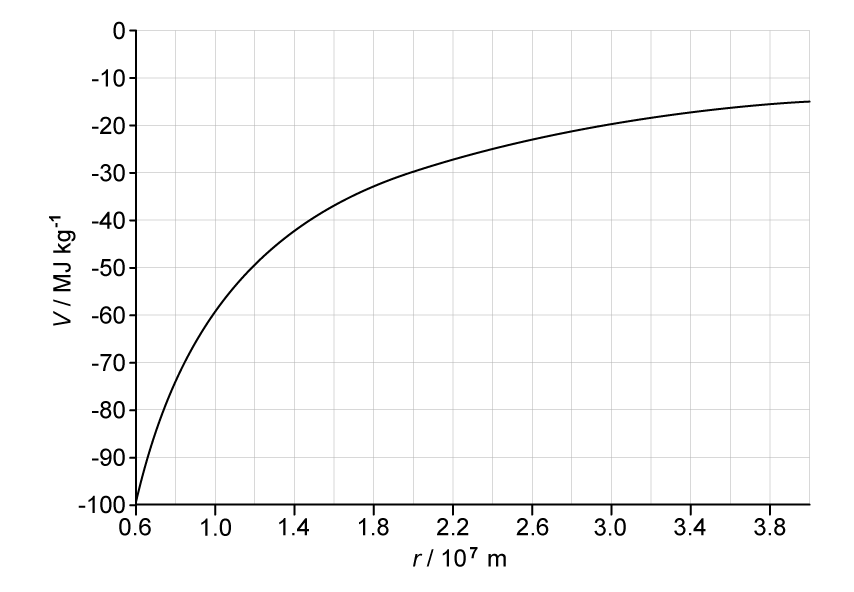
What is the best estimate of the gravitational field strength at a distance of 1.1 × 10⁷ m from the centre of the planet?
Was this exam question helpful?