Work Done on a Mass (AQA A Level Physics): Revision Note
Exam code: 7408

Work done on a mass
When a mass is moved against the force of gravity, work is done
The work done in moving a mass is given by:
Where:
= change in work done (J)
= mass (kg)
= change in gravitational potential (J kg-1)
Change in gravitational potential energy
Two points at different distances from a mass will have different gravitational potentials
This is because the gravitational potential increases with distance from a mass
Therefore, there will be a gravitational potential difference between the two points
Where:
= initial gravitational potential (J kg–1)
= final gravitational potential (J kg–1)
The change in work done against a gravitational field is equal to the change in gravitational potential energy (GPE)
When , then the GPE = 0
It is usually more useful to find the change in the GPE of a system
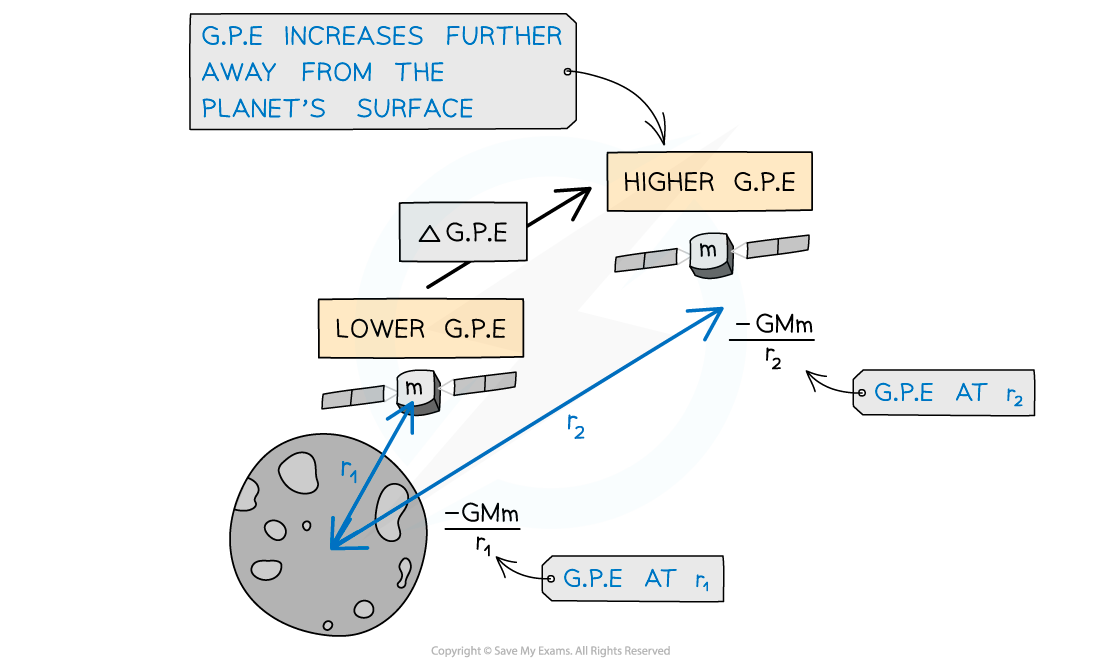
For example, a satellite lifted into space from the Earth’s surface
The change in GPE when a mass moves towards, or away from, another mass is given by:
Where:
= mass that is producing the gravitational field (e.g. a planet) (kg)
= mass that is moving in the gravitational field (e.g. a satellite) (kg)
= first distance of from the centre of (m)
= second distance of from the centre of (m)
The change in potential is the same, without the mass of the object :
Work is done when an object in a planet's gravitational field moves against the gravitational field lines i.e. away from the planet
Worked Example
A spacecraft of mass 300 kg leaves the surface of Mars to an altitude of 700 km. Calculate the work done by the spacecraft.
Radius of Mars = 3400 km
Mass of Mars = 6.40 × 10²³ kg
[3]
Answer:
Step 1: Write down the work done (or change in G.P.E) equation
Step 2: Determine values for r1 and r2
is the radius of Mars
is the radius + altitude [1 mark]
Step 3: Substitute in values
[1 mark]
[1 mark]
Examiner Tips and Tricks
Make sure to not confuse the ΔGPE equation with
The above equation is only relevant for an object lifted in a uniform gravitational field (close to the Earth’s surface). The new equation for G.P.E will not include , because this varies for different planets and is no longer a constant (decreases by ) outside the surface of a planet.
Gravitational equipotential surfaces
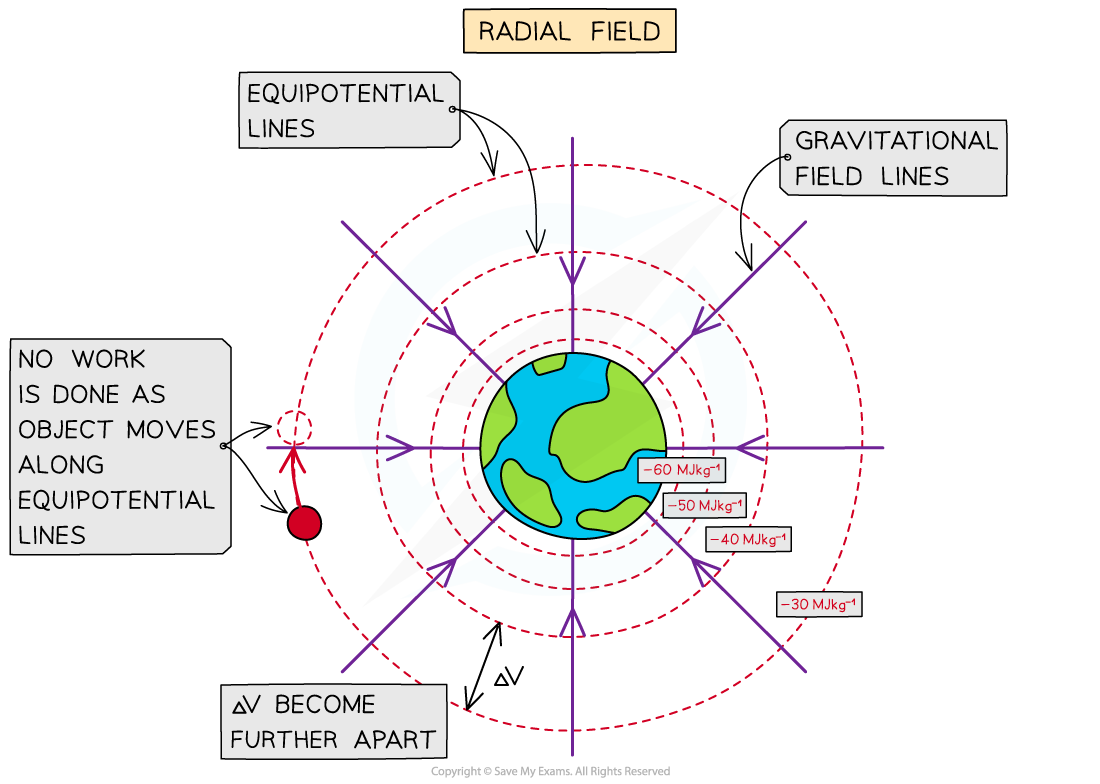
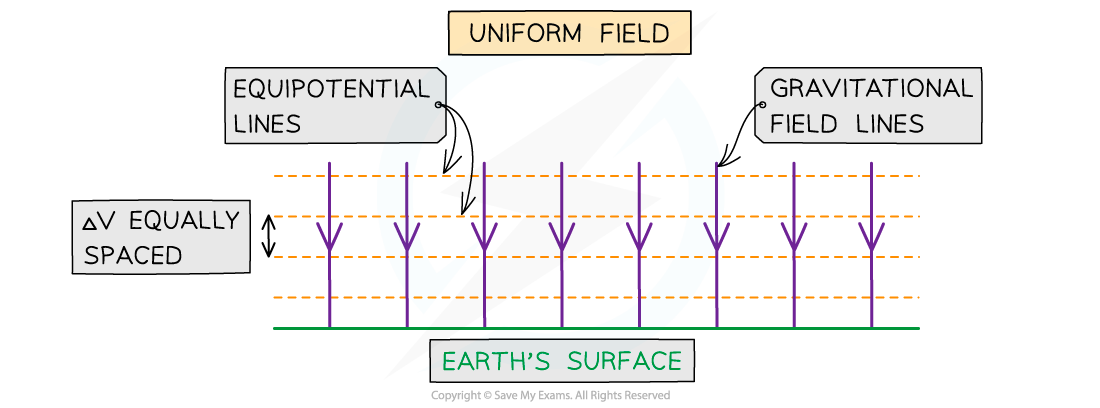
Equipotential lines (2D) and surfaces (3D) join together points that have the same gravitational potential
These are always:
perpendicular to the gravitational field lines in both radial and uniform fields
represented by dotted lines (unlike field lines, which are solid lines with arrows)
In a radial field (e.g. a planet), the equipotential lines:
are concentric circles around the planet
can become further apart as they move further away from the planet
In a radial field, equipotential lines can become further apart as they move further away from the planet because:
potential increases with distance away
the gravitational field gets weaker with distance away
a greater distance needs to be moved to obtain the same change in potential,
In a uniform field (eg. near the Earth's surface), the equipotential lines are:
horizontal straight lines
parallel
equally spaced
No work is done when moving along an equipotential line or surface, only between equipotential lines or surfaces
This means that an object travelling along an equipotential doesn't lose or gain energy and
Examiner Tips and Tricks
Remember equipotential lines should not have arrows on them like gravitational field lines do, since they have no particular direction and are not vectors. Make sure to draw any straight lines with a ruler or a straight edge.

Unlock more, it's free!
Join the 100,000+ Students that ❤️ Save My Exams
the (exam) results speak for themselves:

Was this revision note helpful?
Build on this topic