Magnetic Flux (AQA A Level Physics): Revision Note
Exam code: 7408

Magnetic flux
Electromagnetic induction is the process of inducing an e.m.f in a conductor when there is relative movement between a charge and a magnetic field
This can be observed using a magnet and a coil or a solenoid
This happens when a conductor cuts through magnetic field lines
The amount of e.m.f induced is determined by the magnetic flux
The amount of magnetic flux varies as the coil rotates within the field
The flux is the total magnetic field that passes through a given area
It is a maximum when the magnetic field lines are perpendicular to the plane of the area
It is zero when the magnetic field lines are parallel to the plane of the area
The magnetic flux is defined as:
The product of the magnetic flux density and the cross-sectional area perpendicular to the direction of the magnetic flux density
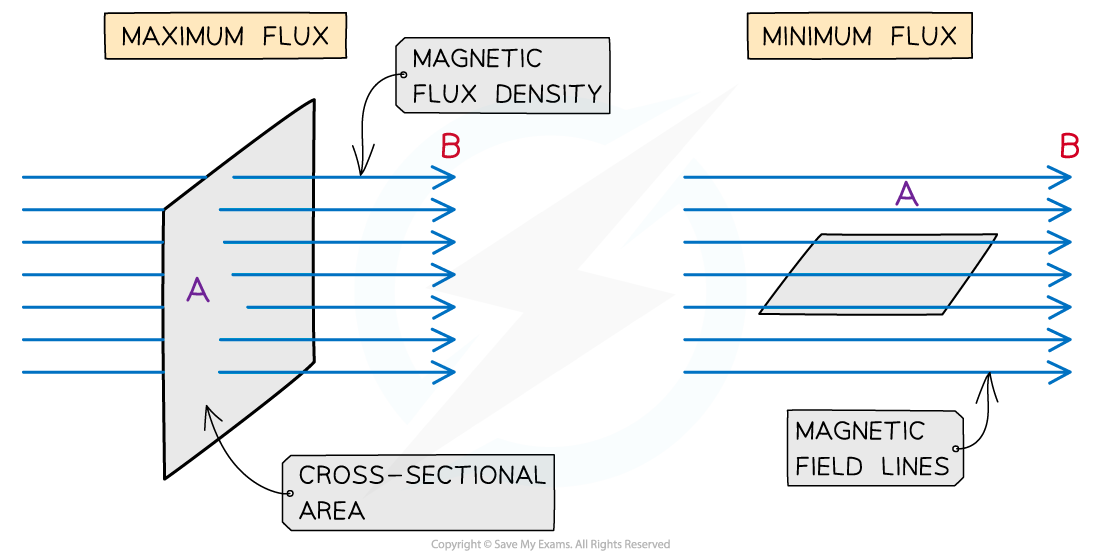
In other words, magnetic flux is the number of magnetic field lines through a given area
Magnetic flux is defined by the symbol (greek letter ‘phi’)
It is measured in units of Webers (Wb)
Magnetic flux can be calculated using the equation:
Where:
= magnetic flux (Wb)
= magnetic flux density (T)
= cross-sectional area (m2)
Worked Example
An aluminium window frame has a width of 40 cm and length of 73 cm shown in the diagram below.
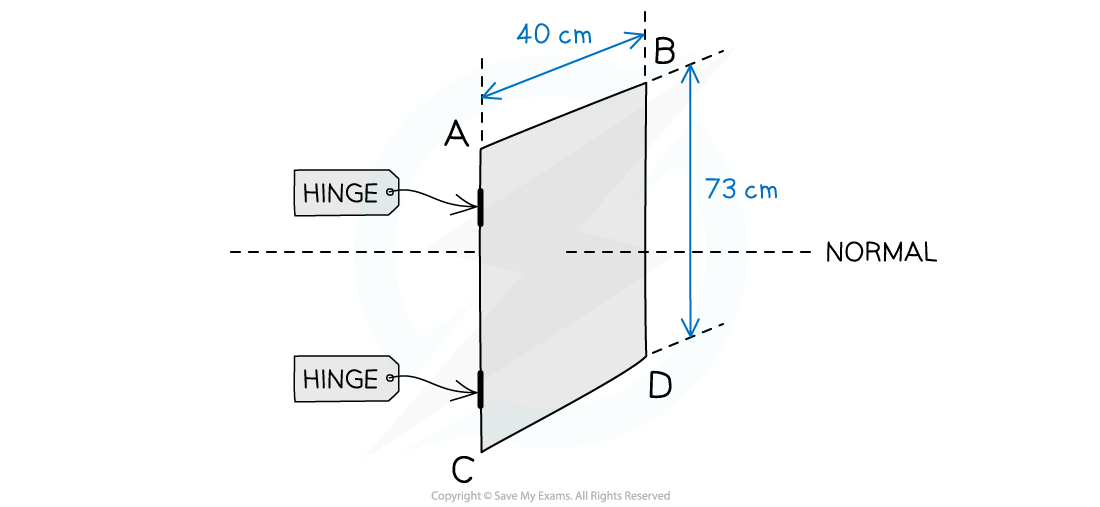
The frame is hinged along the vertical edge AC. When the window is closed, the frame is normal to the Earth's magnetic field with magnetic flux density 1.8 × 10⁻⁵ T.
a) Calculate the magnetic flux through the window when it is closed [2]
b) Sketch the graph of the magnetic flux against angle between the field lines and the normal when the window is opened and rotated by 180° [3]
Answer:
Part (a)
Step 1: Write out the known quantities
Cross-sectional area,
Magnetic flux density,
Step 2: Write down the equation for magnetic flux
Step 3: Substitute in values
[1 mark]
[1 mark]
Part (b)
The magnetic flux will be at a maximum when fully closed or opened to 180° [1 mark]
The magnetic flux will be at a minimum when the window is opened by 90° [1 mark]

[1 mark]
Examiner Tips and Tricks
Consider carefully the value of , it is the angle between the field lines and the line normal (perpendicular) to the plane of the area the field lines are passing through. If it helps, drawing the normal on the area provided will help visualise the correct angle.

Unlock more, it's free!
Join the 100,000+ Students that ❤️ Save My Exams
the (exam) results speak for themselves:

Was this revision note helpful?
Build on this topic