Fleming's Left Hand Rule (AQA A Level Physics): Revision Note
Exam code: 7408

Direction of force on a current-carrying conductor
When a current-carrying conductor is placed in a magnetic field, the force, -field and current are all mutually perpendicular to each other
Their directions can be determined using Fleming’s left-hand rule
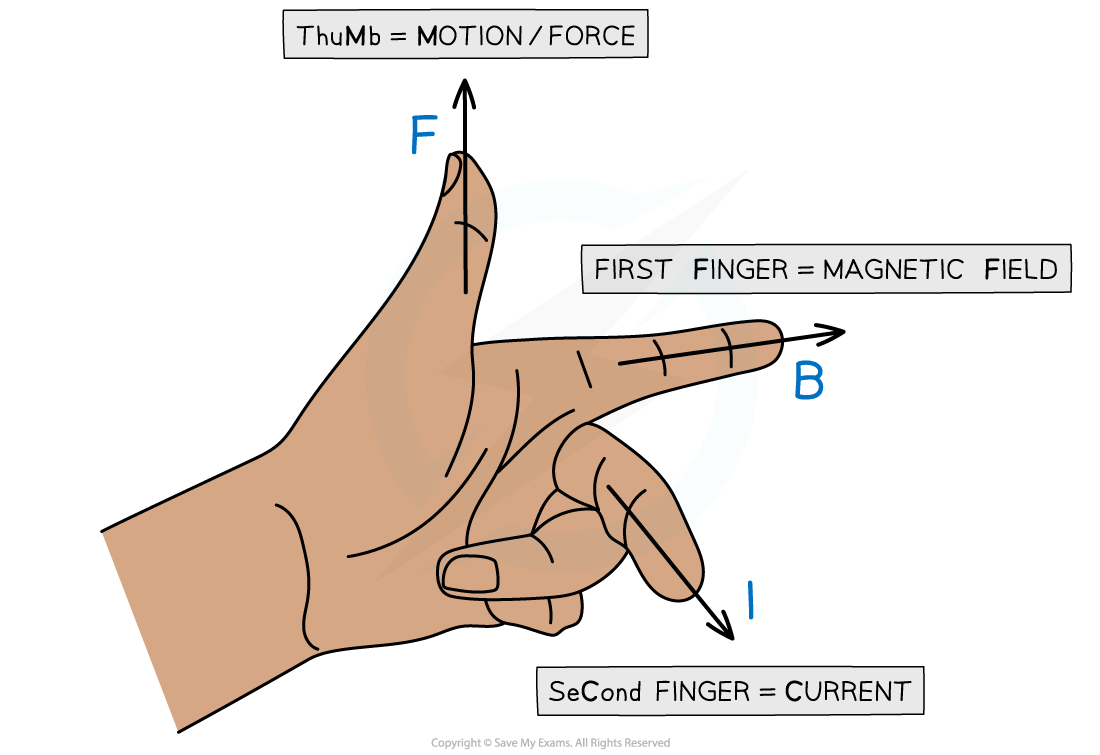
To use Fleming's left-hand rule, point the thumb, first finger and second finger at right angles to each other
The thumb points in the direction of motion or force of the conductor
The first finger points in the direction of the applied magnetic field
The second finger points in the direction of the flow of conventional current (from positive to negative)
Representing magnetic fields in 3D
When solving problems in three-dimensional space, the current, force or magnetic field could be directed into or out of the page
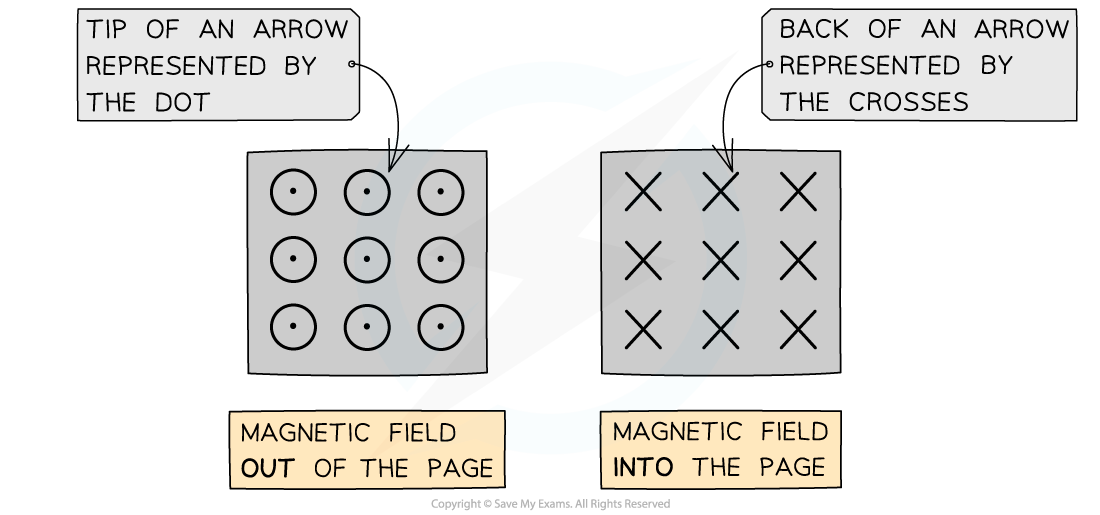
When the magnetic field is directed into or out of the page, the following symbols are used:
Dots (sometimes with a circle around them) represent the magnetic field directed out of the plane of the page
Crosses represent the magnetic field directed into the plane of the page
The way to remember this is by imagining an arrow used in archery or darts:
If the arrow is approaching head-on, such as out of a page, only the very tip of the arrow can be seen (a dot)
When the arrow is receding away, such as into a page, only the cross of the feathers at the back can be seen (a cross)
Worked Example
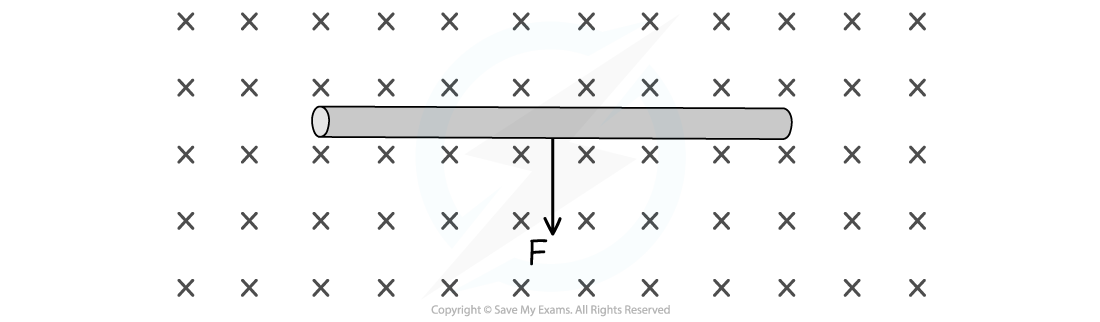
When a current-carrying wire is placed in a magnetic field, a force acts on it, as shown in the diagram.
State the direction of the current flowing in the wire.
[1]
Answer:
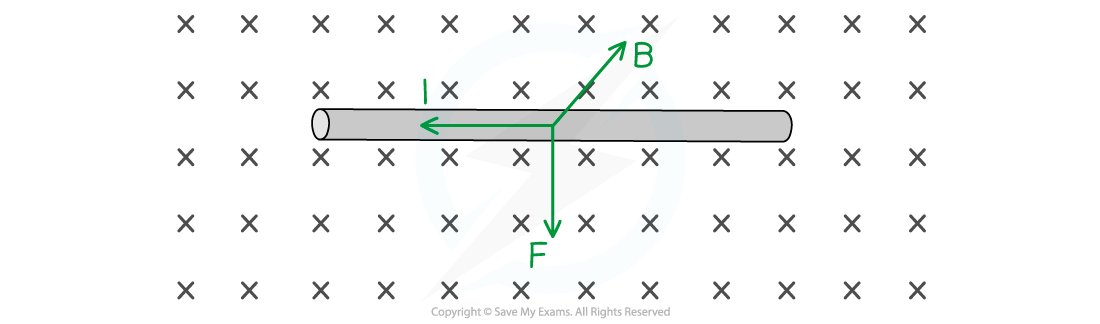
Using Fleming’s left-hand rule:
Magnetic field, = into the page
Force, = vertically downwards
Current, = from right to left [1 mark]
Examiner Tips and Tricks
Don’t be afraid to use Fleming’s left-hand rule during an exam. Although, it is best to do it subtly in order not to give the answer away to other students.

Unlock more, it's free!
Join the 100,000+ Students that ❤️ Save My Exams
the (exam) results speak for themselves:

Was this revision note helpful?
Build on this topic