The Weak Interaction (AQA A Level Physics): Revision Note

Exam code: 7408

Ashika

Written by: Ashika

Reviewed by: Tim

Updated on

Guided study available on this topic

Understand this topic with deeper explanations and understanding checks.

The weak interaction

  • The weak interaction is responsible for the radioactive decay of atoms

  • The exchange particle that carries this force is the W–, W+ or Z0 boson

    • The type of exchange particle depends on the type of interaction

β decay

  • β– and β+ decay are examples of the weak interaction in action

  • In β– decay, a neutron turns into a proton emitting an electron and an electron anti-neutrino

n → p + e− + ν¯e

  • The W– boson is the exchange particle in this interaction

A Feynman diagram of a neutron becoming a proton, emitting a W minus boson that decays into an electron and an electron anti-neutrino.
Feynman diagram showing beta minus decay. The W⁻ boson is the exchange particle
  • In β+ decay, a proton turns into a neutron emitting a positron and an electron neutrino

p → n + e+ + νe

  • The W+ boson is the exchange particle in this interaction

A Feynman diagram of a proton becoming a neutron, emitting a W plus boson that decays into a positron and an electron neutrino.
Feynman diagram showing beta plus decay. The W⁺ boson is the exchange particle

Electron capture & electron–proton collisions

  • Electrons and protons are attracted to each other via the electromagnetic interaction

    • However, when they interact with each other, it is the weak interaction that facilitates the collision

  • Both electron capture and electron-proton collisions have the same decay equation

p + e− → n + νe

  • Electron capture is when an atomic electron is absorbed by a proton in the nucleus resulting in the release of a neutron and an electron neutrino

    • This decay is mediated by the W+ boson

  • Electron-proton collisions are similar; when an electron collides with a proton, a neutron and an electron neutrino are emitted

    • This decay is mediated by the W– boson
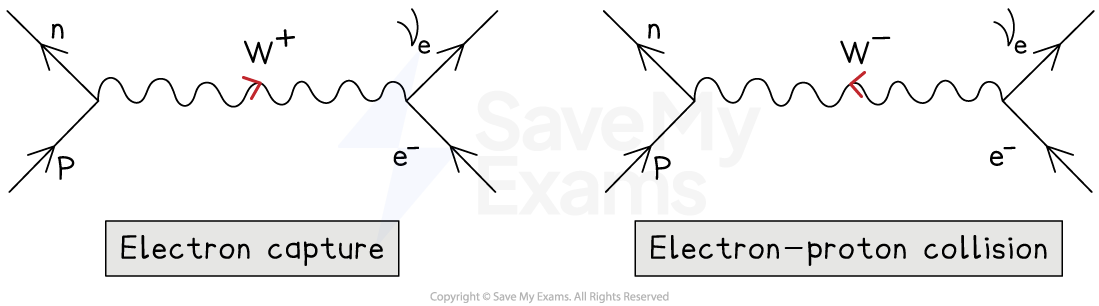
Two Feynman diagrams side by side. One for electron capture shows a proton and electron producing a neutron and electron neutrino via a W⁺ boson, and one for an electron-proton collision shows the same particles via a W⁻ boson.
Feynman diagrams for electron capture and an electron-proton collision. These are equal except for the sign of the W boson

Examiner Tips and Tricks

Notice that the sign of the W boson matches that of the beta decay. The W– boson is exchanged in beta minus decay and W+ boson is exchanged in beta plus decay.

Unlock more, it's free!

Join the 100,000+ Students that ❤️ Save My Exams

the (exam) results speak for themselves:

Build on this topic

Ashika

Author: Ashika

Expertise: Physics Content Creator

Ashika graduated with a first-class Physics degree from Manchester University and, having worked as a software engineer, focused on Physics education, creating engaging content to help students across all levels. Now an experienced GCSE and A Level Physics and Maths tutor, Ashika helps to grow and improve our Physics resources.

Tim

Reviewer: Tim

Expertise: Content Creator

Timothy graduated with a first class degree in Mathematics and Physics from the University of Warwick. After working as a postgraduate researcher, Timothy has worked as a content creator for various online revision platforms, creating physics resources for a range of levels and exam boards.