Faraday's & Lenz's Laws (AQA A Level Physics): Revision Note
Exam code: 7408

Faraday's & Lenz's Laws
Faraday's law relates the rate of change of flux linkage to the e.m.f. induced in a conductor
It is defined as:
The magnitude of the induced e.m.f. is directly proportional to the rate of change in magnetic flux linkage
Lenz’s Law describes the direction of the induced e.m.f. as defined by Faraday’s law:
The induced e.m.f acts in such a direction to produce effects that oppose the change causing it
Experimental evidence for Lenz’s law
To verify Lenz’s law, the only apparatus needed is:
a bar magnet
a coil of wire
a sensitive ammeter
Note: a cell is not required
A known pole (either north or south) of the bar magnet is pushed into the coil, which induces a magnetic field in the coil
Using the right-hand grip rule, the curled fingers indicate the direction of the current, and the thumb indicates the direction of the induced magnetic field
The direction of the current is observed on the ammeter
Reversing the magnet direction would give an opposite deflection on the meter
The induced field (in the coil) repels the bar magnet
This is because of Lenz’s law:
The direction of the induced field in the coil pushes against the change creating it, i.e. the bar magnet
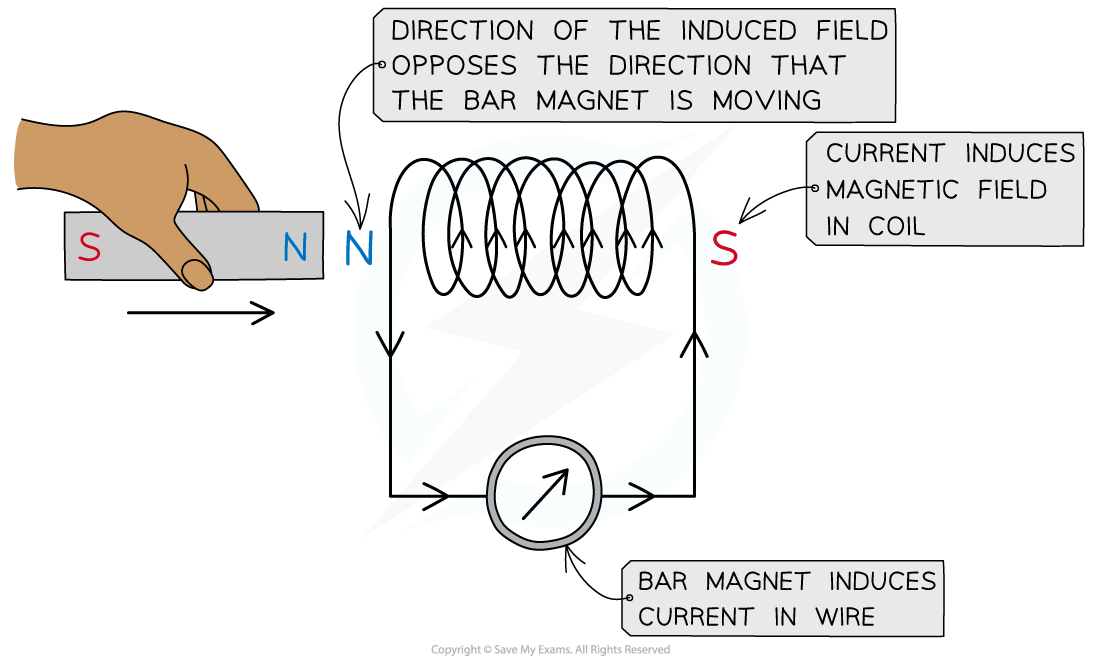
Lenz’s law can be verified using a coil connected in series with a sensitive ammeter and a bar magnet
Calculating Induced EMF
Faraday's law of induction can be written mathematically as:
Where:
= induced e.m.f (V)
= number of turns of coil
= change in magnetic flux (Wb)
= time interval (s)
This equation shows that the gradient of a magnetic flux linkage against time graph is the e.m.f
Lenz’s law combined with Faraday’s law is given by the equation:
This equation shows:
When a bar magnet goes through a coil, an e.m.f. is induced within the coil due to a change in magnetic flux
A current is also induced. which means the coil now has its own magnetic field
The coil’s magnetic field acts in the opposite direction to the magnetic field of the bar magnet (shown by the minus sign)
If a direct current (d.c.) power supply is replaced with an alternating current (a.c.) supply, the e.m.f. induced will also be alternating with the same frequency as the supply
Worked Example
A small rectangular coil contains 350 turns of wire. The longer sides are 3.5 cm and the shorter sides are 1.4 cm.

The coil is held between the poles of a large magnet so that the coil can rotate about an axis through its centre.
The magnet produces a uniform magnetic field of flux density 80 mT between its poles. The coil is positioned horizontally and then turned through an angle of 40° in a time of 0.18 s.
Calculate the magnitude of the average e.m.f. induced in the coil.
Answer:
Step 1: Write down the known quantities
Magnetic flux density, B = 80 mT = 80 × 10-3 T
Area, A = 3.5 × 1.4 = (3.5 × 10-2) × (1.4 × 10-2) = 4.9 × 10⁻⁴ m2
Number of turns, N = 350
Time interval, Δt = 0.18 s
Angle between coil and field lines = 40o
Therefore, the angle between the normal to the area and the field lines, θ = (90 − 40) = 50°
Step 2: Write out the equation for Faraday’s law:
Step 3: Write out the equation for flux linkage:
Step 4: Substitute values into flux linkage equation:
Step 5: Substitute flux linkage and time into Faraday’s law equation:
Examiner Tips and Tricks
The 'magnitude' of the e.m.f. just means it's size, rather than direction. This is often what is required in exam questions, so the minus sign in Lenz's law is not necessarily required in calculations.
However, you may be expected to explain the significance of the minus sign in Lenz's law.

Unlock more, it's free!
Join the 100,000+ Students that ❤️ Save My Exams
the (exam) results speak for themselves:

Was this revision note helpful?
Build on this topic
