Demonstrating Interference (AQA A Level Physics): Revision Note
Exam code: 7408

Interference & diffraction of a laser
Lasers are the ideal piece of equipment to analyse diffraction and intensity patterns because they form light that is:
coherent (have a constant phase difference and frequency)
monochromatic (have the same wavelength)
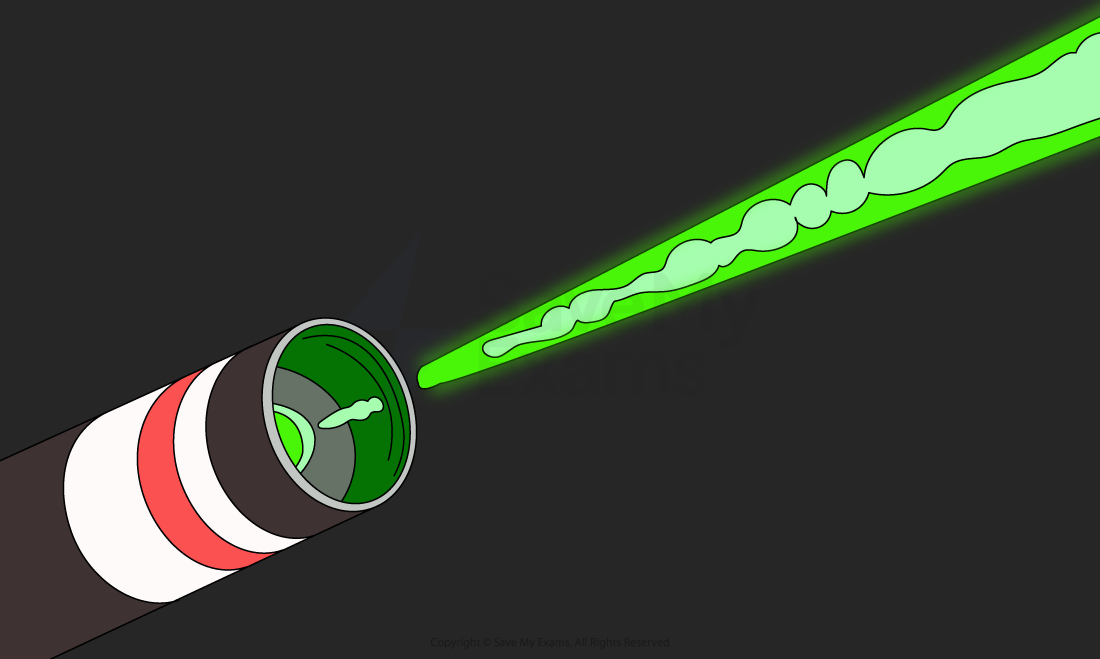
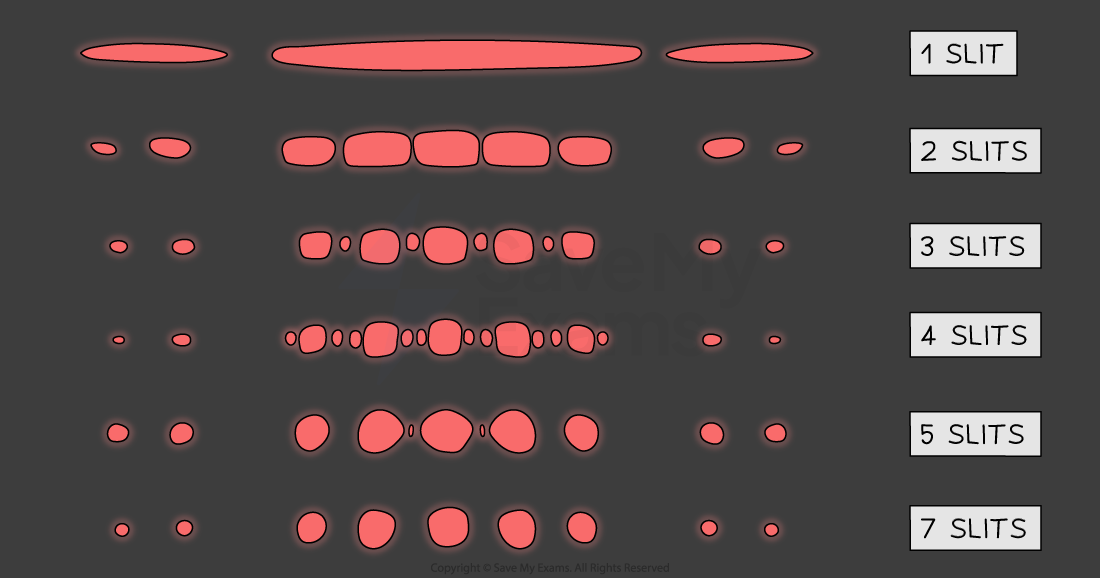
The diffraction pattern produced by a laser on a screen is made up of:
areas of constructive interference - the bright strips or fringes
areas of destructive interference - the dark fringes
Other sources of light, such as a filament bulb or a sodium lamp, are non-coherent, so they produce white light
Safety issues with lasers
Lasers produce a very high-energy beam of light
This intense beam can cause permanent eye damage or even blindness
Precautions
It's important to use lasers safely and follow the guidelines:
Never look directly at a laser or its reflection
Don’t shine the laser towards a person
Don't allow a laser beam to reflect from shiny surfaces into someone else's eyes
Wear laser safety goggles
Place a ‘laser on’ warning light outside the room
Stand behind the laser
Sound & EM wave interference
Using sound waves
Two-source interference can be demonstrated with two speakers emitting a coherent sound
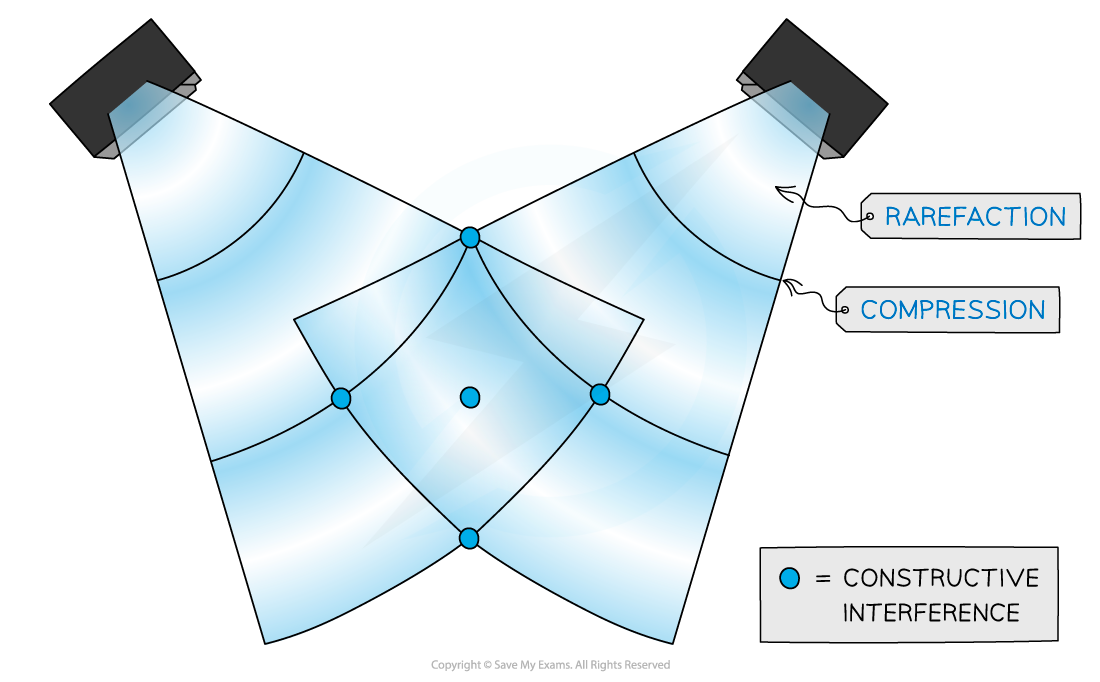
Sound waves are longitudinal waves made up of compressions and rarefactions
Constructive interference occurs when the compressions and rarefactions from each wave line up and the sound appears louder
Destructive interference occurs when a compression from one wave lines up with a rarefaction from the other and vice versa
The two waves cancel each other out, so zero sound is heard
This is the technology used in noise-cancelling headphones
Using microwaves
Two-source interference for microwaves (and other electromagnetic waves) can be detected with a moveable microwave detector
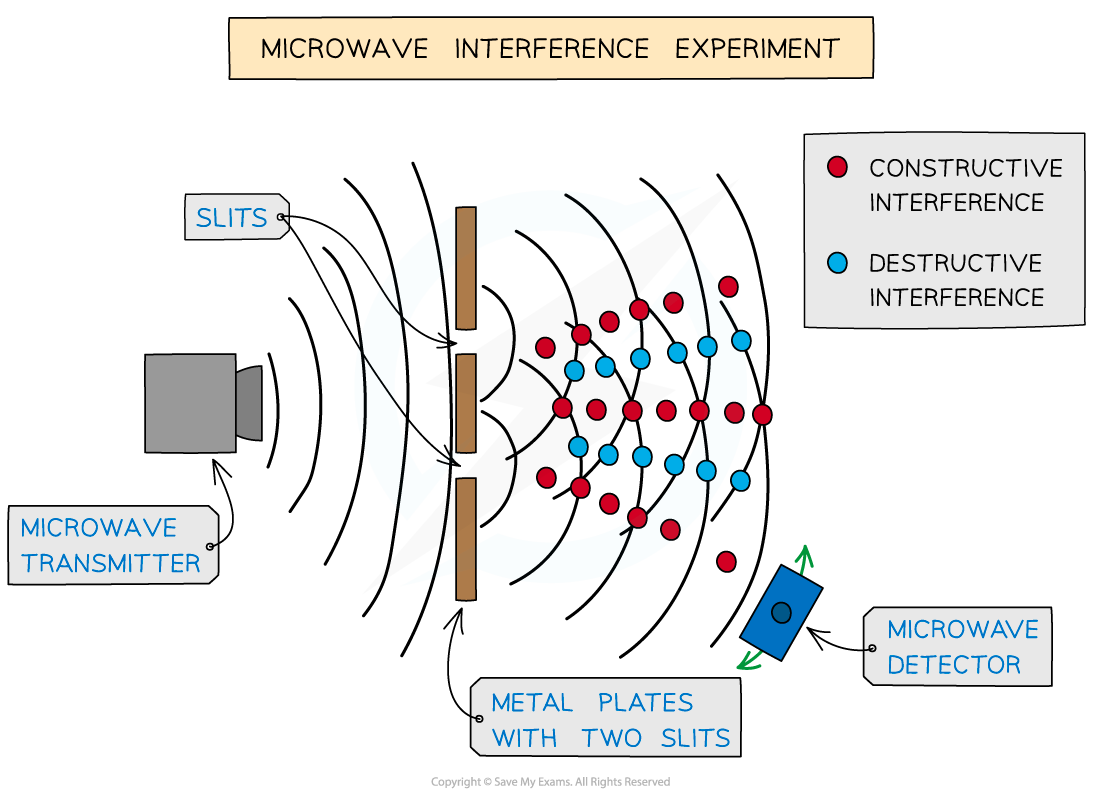
The detector picks up a maximum amplitude or intensity in regions of constructive interference
The detector picks up a minimum or zero amplitude, so no signal in regions of destructive interference
Intensity variation with amplitude
By definition, the intensity of a wave (its power per unit area) is proportional to the energy transferred by the wave
The intensity of a wave at a particular point is related to the amplitude of the wave at that point
The energy transferred by a wave is proportional to the square of the amplitude
Therefore, the intensity of a wave is proportional to the square of the amplitude
Where:
= intensity of the wave in W m–2
= amplitude of the wave in metres (m)
Worked Example
Two speakers are set up in a room and play a note of frequency 280 Hz. The waves are in phase as they leave the speakers.
A student walks 3.0 m from speaker A towards speaker B. Before moving, they initially hear a loud sound at speaker A, but as they move from speaker A towards speaker B, they hear quiet and loud sounds.
Calculate the number of quiet spots the student hears as they walk.
Speed of sound in air = 340 m s–1
[3]
Answer:
Step 1: Calculate the wavelength
wave equation:
[1 mark]
Step 2: Write down the condition for destructive interference
Path difference =
Step 3: Calculate the smallest path difference
The shortest path difference occurs when n = 0
Shortest path difference =
Therefore, the first quiet spot is at 0.6 m [1 mark]
Step 4: Calculate the next smallest path differences
When n = 1:
Path difference = [1 mark]
When n = 2:
Path difference =
Step 5: Write a concluding sentence
Therefore, in 3.0 m the student hears three quiet spots [1 mark]

Unlock more, it's free!
Join the 100,000+ Students that ❤️ Save My Exams
the (exam) results speak for themselves:

Was this revision note helpful?
Build on this topic