Gravitational Field Strength (AQA A Level Physics): Revision Note
Exam code: 7408

Gravitational force
There is a universal force of attraction between all matter with mass
This force is known as the ‘force due to gravity’ or the weight
The Earth’s gravitational field is responsible for the weight of all objects on Earth
A gravitational field is defined as:
A region of space where a mass experiences a force due to the gravitational attraction of another mass
The direction of the gravitational field is always towards the centre of the mass
Gravitational forces cannot be repulsive
Gravity has an infinite range, meaning it affects all objects in the universe
There is a greater gravitational force around objects with a large mass (such as planets)
There is a smaller gravitational force around objects with a small mass (almost negligible for atoms)

Gravitational field strength
The strength of this gravitational field g at a point is the force F per unit mass m of an object at that point:
Where:
= gravitational field strength (N kg-1)
= force due to gravity, or weight (N)
= mass (kg)
This equation shows that:
the larger the mass of an object, the greater its pull on another object
on planets with a large value of , the gravitational force per unit mass is greater than on planets with a smaller value of
An object's mass remains the same at all points in space
However, on planets such as Jupiter, the weight of an object will be a lot greater than on a less massive planet, such as Earth
This means the gravitational force would be so high that humans, for example, would be unable to fully stand up
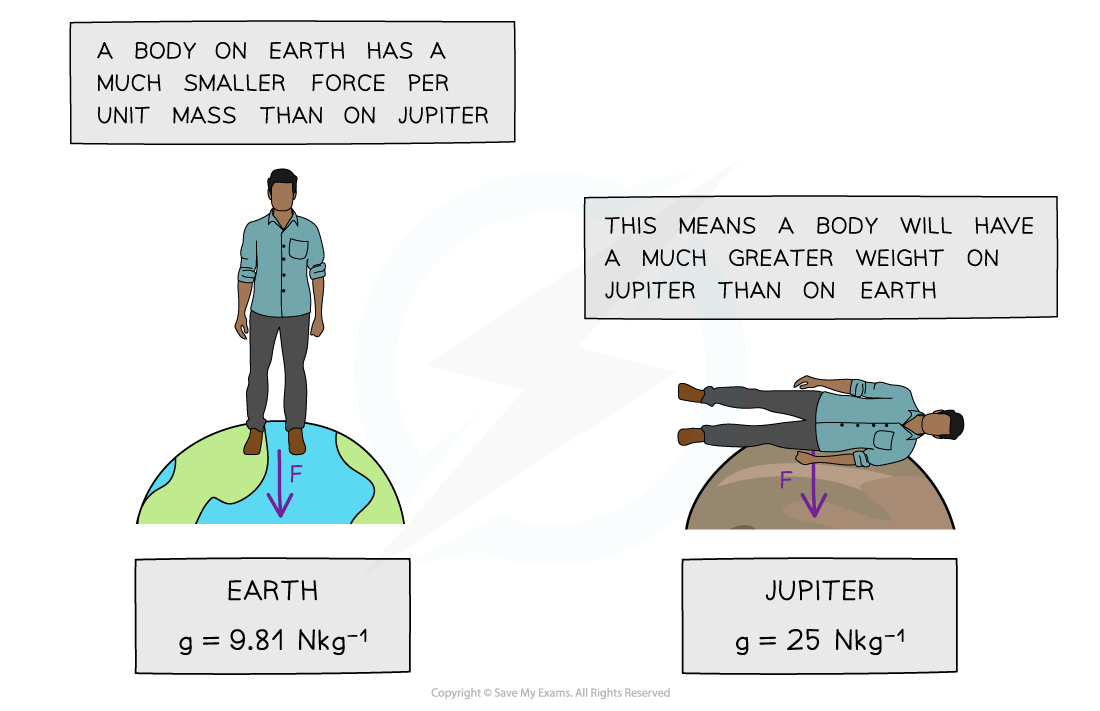
Factors that affect the gravitational field strength at the surface of a planet are:
the radius (or diameter) of the planet
the mass (or density) of the planet
Worked Example
Calculate the mass of an object with weight 10 N on Earth.
[1]
Answer:
[1 mark]
Examiner Tips and Tricks
There is a big difference between and (sometimes referred to as ‘little g’ and ‘big G’ respectively), is the gravitational field strength and is Newton’s gravitational constant. Make sure not to use these interchangeably. Remember the equation density ρ = mass m ÷ volume V, which may come in handy with some calculations.

Unlock more, it's free!
Join the 100,000+ Students that ❤️ Save My Exams
the (exam) results speak for themselves:

Was this revision note helpful?
Build on this topic