Rutherford Scattering (AQA A Level Physics): Revision Note
Exam code: 7408

Rutherford scattering
Evidence for the structure of the atom was discovered by Ernest Rutherford at the beginning of the 20th century from the study of alpha particle scattering
Rutherford passed beams of alpha particles through a thin sheet of gold foil to investigate:
the different angles of deflection of the alpha particles
the number of alpha particles that were deflected at each angle
Apparatus for the Rutherford scattering experiment
The setup for the scattering experiment consisted of:
a source of alpha particles in a lead container
a thin sheet of gold foil
a movable detector
an evacuated chamber

Purpose of the lead container
Alpha particles are emitted in all directions, so the source was placed in a lead container
This was to produce a collimated beam of alpha particles
This is because alpha particles are absorbed by lead, so a long narrow hole at the front allowed a concentrated beam of alpha particles to escape and be directed as needed
Purpose of the thin sheet of gold foil
The target material needed to be extremely thin, about 10−6 m thick
This is because a thicker foil would stop the alpha particles completely
Gold was chosen due to its malleability, meaning it was easy to hammer into thin sheets
Purpose of the evacuated chamber
Alpha particles are highly ionising, meaning they only travel about 5 cm before interacting with molecules of air
So, the apparatus was placed in an evacuated chamber
This was to ensure that the alpha particles did not collide with any particles on their way to the foil target
Findings from the Rutherford scattering experiment
An alpha (α
) particle is the nucleus of a helium atom, so it has a positive charge

The observations from Rutherford's experiment were:
A. The majority of α-particles passed straight through the foil undeflected
This suggests the atom is mostly empty space
B. Some α-particles deflected through small angles of <10°
This suggests there is a positive nucleus at the centre (since two positive charges would repel)
C. Only a small number of α-particles deflected straight back at angles of >90°
This suggests the nucleus is extremely small and is where most of the mass and charge of the atom are concentrated
This led to the conclusion that atoms consist of small, dense positively charged nuclei surrounded by negatively charged electrons

Note: The atom is around 100 000 times larger than the nucleus!
Worked Example
In an α-particle scattering experiment, a student set up the apparatus below to determine the number n of α-particle incident per unit time on a detector held at various angles θ.
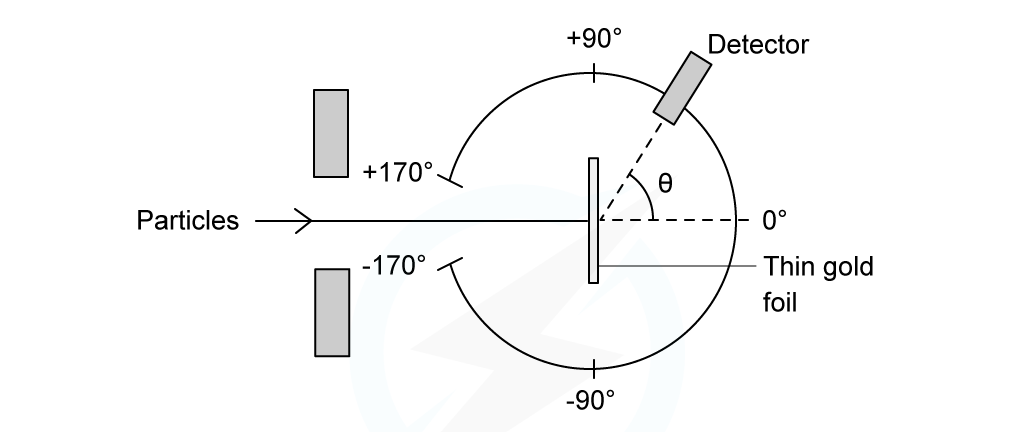
Which of the following graphs best represents the variation of n with θ from 0 to 90°?

[1]
Answer:
The Rutherford scattering experiment directed parallel beams of α-particles at gold foil
The observations were:
Most of the α-particles went straight through the foil
The largest value of n will therefore be at small angles
Some of the α-particles were deflected through small angles
n drops quickly with increasing angle of deflection θ
These observations fit with graph A [1 mark]

Unlock more, it's free!
Join the 100,000+ Students that ❤️ Save My Exams
the (exam) results speak for themselves:

Was this revision note helpful?
Build on this topic