Time Dilation (AQA A Level Physics): Revision Note
Exam code: 7408

Time dilation
When objects travel close to the speed of light, to an observer moving relative to that object, it looks as if the object has slowed down
This is best demonstrated by clocks
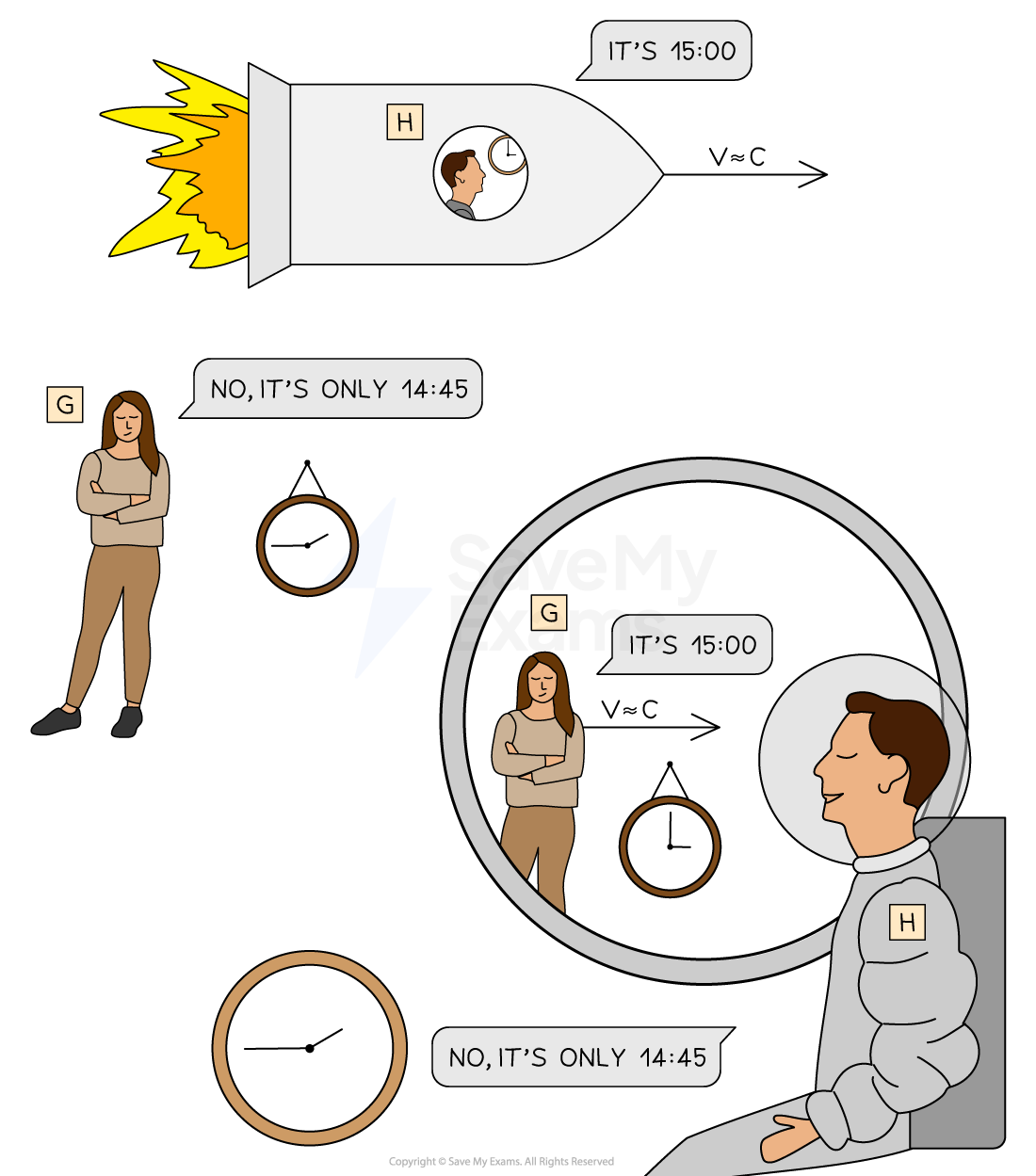
Observer H is in a rocket moving close to the speed of light
They will see their clock ticking at a regular pace, say, it is reading 15:00
Observer G at rest on Earth, with remarkable eyesight, will measure the clock as ticking slower
They will observe that time has slowed down in the spaceship from their reference frame i.e. they may see the time as 14:45 instead of 15:00
However, the same occurs the other way around
For observer H on the rocket, it is observer G that is moving relative to them
Therefore, observer H will measure observer G's clock as ticking slower i.e. they see time slow down on Earth from their reference frame
The gamma term
Recall from Einstein's Postulates that moving between frames of reference means the speed needs to be changed through simple addition or subtraction
When travelling at speeds close to the speed of light, this no longer applies, because the speed of light is independent of the frame of reference
This transformation from one reference frame to another is corrected by multiplying by a scaling factor called the gamma factor,
As is always less than (the speed of light), this means is always greater than 1
This is especially important for time dilation and length contraction
Time dilation will be used to explain where this gamma term comes from
Time dilation equation
Consider a light clock
This consists of two mirrors facing each other with a beam of light travelling up and down between them
An observer is at rest relative to the clock on a train platform and watches the light reflect between the mirrors
The distance between the mirrors is and the light travels at a speed
Therefore, the time interval for the light to travel from the top mirror back down to the bottom is:

Another light clock is on a moving train, relative to the initial observer on the platform, travelling at constant velocity
This velocity is close to the speed of light
The stationary observer on the platform sees the light clock on the train and watches the reflection of the rays between the mirrors
It appears that the light rays travel to the right at an angle to the direction of motion

The observer on the train platform sees the mirror at:
position 1, when the light leaves the bottom mirror
position 2, when the light returns to it
The distance between the mirrors, , is the same, but the light now travels a longer path,
The distance travelled by the light ray is now , and the time observed between the reflections is now
The apparent distance horizontally travelled by the mirror is where is the speed of the train
Notice that this is part of a right-angled triangle, so Pythagoras' theorem gives:
Where:
The aim is to find , the time taken for the light ray to travel up and down in the reference frame of the stationary observer on the train platform, who is moving relative to the light clock on the train
Remember, although it is the train that is moving, in the reference frame of an observer on the train, it is the observer on the platform that is moving
Remember the gamma factor
Therefore:
Where:
= the time interval measured from an observer moving relative to the time interval being measured (s)
= the proper time interval (s)
As , this means that the
In other words, a clock observed from a reference frame moving relative to it will be measured to tick slower than a clock that is at rest in its frame of reference
The observer on the platform will view the train clock as moving slower
The observer on the train will view the platform as moving slower
It is normal to wonder why it's the time that slows down for the light beam, and not the light beam just speeding up to hit each mirror at the same frequency
This is due to Einstein's second postulate
Both Observers G and H must measure the speed of light to be c, so it doesn't slow down or speed up according to either reference frame
It is important to note that the time has been measured at the same position
In other words, the time interval is the position at which the light leaves the first mirror and at which it returns to the second mirror in the reference frame of the mirror
Worked Example
Alex's spacecraft is on a journey to a star travelling at . Emma is on a space station on Earth at rest. According to Emma, the distance from the base station to the star is 14.2 ly.
Show that Alex measures the time taken for her to travel from the base station to the star to be about 14.5 years.
[3]
Answer:
Step 1: List the known quantities
Distance of space station according to Emma = 14.2 ly
Speed of Alex's spacecraft,
Step 2: Analyse the situation
The aim is to find the time that Alex measures for her travel i.e. the time she would measure on her own clock in the spaceship which she is stationary relative to
This is the proper time,
Step 3: Calculate the time taken according to Emma,
1 ly (light year) is the distance, , light (at speed ) travels in a year
Therefore it takes the light 14.2 years (time) to travel the distance at speed c
Therefore, the time taken according to Emma is:
[1 mark]
Step 4: Substitute values into the time dilation equation
[1 mark]
[1 mark]
Step 5: Check whether your answer makes sense
Since Emma (who is stationary) is viewing Alex's clock (which is moving), she would measure a longer time for Alex to reach the star than Alex will
As Emma records 20.29 years, but Alex only records 14.5 years, this time makes sense
Examiner Tips and Tricks
A nice way to remember this is 'moving clocks run slower'. The caveat is what is considered 'moving' depends on the reference frame.
You will not be expected to remember this derivation, but it's helpful to know where all the factors have come from. The time dilation equation is given on your data sheet.
The notion of 'proper time' is incredibly important here, as it depends on the reference frame the time interval is being measured from.
The maths for the derivation is only using and Pythagoras' theorem.

Unlock more, it's free!
Join the 100,000+ Students that ❤️ Save My Exams
the (exam) results speak for themselves:

Was this revision note helpful?
Build on this topic