Thermodynamic Processes (AQA A Level Physics): Revision Note

Exam code: 7408

Ashika

Written by: Ashika

Reviewed by: Caroline Carroll

Updated on

Thermodynamic Processes

  • The four main thermodynamic processes are

    • constant volume open parentheses W space equals space 0 close parentheses

    • constant pressure open parentheses increment p space equals space 0 close parentheses

    • isothermal open parentheses increment T space equals space 0 close parentheses

    • adiabatic open parentheses increment Q space equals space 0 close parentheses

Constant pressure

  • An isobaric (constant pressure) process is defined as:

A process in which no change in pressure occurs

  • This occurs when gases are allowed to expand or contract freely during a change in temperature

  • When there is a change in volume ΔV at a constant pressure p, work done W is equal to

W space equals space p increment V

  • From the first law of thermodynamics:

Q space equals space increment U space space plus space W

Q space equals space increment U space space plus-or-minus thin space p increment V

  • The ± sign reflects whether work has been done on or by the gas as a result of the change in volume
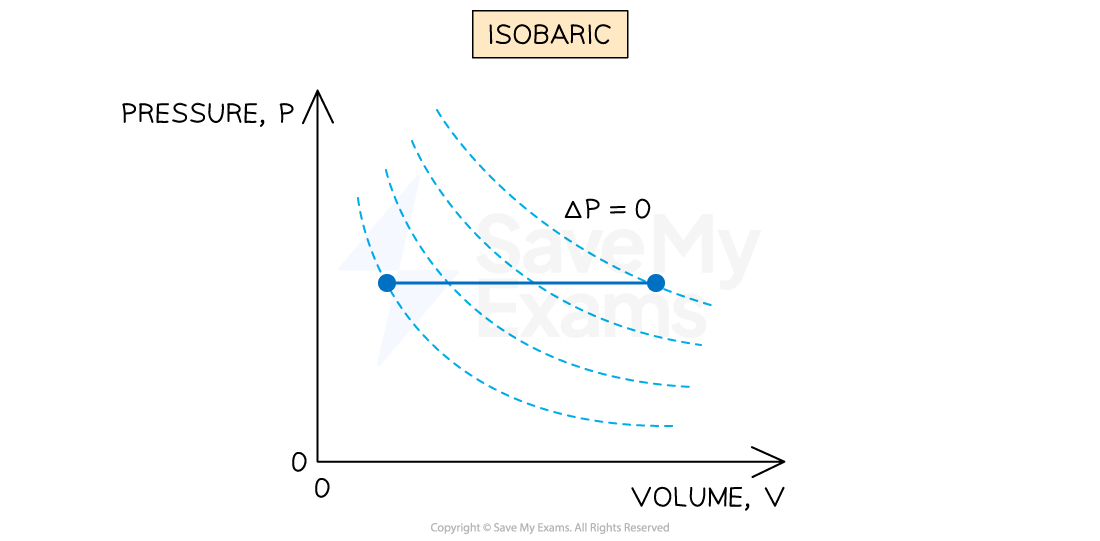
2-4-6-isobaric-pv-diagram

The solid blue line represents an isobaric process at constant pressure on a p-V diagram

Constant volume

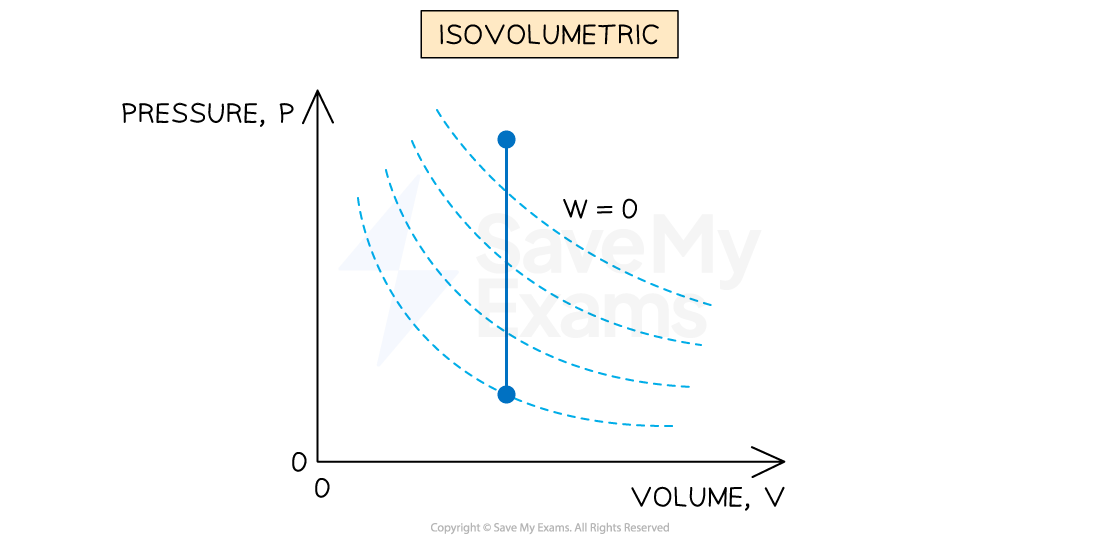
  • An isovolumetric (constant volume) process is defined as:

A process where no change in volume occurs and the system does no work

  • If there is no change in volume, then there is no work done on or by the gas, so W space equals space 0

  • Therefore, from the first law of thermodynamics:
Q space equals space increment U space space plus space W space equals space increment U space space plus space 0

Q space equals space increment U 

2-4-6-isovolumetric-pv-diagram

The solid blue line represents an isovolumetric process at constant volume on a p-V diagram

Constant temperature (isothermal)

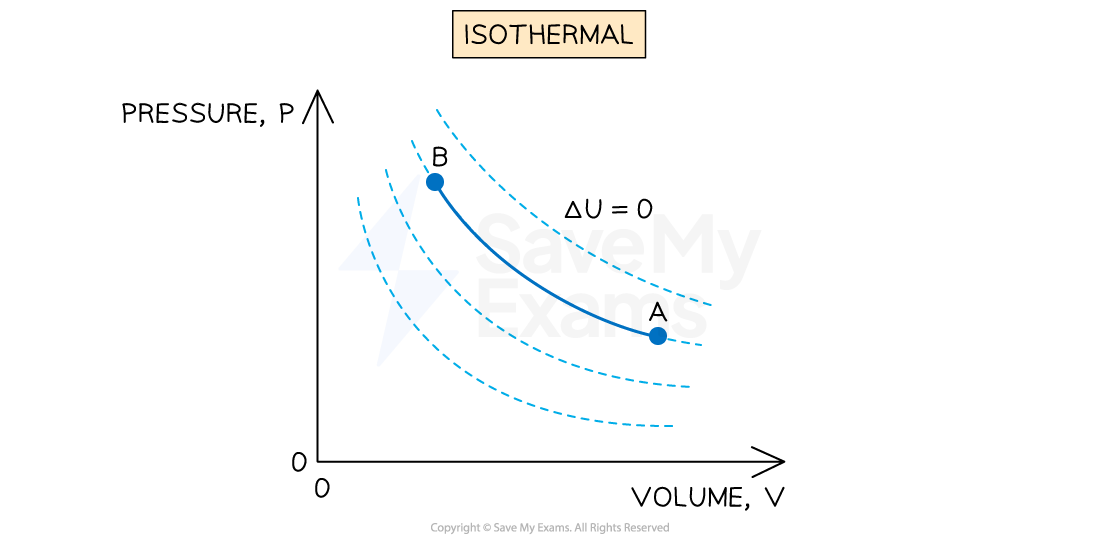
  • An isothermal process is defined as:

A process in which no change in temperature occurs

  • If the temperature does not change, then the internal energy of the gas will not change, so increment U space equals space 0

  • Therefore, from the first law of thermodynamics:
Q space equals space increment U space space plus space W space equals space 0 space plus thin space W

Q space equals space W

2-4-6-isothermal-pv-diagram

The solid blue line represents an isothermal process with constant temperature on a p-V diagram

Constant thermal energy (adiabatic)

  • An adiabatic process is defined as:

A process where no heat is transferred into or out of the system

  • If there is no heat entering or leaving the system then Q space equals space 0

  • Therefore, from the first law of thermodynamics:

Q space equals space increment U space space plus space W space equals space 0

W space equals space minus increment U space

  • This means that all the work done is at the expense of the system's internal energy

  • Hence, an adiabatic process will usually be accompanied by a change in temperature
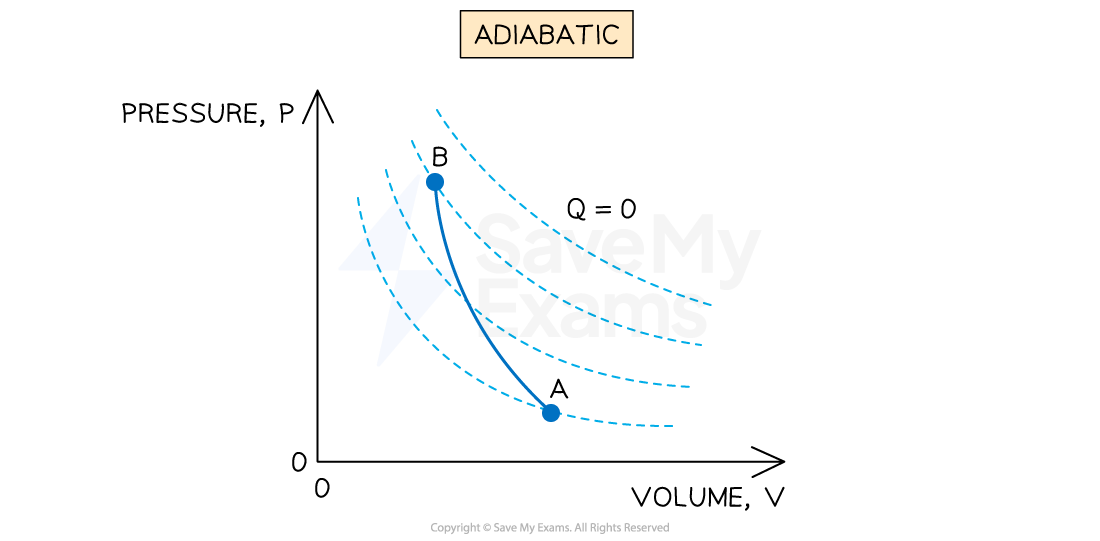
2-4-6-adiabatic-pv-diagram

The solid blue line represents an adiabatic process with constant thermal energy on a p-V diagram

Adiabatic Processes

  • Adiabatic processes in ideal gases can be modelled by the equation

space p V to the power of gamma space equals space c o n s t a n t

  • Where:

    • p = pressure of the gas (Pa)

    • V = volume occupied by the gas (m3)

  • This equation can be used for calculating changes in pressure, volume and temperature, e.g. for monatomic ideal gases, where gamma space equals space 5 over 3

space p subscript 1 V subscript 1 to the power of 5 over 3 end exponent space equals space p subscript 2 V subscript 2 to the power of 5 over 3 end exponent

  • Where:

    • space p subscript 1 = initial pressure (Pa)

    • space p subscript 2 = final pressure (Pa)

    • V subscript 1 = initial volume (m3)

    • V subscript 2 = final volume (m3)

Worked Example

A quantity of energy Q is supplied to three ideal gases X, Y and Z.

Gas X absorbs Q isothermally, gas Y isovolumetrically and gas Z isobarically.

Complete the table by inserting the words ‘positive’, ‘zero’ or ‘negative’ for the work done W, the change in internal energy ΔU and the temperature change ΔT for each gas.


W

increment U

increment T

X


Y


Z


Answer:

  • X: Isothermal = constant temperature, no change in internal energy

    • Temperature:  increment T space equals space 0

    • Internal energy:  increment T space proportional to space increment U, so, increment U space equals space 0

    • Work done:  Q space equals space increment U space space plus space W space space space space space rightwards double arrow space space space space space Q space equals space plus W

  • Y: Isovolumetric = constant volume, no work done

    • Work done:  W space proportional to space increment V, so, W space equals space 0

    • Internal energy:  Q space equals space increment U space space plus space W space space space space space rightwards double arrow space space space space space Q space equals space plus increment U

    • Temperature:  increment T space proportional to space increment U, so, increment T space greater than space 0

  • Z: Isobaric = constant pressure 

    • Work done:  increment p space equals space 0, so W space equals space p increment V, so W space greater than space 0

    • Internal energy:  Q space equals space increment U space space plus space W, so increment U space greater than space 0

    • Temperature:  increment T space proportional to space increment U, so increment T space greater than space 0


W

increment U

increment T

X

positive

0

0

Y

0

positive

positive

Z

positive

positive

positive

Worked Example

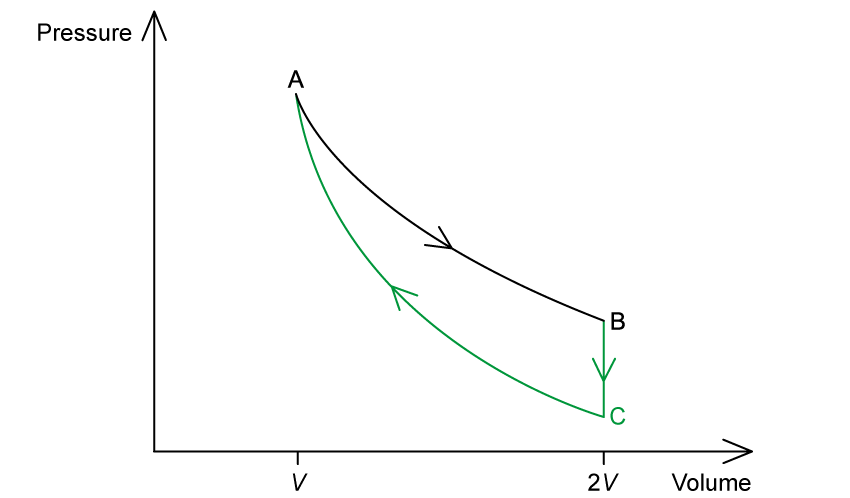
A heat engine operates on the cycle shown in the pressure-volume diagram. One step in the cycle consists of an isothermal expansion of an ideal gas from state A of volume V to state B of volume 2V.  

2-4-6-entropy-in-a-heat-engine-worked-example

On the graph, complete the cycle ABCA by drawing curves to show

  • a change at constant volume from state B to state C

  • an adiabatic compression from state C to state A

Answer:

  • Constant volume = no work done

  • Next step is a compression (where pressure increases), so this step should involve a pressure drop 

    • Hence, B to C: line drawn vertically down

  • Adiabatic = no heat supplied or removed, compression = work is done on the gas, volume decreases

    • Hence, C to A: line curves up to meet A
2-4-6-entropy-in-a-heat-engine-worked-example-ma

Worked Example

An ideal monatomic gas open parentheses gamma space equals space 5 over 3 close parentheses expands adiabatically from a state with pressure 7.5 × 10⁵ Pa and volume 1.8 × 10⁻³ m3 to a state of volume 4.2 × 10⁻³ m3.

Calculate the new pressure of the gas.

Answer:

  • For an ideal monatomic gas undergoing an adiabatic change:

space p V to the power of 5 over 3 end exponent space equals space C

space p subscript 1 V subscript 1 to the power of 5 over 3 end exponent space equals space p subscript 2 V subscript 2 to the power of 5 over 3 end exponent

  • Where:

    • Initial pressure, space p subscript 1 = 7.5 × 10⁵ Pa

    • Final pressure =space p subscript 2

    • Initial volume, V subscript 1 = 1.8 × 10⁻³ m3 

    • Final volume, V subscript 2 = 4.2 × 10⁻³ m3

space p subscript 2 space equals space p subscript 1 space open parentheses V subscript 1 over V subscript 2 close parentheses to the power of 5 over 3 end exponent

space p subscript 2 space equals space open parentheses 7.5 cross times 10 to the power of 5 close parentheses space cross times space open parentheses fraction numerator 1.8 cross times 10 to the power of negative 3 end exponent over denominator 4.2 cross times 10 to the power of negative 3 end exponent end fraction close parentheses to the power of 5 over 3 end exponent

New pressure: space p subscript 2 = 1.8 × 10⁵ Pa

Unlock more, it's free!

Join the 100,000+ Students that ❤️ Save My Exams

the (exam) results speak for themselves:

Build on this topic

Ashika

Author: Ashika

Expertise: Physics Content Creator

Ashika graduated with a first-class Physics degree from Manchester University and, having worked as a software engineer, focused on Physics education, creating engaging content to help students across all levels. Now an experienced GCSE and A Level Physics and Maths tutor, Ashika helps to grow and improve our Physics resources.

Caroline Carroll

Reviewer: Caroline Carroll

Expertise: Head of Content Delivery

Caroline graduated from the University of Nottingham with a degree in Chemistry and Molecular Physics. She spent several years working as an Industrial Chemist in the automotive industry before retraining to teach. Caroline has over 12 years of experience teaching GCSE and A-level chemistry and physics. She is passionate about delivering high-quality resources to help students achieve their full potential.