Centripetal Force (AQA A Level Physics): Revision Note
Exam code: 7408

Calculating centripetal force
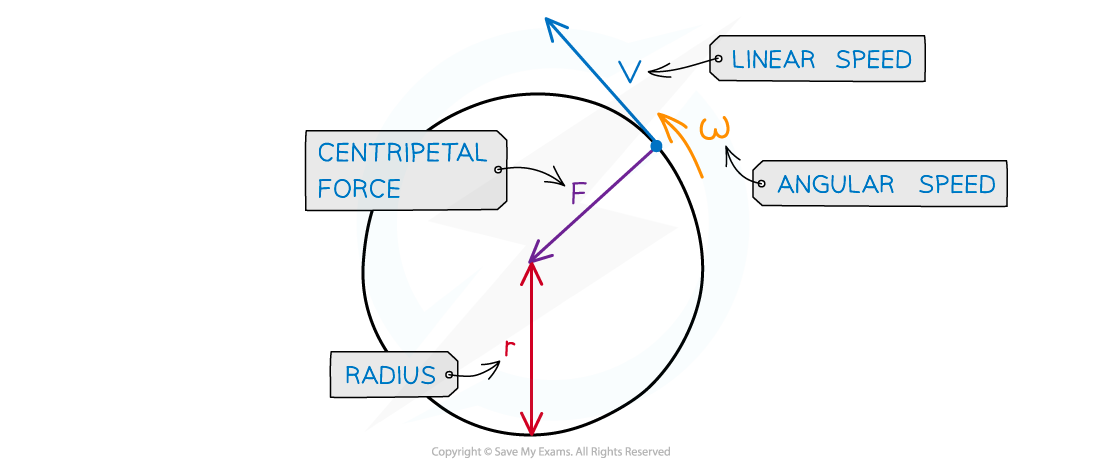
An object moving in a circle is not in equilibrium, it has a resultant force acting upon it
This is known as the centripetal force and is what keeps the object moving in a circle
The centripetal force (F) is defined as:
The resultant force towards the centre of the circle required to keep a body in uniform circular motion.
It is always directed towards the centre of the body's rotation
Centripetal force can be calculated using:
Where:
= centripetal force (N)
= mass (kg)
= linear velocity (m s-1)
= angular speed (rad s-1)
= radius of the orbit (m)
Note: centripetal force and centripetal acceleration act in the same direction
This is due to Newton’s second law
The centripetal force is not a separate force of its own
It can be any type of force, depending on the situation, which keeps an object moving in a circular path
Situation | Centripetal force |
|---|---|
Car travelling around a roundabout | Friction between car tyres and the road |
Ball attached to a rope moving in a circle | Tension in the rope |
Earth orbiting the Sun | Gravitational force |
When solving circular motion problems involving one of these forces, the equation for centripetal force can be equated to the relevant force equation
For example, for a mass orbiting a planet in a circular path, the centripetal force is provided by the gravitational force
When an object travels in circular motion, there is no work done
This is because there is no change in kinetic energy
Worked Example
A 300 g ball is made to travel in a circle of radius 0.8 m on the end of a string. If the maximum force the ball can withstand before breaking is 60 N, what is the maximum speed of the ball?
[2]
Answer:
Step 1: List the known quantities
Mass, m = 300 g = 300 × 10-3 kg
Radius, r = 0.8 m
Resultant force, F = 60 N
Step 2: Rearrange the centripetal force equation for v
[1 mark]
Step 3: Substitute in the values
[1 mark]

Unlock more, it's free!
Join the 100,000+ Students that ❤️ Save My Exams
the (exam) results speak for themselves:

Was this revision note helpful?
Build on this topic