Force on a Moving Charge (AQA A Level Physics): Revision Note
Exam code: 7408

Magnetic force on a moving charge
A moving charge produces its own magnetic field
When interacting with an applied magnetic field, it will experience a force
The force on an isolated particle with charge moving with speed at an angle to a magnetic field with flux density is defined by the equation
Where:
= magnetic force on the particle (N)
= magnetic flux density (T)
= charge of the particle (C)
= speed of the particle (m s−1)
Current is taken as the rate of flow of positive charge (i.e. conventional current)
This means that the direction of the current for a flow of negative charge (e.g. a beam of electrons) is in the opposite direction to its motion
As with a current-carrying conductor, the maximum force on a charged particle occurs when it travels perpendicular to the field
This is when , so
The equation for the magnetic force becomes:
, and are mutually perpendicular, therefore:
If the direction of the particle's motion changes, the magnitude of the force will also change
If the particle travels parallel to a magnetic field, it will experience no magnetic force
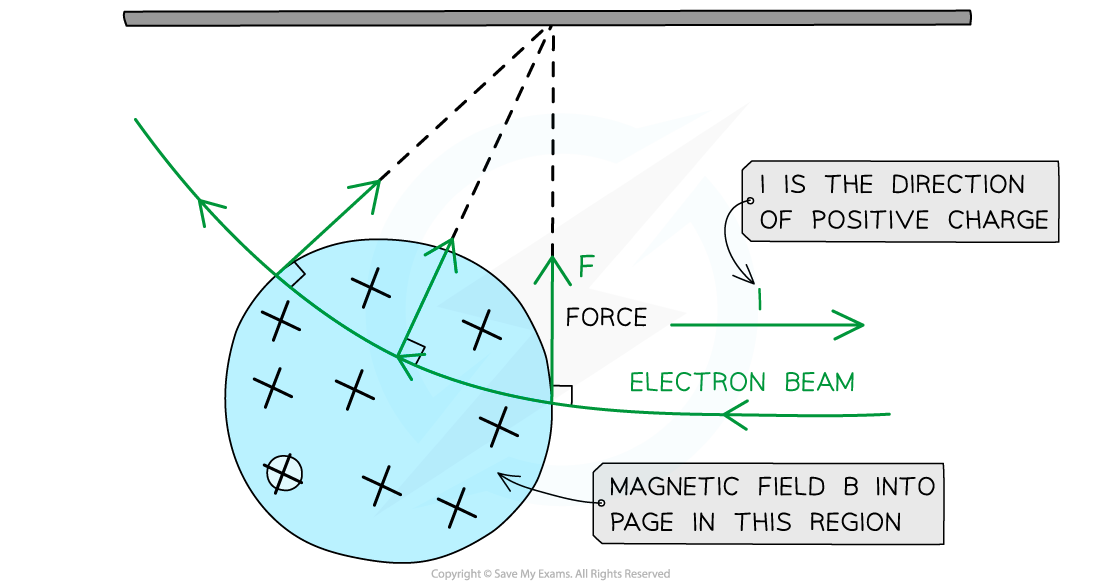
From the diagram above, when a beam of electrons enters a magnetic field which is directed into the page:
Electrons are negatively charged, so current I is directed to the right (as motion is directed to the left)
Using Fleming’s left hand rule, the force on an electron will be directed upwards
Worked Example
An electron moves in a uniform magnetic field of flux density 0.2 T at a velocity of 5.3 × 10⁷ m s−1.
Calculate the force on the electron when it moves perpendicular to the field.
[2]
Answer:
Step 1: Write out the known quantities
Magnetic flux density,
Charge of an electron,
Velocity of the electron,
Step 2: Write down the equation for the magnetic force on an isolated particle
The electron moves perpendicular () to the field, so
[1 mark]
Step 3: Substitute in values, and calculate the force on the electron
[1 mark]
Examiner Tips and Tricks
Remember not to mix this up with .
is for a current-carrying conductor
is for an isolated moving charge (which may be inside a conductor)
Direction of force on a moving charge
The direction of the magnetic force on a charged particle depends on:
the direction of flow of current
the direction of the magnetic field
This can be found using Fleming's left-hand rule
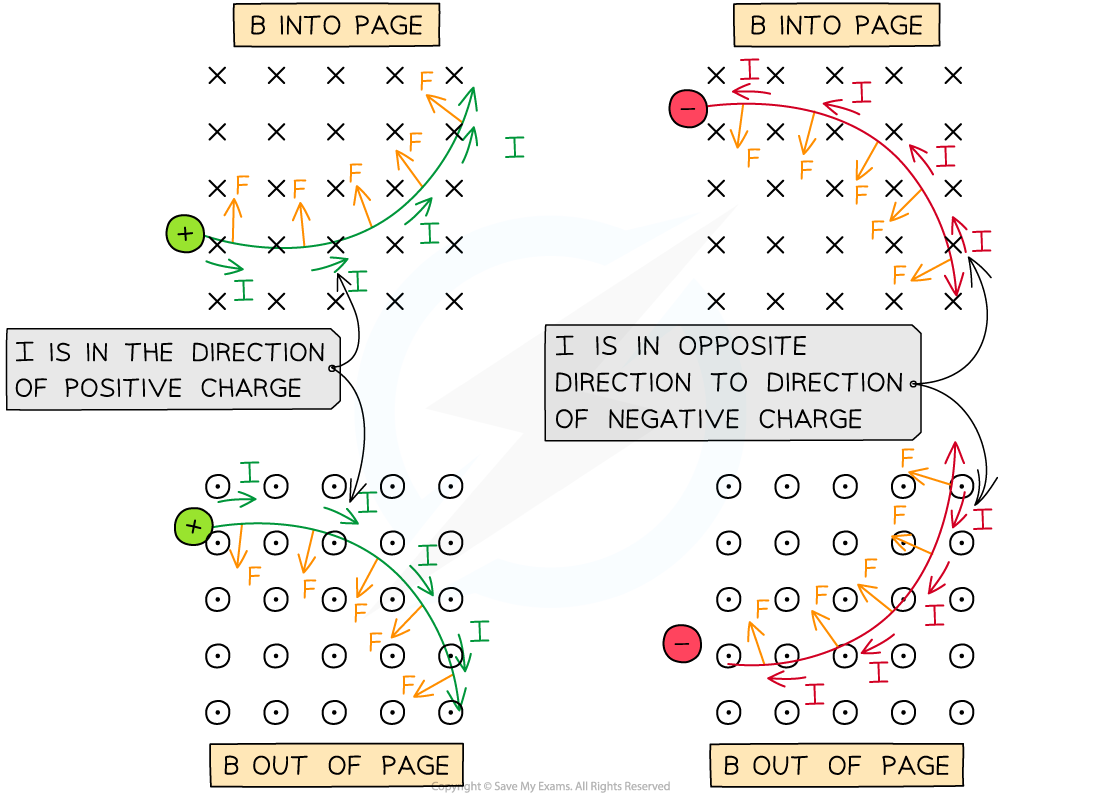
The second finger represents the current flow or the flow of positive charge
For a positive charge, the current points in the same direction as its velocity
For a negative charge, the current points in the opposite direction to its velocity

When a positive charge enters a magnetic field from left to right, using Fleming's left-hand rule:
The first finger (field) points into the page
The second finger (current) points to the right
The thumb (force) points upwards
When a charged particle moves in a uniform magnetic field, the force acts perpendicular to the field and the particle's velocity
As a result, it follows a circular path
Examiner Tips and Tricks
Remember not to get this mixed up with Fleming's right-hand rule. That is used for a generator (or dynamo), where a current is induced in the conductor. Fleming's left-hand rule is sometimes referred to as the 'Fleming's left-hand rule for motors'.

Unlock more, it's free!
Join the 100,000+ Students that ❤️ Save My Exams
the (exam) results speak for themselves:

Was this revision note helpful?
Build on this topic