Wien’s Displacement Law (AQA A Level Physics): Revision Note
Exam code: 7408

Wien’s displacement law
All bodies emit a spectrum of thermal radiation in the form of electromagnetic waves
An ideal black-body radiator is one that absorbs and emits all wavelengths
A perfect black-body radiator is a theoretical object
However, stars are the best approximation there is
The radiation emitted from a black body has a characteristic spectrum that is determined by the temperature alone
This can be represented on a black-body radiation curve of intensity against wavelength
As the temperature increases, the peak of the curve moves
This moves to a lower wavelength and a higher intensity
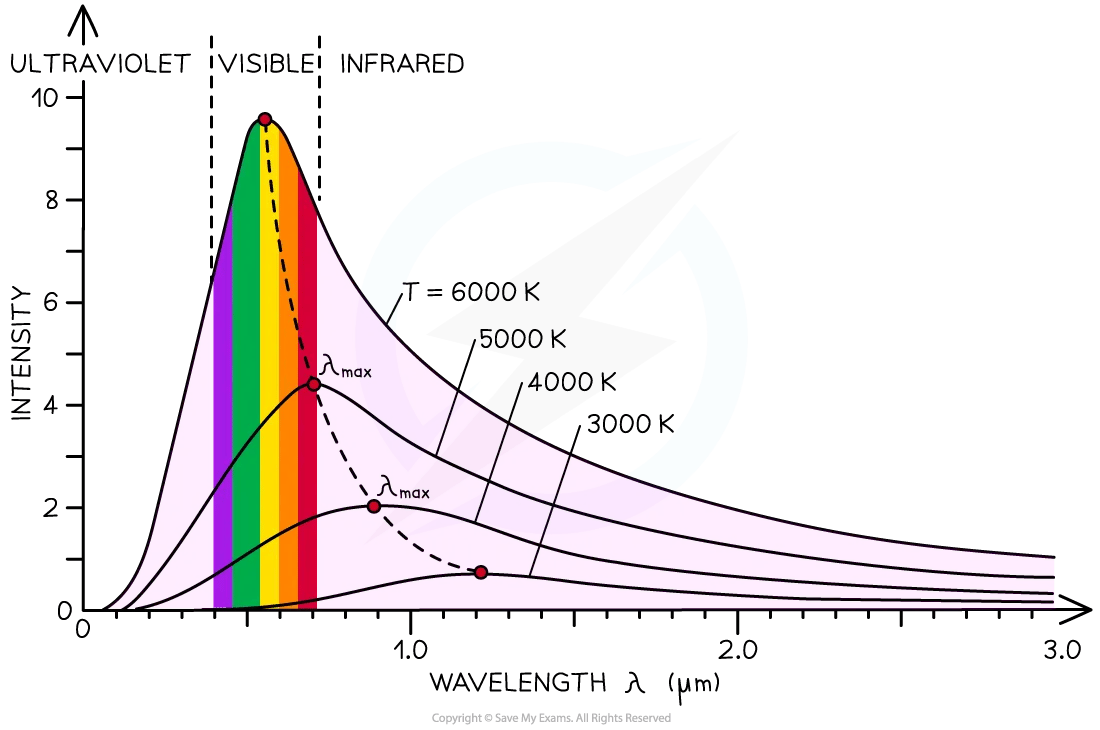
Wien’s displacement law relates the observed wavelength of light from an object to its surface temperature, it states:
The black body radiation curve for different temperatures peaks at a wavelength that is inversely proportional to the temperature
This relation can be written as:
Where:
= the maximum wavelength emitted by an object at the peak intensity (m)
= the surface temperature of an object (K)
Wien's displacement law can be written as:
This equation shows that the higher the temperature of a body:
the shorter the wavelength at the peak intensity (i.e. hotter objects tend to be white or blue, and cooler objects tend to be red or yellow)
the greater the intensity of the radiation at each wavelength
The following table compares the colour of a star with its surface temperature:
Star Colour | Temperature / K |
|---|---|
blue | >33 000 |
blue-white | 10 000 - 30 000 |
white | 7500 - 10 000 |
yellow-white | 6000 - 7500 |
yellow | 5000 - 6000 |
orange | 3500 - 5000 |
red | <3500 |
Worked Example
The black-body radiation curve of an object at 900 K is shown in the diagram below.
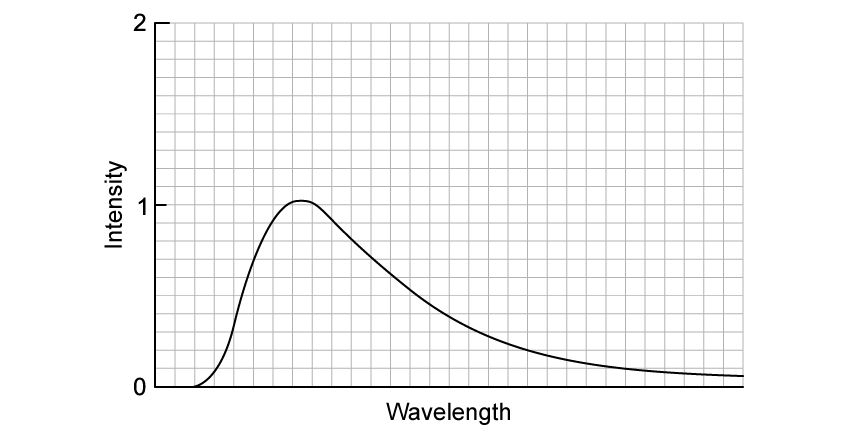
Which of the following shows the black-body radiation curve of an object at 650 K?
The dashed line represents the curve of the object at 900 K.
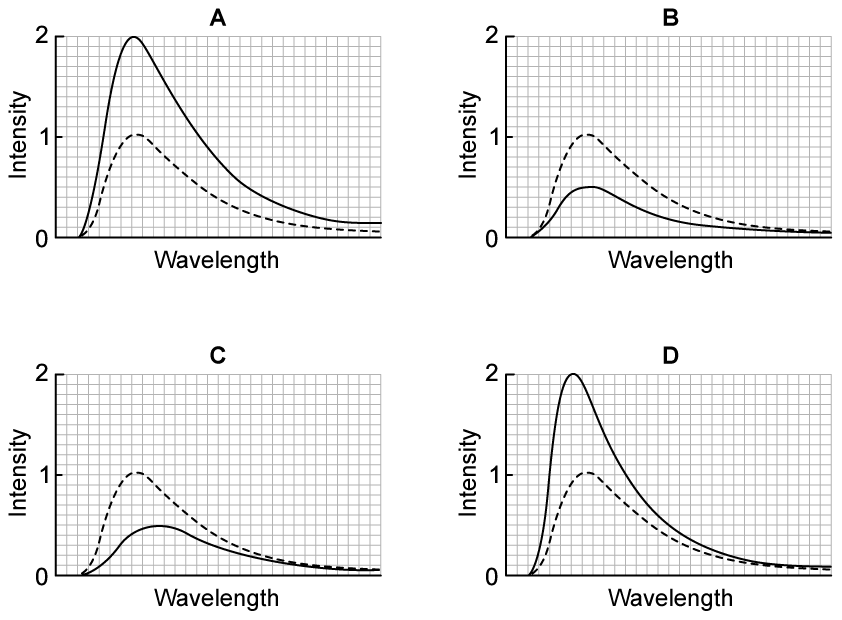
[1]
Answer:
From Wien's displacement law:
A curve with a longer peak wavelength will correspond to a lower temperature
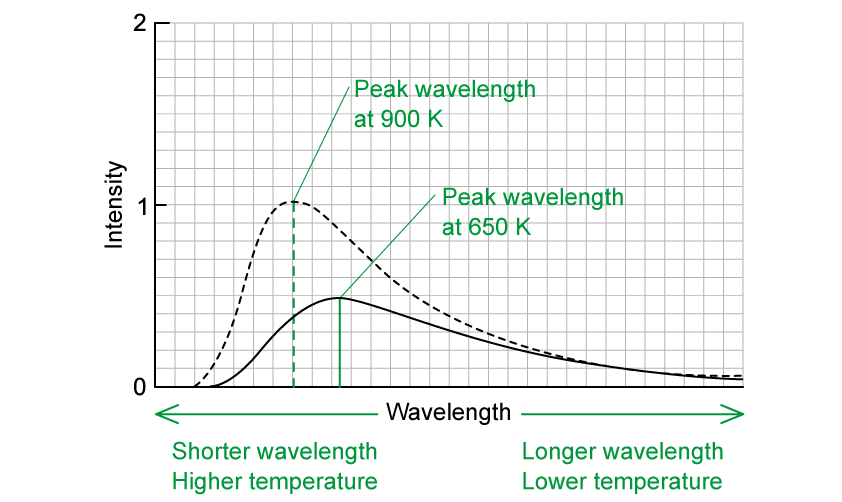
Therefore, the correct radiation curve is C [1 mark]
Worked Example
The spectrum of the star Rigel in the constellation of Orion peaks at a wavelength of 263 nm, while the spectrum of the star Betelgeuse peaks at a wavelength of 828 nm.
Determine which of these two stars, Betelgeuse or Rigel, is cooler.
[2]
Answer:
Step 1: List the known quantities
Maximum emission wavelength of Rigel = 263 nm = 263 × 10−9 m
Maximum emission wavelength of Betelgeuse = 828 × 10−9 m
Step 2: Write down Wien’s displacement law and rearrange for temperature T
Step 3: Calculate the surface temperature of each star
Rigel:
Betelgeuse: [1 mark]
Step 4: Write a concluding sentence
Betelgeuse has a surface temperature of 3500 K, therefore, it is much cooler than Rigel [1 mark]

Examiner Tips and Tricks
Note that the temperature used in Wien’s Law is in Kelvin (K). Remember to convert from °C if the temperature is given in degrees in the question before using the Wien’s law equation.
If you're asked to draw a black-body curve in the exam, make sure to avoid these common errors:
Drawing the right side of the curve steeper than the left side (remember it increases sharply and decreases more steadily)
Drawing the right side of the curve so that it decreases to zero (it should not meet zero as it decreases)
Drawing the curve through the intensity axis (there are no negative wavelengths)

Unlock more, it's free!
Join the 100,000+ Students that ❤️ Save My Exams
the (exam) results speak for themselves:

Was this revision note helpful?
Build on this topic