Newton’s Second Law for Rotation (AQA A Level Physics): Revision Note
Exam code: 7408

Newton’s Second Law for Rotation
In linear motion, the force required to give an object a certain acceleration depends on its mass
This is Newton's Second Law of linear motion, where:
F = force (N)
m = mass (kg)
a = linear acceleration (m s−2)
In rotational motion, the torque required to give a rotating object a certain angular acceleration depends on its moment of inertia
This is Newton's Second Law of rotational motion, where:
= torque (N m)
= moment of inertia (kg m2)
= angular acceleration (rad s−2)
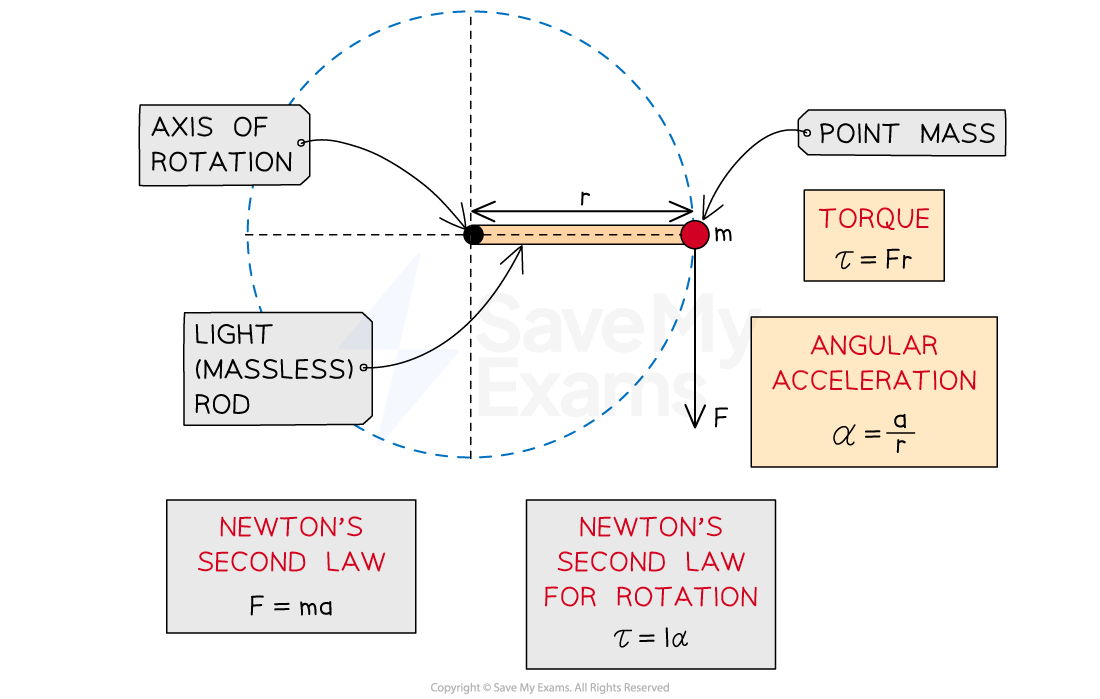
Newton's second law for rotating bodies is equivalent to Newton's second law for linear motion
This equation comes from the fact that torque is the rotational equivalent of force:
Force:
Torque:
Where:
= perpendicular distance from the axis of rotation (m)
Combining these equations gives:
The moment of inertia of a rotating body can be thought of as analogous to (the same as) mass
The inertia of a mass describes its ability to resist changes to linear motion, which is referring to linear acceleration
Similarly, the moment of inertia of a mass describes its ability to resist changes to rotational motion, which is referring to angular acceleration
Angular acceleration:
Moment of inertia (point mass):
Using these equations with the equations for force and torque leads to:
Comparison of linear and rotational variables in Newton's Second Law
Linear variable | Rotational variable |
|---|---|
Force, | Torque, |
Mass, | Moment of inertia, |
Acceleration, | Angular acceleration, |
Newton's Second Law, | Newton's Second Law, |
Worked Example
A block of mass m is attached to a string that is wrapped around a cylindrical pulley of mass M and radius R, as shown in the diagram.
The moment of inertia of the cylindrical pulley about its axis is .
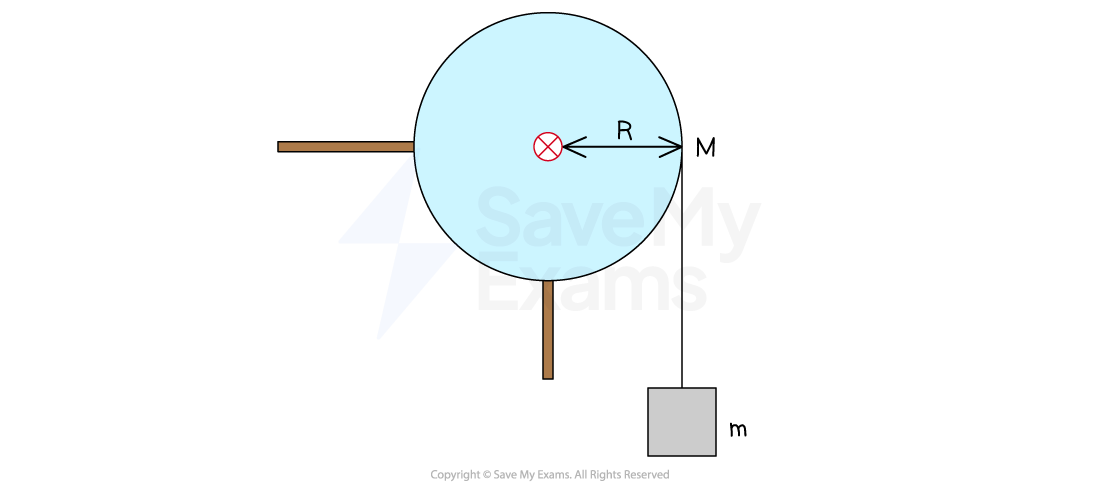
When the block is released, the pulley begins to turn as the block falls.
Write an expression for the acceleration of the block.
Answer:
Step 1: Identify the forces acting on the block
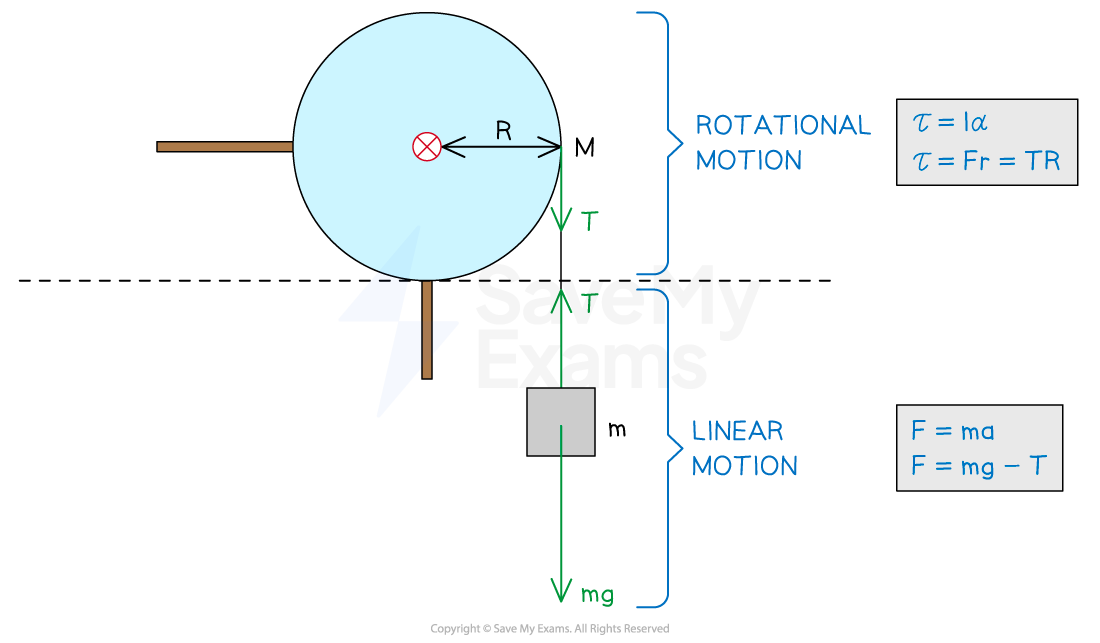
Step 2: Apply Newton's second law to the motion of the block
eq. (1)
Step 3: Apply Newton's second law to the rotation of the pulley
Step 4: Write the equation for the pulley in terms of acceleration a
The angular acceleration of the pulley is:
Substitute this into the previous equation:
Substitute in the expression for the moment of inertia and simplify:
Moment of inertia of the cylinder:
eq. (2)
Step 5: Substitute eq. (2) into eq. (1) and rearrange for acceleration a
Acceleration of the block:

Unlock more, it's free!
Join the 100,000+ Students that ❤️ Save My Exams
the (exam) results speak for themselves:

Was this revision note helpful?
Build on this topic