Harmonics (AQA A Level Physics): Revision Note
Exam code: 7408

Harmonics
Stationary waves can have different wave patterns, known as harmonics
These depend on the frequency of the vibration and the situation in which they are created
These harmonics can be observed on a string with two fixed ends
As the frequency is increased, more harmonics begin to appear
Harmonics on a string
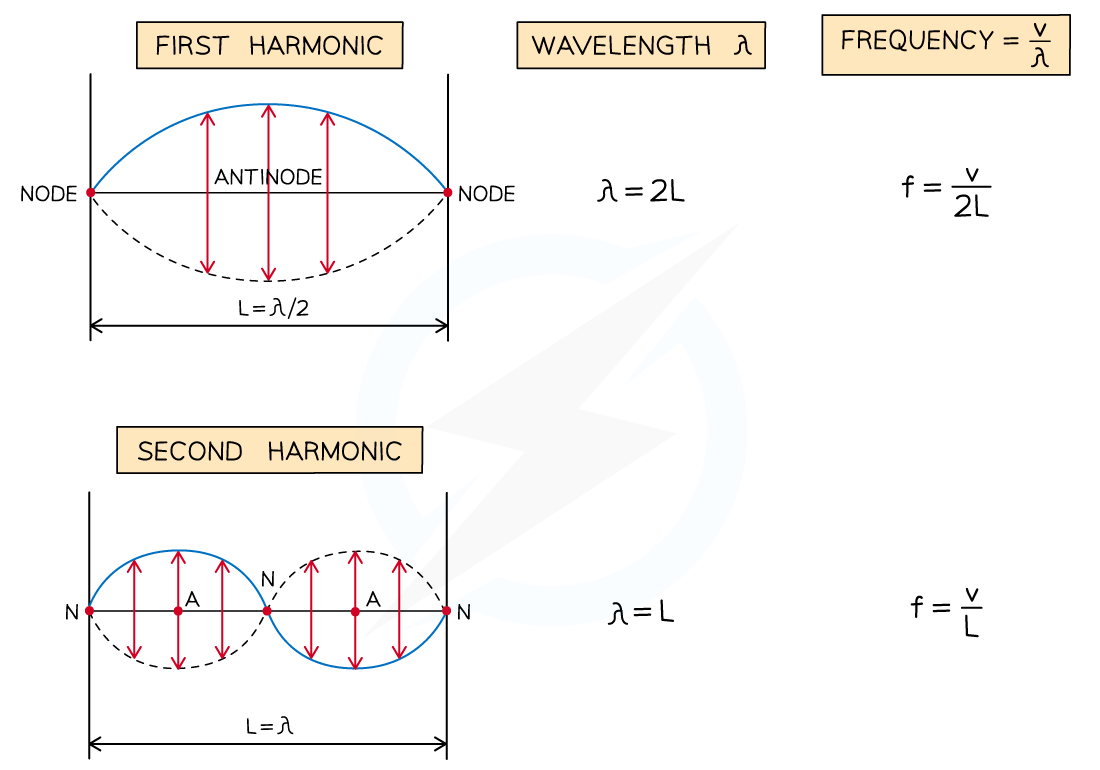
When a stationary wave, such as a vibrating string, is fixed at both ends, the simplest wave pattern is a single loop made up of two nodes and an antinode
This is called the first harmonic or fundamental frequency
The particular frequencies (i.e. resonant frequencies) of stationary waves formed depend on the length of the string L and the wave speed v
The frequencies can be calculated from the string length and wave equation
For a string of length L, the wavelength of the lowest harmonic is 2L
This is because there is only one loop of the stationary wave, which is a half wavelength
Therefore, the frequency is equal to:
The second harmonic has three nodes and two antinodes
The wavelength is L and the frequency is equal to:
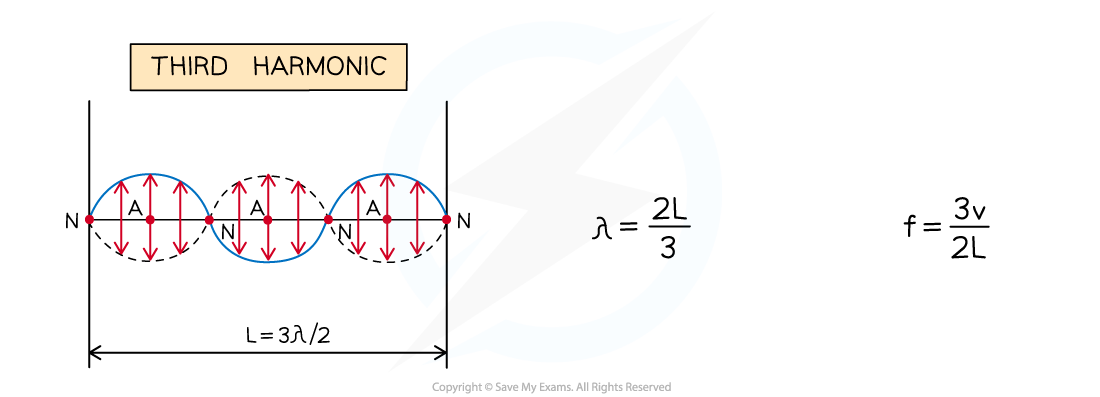
The third harmonic has four nodes and three antinodes
The wavelength is 2L / 3 and the frequency is equal to:
The nth harmonic has n antinodes and n + 1 nodes
The wavelengths and frequencies of the first three harmonics can be summarised as follows:
Comparing the equations for the first, second and third harmonics shows that for the nth harmonic:
Worked Example
A stationary wave made from a string vibrating in the third harmonic has a frequency of 150 Hz. Calculate the frequency of the fifth harmonic.
[2]
Answer:
Step 1: Calculate the frequency of the first harmonic
[1 mark]
Step 2: Calculate the frequency of the fifth harmonic
[1 mark]
Examiner Tips and Tricks
Make sure to match the correct wavelength with the harmonic asked for in the question:
The first harmonic (or n = 1) is the lowest frequency with half or quarter of a wavelength
The second harmonic (or n = 2) is a full wavelength
Frequency of the first harmonic
The speed of a wave travelling along a string with two fixed ends is given by:
Where:
= tension in the string (N)
= mass per unit length of the string (kg m–1)
For the first harmonic of a stationary wave of length L, the wavelength, λ = 2L
Therefore, according to the wave equation, the speed of the stationary wave is:
Combining these two equations leads to the frequency of the first harmonic:
Where:
= frequency (Hz)
= the length of the string (m)
Worked Example
A guitar string of mass 3.2 g and length 90 cm is fixed onto a guitar. The string is tightened to a tension of 65 N between two bridges at a distance of 75 cm.
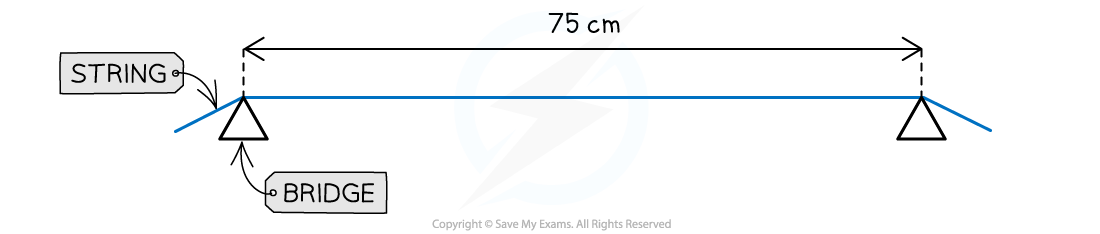
Calculate the frequency of the first harmonic produced when the string is plucked.
[3]
Answer:

Step 1: List the known quantities
Mass of string
String length
Tension,
Length of string between bridges,
Step 2: Calculate the mass per unit length of the string
[1 mark]
Step 3: Write down the required equation
Step 4: Calculate the frequency of the first harmonic
[1 mark]
[1 mark]

Unlock more, it's free!
Join the 100,000+ Students that ❤️ Save My Exams
the (exam) results speak for themselves:

Was this revision note helpful?
Build on this topic