Neutron Stars & Black Holes (AQA A Level Physics): Revision Note
Exam code: 7408

Neutron Stars
Neutron stars are objects which form after a supernova has ejected the outer layers of a star into space
A core which has a mass between 1.4 and 3 solar masses will become a neutron star
A neutron star is defined as:
An extremely dense collapsed star made up of neutrons
Neutron stars are extremely small and dense (~1017 kg m−3)
A neutron star with the mass of the Sun would have a diameter of about 30 km
A teaspoon of neutron star would have a mass of about 100 million tonnes
The immense gravitational forces acting on the core crush the electrons and protons until they combine into neutrons, via reverse beta decay:
Further collapse is prevented by neutron degeneracy pressure
Some neutron stars rotate rapidly (up to 600 times per second) emitting bursts of highly directional electromagnetic radiation
These stars are called pulsars
What is a pulsar?
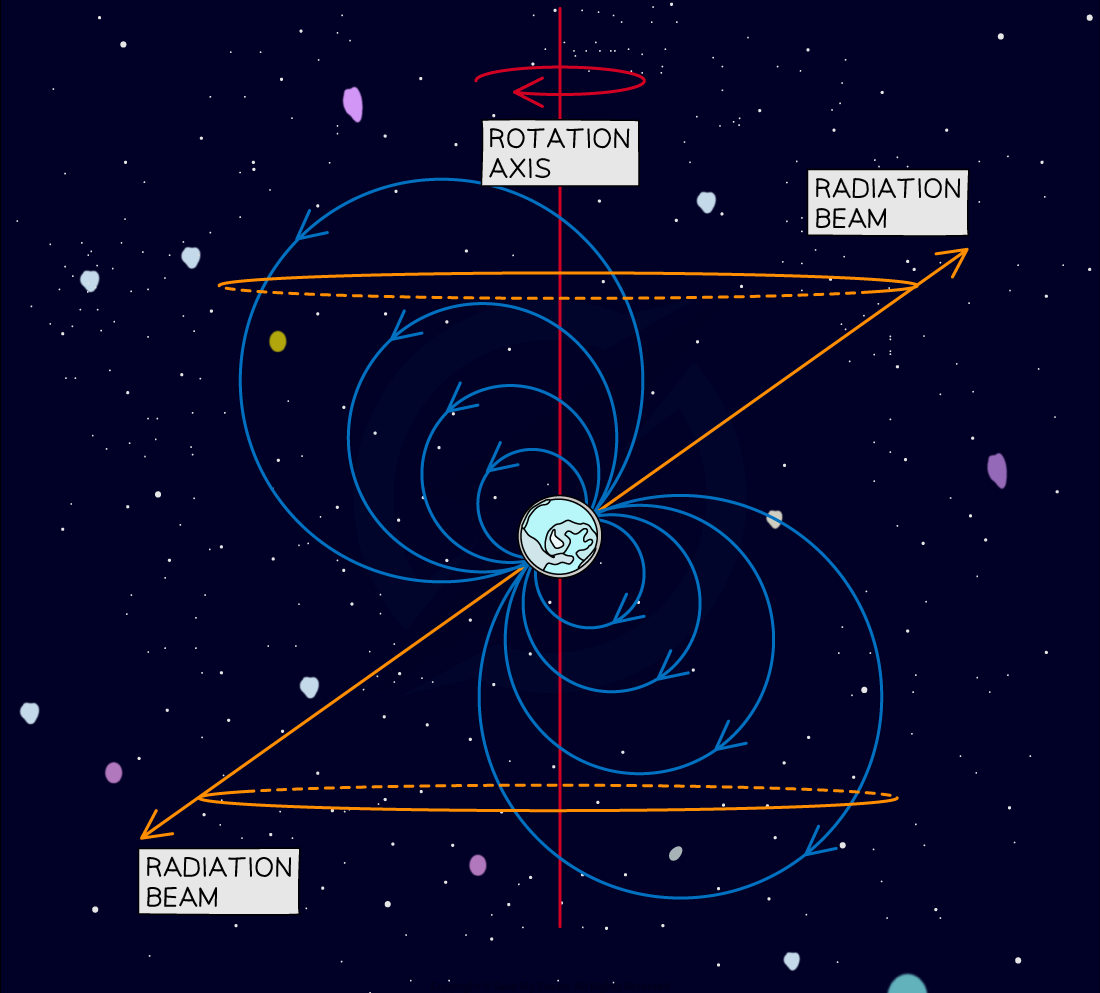
A fast-rotating neutron star is called a pulsar
Pulsars are much easier to identify than slow, or non-rotating, neutron stars
This is because they emit radiation periodically which makes them easier to detect
In particular, they emit radio waves strongly, and sometimes X-rays and gamma rays
Black Holes
After a supernova has ejected the outer layers of a star into space, the most massive cores can collapse into an infinitely dense point called a singularity
A core which has a mass greater than 3 solar masses will become a black hole
The gravitational field around a black hole is so strong that nothing, not even light, can escape it
The boundary at which light and matter cannot escape the gravitational pull of the black hole is called the event horizon
The escape velocity beyond the event horizon is greater than the speed of light
This is why black holes cannot be seen directly, as photons cannot escape beyond the event horizon
What is a black hole?
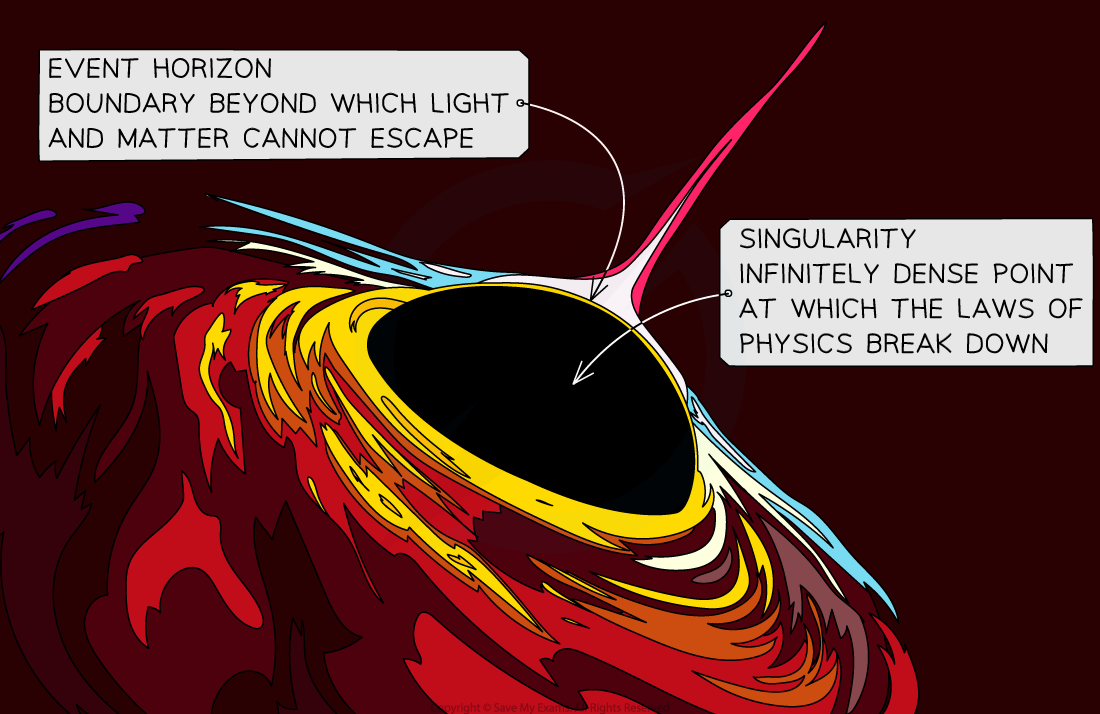
A black hole is an object which is so dense that its escape velocity is greater than the speed of light
Schwarzschild Radius of a Black Hole
The radius of a black hole’s event horizon is called the Schwarzschild radius and is given by:
Where:
= the Schwarzschild radius (m)
= gravitational constant
= mass of the black hole
= speed of light
Supermassive Black Holes
Observations of stars at the centre of the Milky Way suggest that a mass equivalent to millions of stars is contained in a very small volume
Astronomers determined that the mass at the galactic centre is, in fact, a supermassive black hole
Sagittarius A*, the one in our galactic centre, has a mass of 4 million solar masses
Since this discovery, over 150 supermassive black holes have been identified at the centres of other galaxies similar to the Milky Way
This is thought to be strong evidence that supermassive black holes exist at the centres of nearly all large galaxies
Worked Example
Some galaxies, known as Seyfert galaxies, have very active galactic centres. They are believed to host supermassive black holes at their centres.
The black hole at the centre of the galaxy NGC 5252 is found to have a mass 9.5 × 10⁹ times that of the Sun.
(a) Explain what is meant by the ‘event horizon’ of a black hole.
(b) Calculate the radius of the event horizon in terms of solar radii.
(c) Calculate the average density of matter inside the event horizon.
(d) Compare your answer to (c) with the density of a black hole which has the same mass as the Sun.
Answer:
Part (a)
An event horizon is:
The boundary of the region around a black hole, inside of which light cannot escape
Part (b)
Step 1: List the known quantities
Mass of the black hole, = 9.5 × 10⁹
Mass of the Sun, = 1.99 × 1030 kg (from the data booklet)
Gravitational constant, = 6.67 × 10⁻¹¹ N m2 kg–2 (from the data booklet)
Speed of light, = 3.00 × 10⁸ m s–1 (from the data booklet)
Radius of the Sun, = 6.96 × 10⁸ m (from the data booklet)
Step 2: Write down the equation for the Schwarzschild radius
Note: this equation is included in the data booklet
Step 3: Calculate the radius of the event horizon
Schwarzschild radius: = 2.8 × 10¹³ m
Step 4: Convert to solar radii
Schwarzschild radius:
This means the size of the black hole is the equivalent length of 40,000 Suns placed side-by-side
Part (c)
Step 1: Recall the equations for density and volume
We can treat the volume of the black hole as a sphere:
The density of the black hole is therefore given by
Step 2: Calculate the average density of the matter within the event horizon
Part (d)
Step 1: Write expressions for the densities and Schwarzschild radii of the black holes
Density of a solar-mass black hole:
Where
Density of a supermassive black hole:
Where
Step 2: Determine the ratio of the densities and make a comparison
Substituting :
This means that the solar-mass black hole is ~1020 times denser than the supermassive black hole
The density of a black hole must be proportional to the inverse square of its mass, i.e. the more massive the black hole, the less dense it is
Examiner Tips and Tricks
When writing the definition for the event horizon of a black hole, make sure to be clear that it is the boundary where the escape velocity = c
Avoid definitions that describe the event horizon as a point or a distance, as this is not correct.

Unlock more, it's free!
Join the 100,000+ Students that ❤️ Save My Exams
the (exam) results speak for themselves:

Was this revision note helpful?
Build on this topic