Couples (AQA A Level Physics): Revision Note

Exam code: 7408

Katie M

Written by: Katie M

Reviewed by: Timothy Sit

Updated on

Guided study available on this topic

Understand this topic with deeper explanations and understanding checks.

Couples

  • A couple is a pair of equal and opposite coplanar forces that acts to produce rotation only

  • A couple consists of a pair of forces that are:

    • equal in magnitude

    • opposite in direction

    • perpendicular to the distance between them

An upward force at the left and a downward force at the right acts on a horizontal bar. A horizontal double-headed arrow between them is labelled “distance between pair of forces”.
A couple must consist of two equal and opposite forces separated by a perpendicular distance
  • Couples produce a resultant force of zero, so, due to Newton’s Second law (F = ma), the object does not accelerate

  • Unlike moments of a single force, the moment of a couple doesn’t depend on a pivot

  • The moment of a couple is equal to:

Force × Perpendicular distance between the lines of action of the forces

Worked Example

Which pair of forces acts as a couple on the circular object?
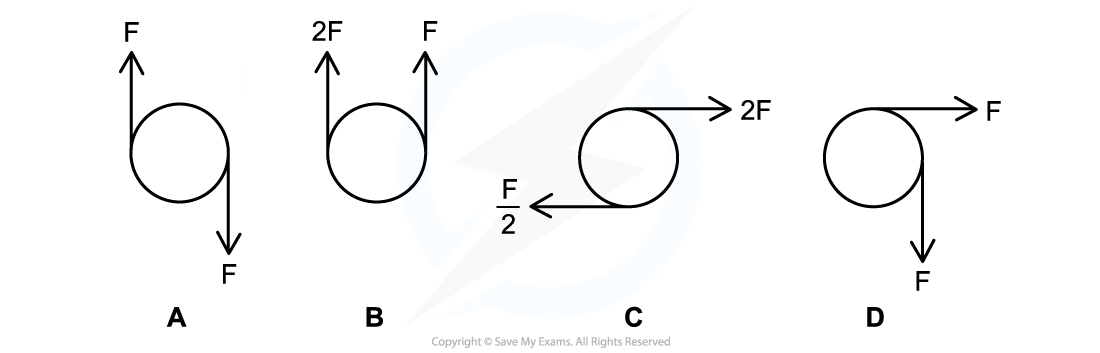
Options A–D, each showing a circle with different pairs of forces acting. 
A: Two forces of magnitude F act at the edge of the circle on opposite sides, one acting upward and the other acting downward.
B: Two forces of magnitude 2F and F act at the edge of the circle on opposite sides, both acting upward.
C: Two forces of magnitude 2F and half F act at the edge of the circle on opposite sides, one acting to the left and the other acting to the right.
D: Two forces of magnitude F act at the edge of the circle, one acting to the right and the other acting downward.

[1]

Answer:

  • The correct answer is diagram A because the forces are:

    • equal in size

    • in opposite directions

    • perpendicular to the distance between them [1 mark]

  • B is incorrect as the forces are in the same direction

  • C is incorrect as the forces are different in size

  • D is incorrect as the distance between the forces is not perpendicular

Examiner Tips and Tricks

Remember that the forces that make up a couple cannot share the same line of action, which is the line through the point where the force is applied. You can see an example of this in the diagram below:

Two equal and opposite forces act along the same line of action on a horizontal bar which do not form a couple.

Unlock more, it's free!

Join the 100,000+ Students that ❤️ Save My Exams

the (exam) results speak for themselves:

Build on this topic

Katie M

Author: Katie M

Expertise: Curriculum Expert

Katie has always been passionate about the sciences, and completed a degree in Astrophysics at Sheffield University. She decided that she wanted to inspire other young people, so moved to Bristol to complete a PGCE in Secondary Science. She particularly loves creating fun and absorbing materials to help students achieve their exam potential.

Timothy Sit

Reviewer: Timothy Sit

Expertise: Content Creator

Timothy graduated with a first class degree in Mathematics and Physics from the University of Warwick. After working as a postgraduate researcher, Timothy has worked as a content creator for various online revision platforms, creating physics resources for a range of levels and exam boards.